


Redefining passenger experience: the transformation of Lucknow Airport’s Terminal 3
Posted: 1 December 2025 | Darshan Singh, Rahul Khanna | No comments yet
Chaudhary Charan Singh International Airport’s Terminal 3 (T3) in Lucknow has set a new standard for passenger experience in India – blending technology, local culture and operational efficiency into a seamless journey for millions of travellers annually.
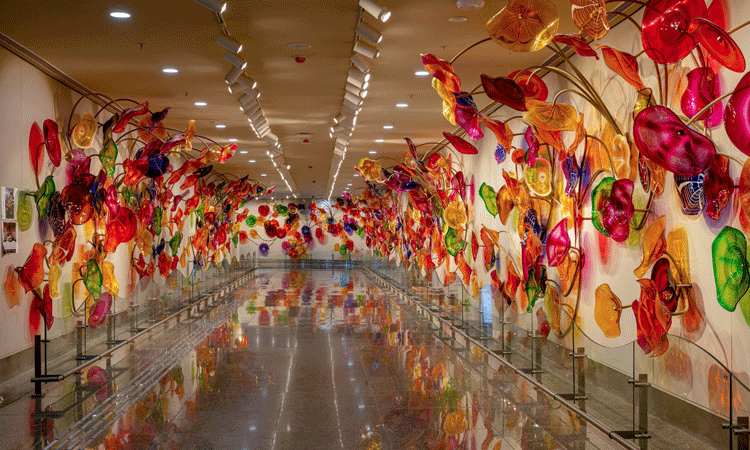
The exquisite mouth-blown glass techniques used to create the artwork of Basant Bahaar, welcomes passengers. c: Adani Holdings Ltd
A bold vision for growth and comfort
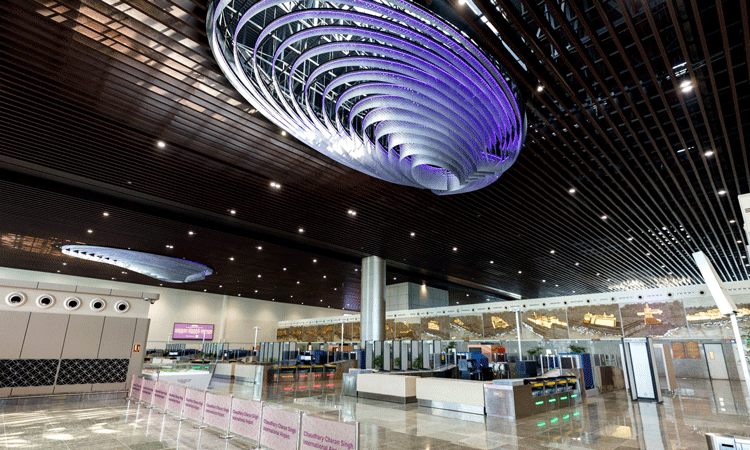
Opened in March 2024, T3 was driven by a clear vision: to accommodate the region’s rapid growth and deliver world-class comfort. At a cost of ₹2,400 crore, the spacious integrated terminal can now handle more than eight million passengers per year, with Phase 2 scaling up to 13 million.
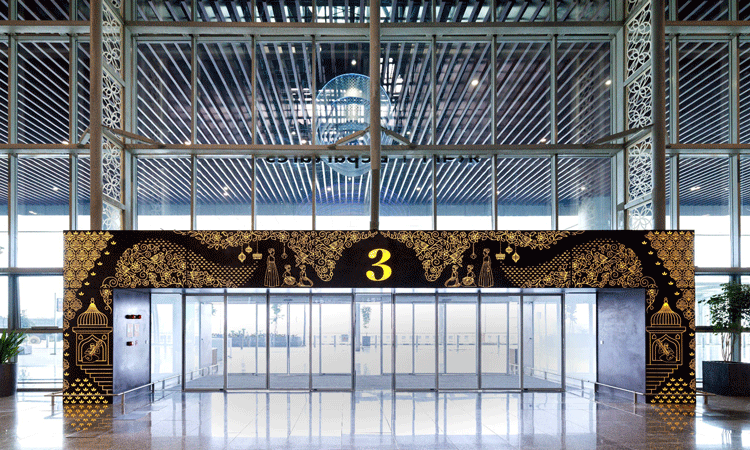
Designers prioritised intuitive navigation, with elevated pathways that clearly separate arrivals and departures and a unidirectional passenger flow — a layout that reduces congestion and enhances overall comfort.
c: Adani Holdings Ltd
Seamless journeys through smart technology
T3’s transformative approach is anchored with digital innovation.
The introduction of ‘Digiyatra’ – a biometric based solution for self-service – has facilitated a truly contactless experience, enabling seamless access and rapid movement through airport entry, check-in, security and gates. This compliments the state driven Fast Track-Trusted Traveller Programme.
Digiyatra – a biometric based solution for self-service – has facilitated a truly contactless experience.
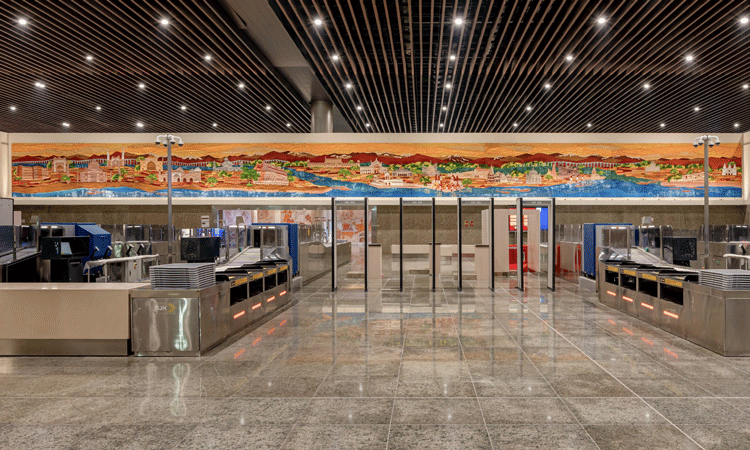
Self-service kiosks, e-gates and self-baggage drop counters support quick, independent check-in, cutting wait times dramatically. State-of-the-art security systems, such as automated tray retrieval and advanced X-ray baggage screening, make the security process faster and more reassuring for passengers.
The airport’s new mobile app, live flight status displays, Automated Flight Announcement Systems and public Wi-Fi ensure travellers remain informed and connected throughout their journey.
Intuitive design for stress-free travel
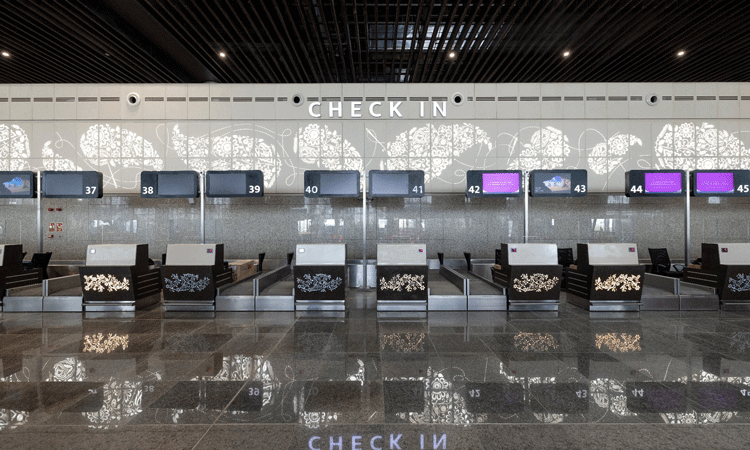
Space and comfort are defining features of T3. With 72 check-in counters, 62 immigration desks, and expanded boarding gates (from 7 to 13), peak-hour traffic remains smooth even as demand grows. Passenger boarding bridges have increased in number from two to seven, and a new 1.4 km elevated road ensures quick vehicle access for arrivals and departures. The facility is fully accessible, with wayfinding signage in multiple languages. Modern lounges, medical centres and an integrated hotel directly address both transit comfort and passenger wellbeing. The terminal facilities provide an inclusive environment to all our beloved commuters across the flows and processes, thus enabling a stress-free journey. The D to D and the I to I connection times are witnessed to be <45 minutes and <60 minutes respectively. The airport has an inherent multimodal hub with air, metro and road transportation systems serving commuters.
c: Adani Holdings Ltd
Digital and operational enablers
As systems and operations mature, the airport aims to shift gears and be a true model of a 1/15 Airport. This means the cumulative processing times across all touch points at the airport – from entry gate to boarding gate – should ideally be 1 minute for every 15 minutes of the total journey time, which is approximately 0.067% of the overall duration.
To achieve this benchmark, LIAL is deploying a series of coordinated digital and operational strategies:
- Biometric and touchless processing: Seamless identity verification powered by DigiYatra and integrated biometric corridors.
- Predictive analytics for flow management: Real-time passenger modelling to anticipate congestion and dynamically adjust resources.
- Automated baggage systems: Fast, secure and digitally traceable baggage processes using RFID and IoT tracking.
- Smart operations centres: AI-assisted decision-making platforms monitoring turnaround times, queue lengths and passenger movement.
- Mobile-first passenger journey: Unified mobile apps offering self-service check-in, wayfinding, live updates and digital payments.
The vision
As systems and operations mature, the airport aims to shift gears and be a true model of a 1/15 Airport.
The 1/15 benchmark serves as a guiding principle for continuous operational innovation and technological integration. By aligning this goal with digital twin insights and real-time performance data, LIAL aims to transform passenger processing into an almost invisible, frictionless layer of the travel experience—where technology works silently in the background to enhance comfort, consistency and control.
Showcasing the spirit of Uttar Pradesh (art and heritage)
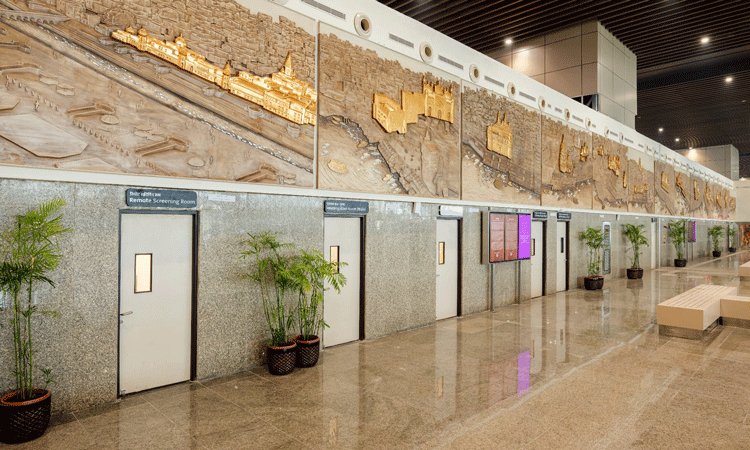
T3 isn’t just about efficiency, it’s about cultivating a sense of place. Travellers are greeted with stunning motifs inspired by Lucknow’s famed ‘Chikankari’ and ‘Mukaish’ embroidery on illuminated check-in counters, while frosted glass art depicts stories from the Ramayana and Mahabharata. Architectural highlights include the ‘Swarna Ghats’, ‘Basant Bahaar’, and a skylit atrium symbolising Lucknow’s rich heritage.
c: Adani Holdings Ltd
Basant Bahaar
The exquisite mouth-blown glass techniques used to create the artwork, welcome passengers just after they pass through the high-stress area of airport security. Most of the installations are strategically placed in zones where passenger anxiety tends to peak due to various airport processes. These artworks aim to ease that tension by offering a sense of local culture, tradition and artistic beauty — helping travellers feel more connected and relaxed.
Basant Bahaar gained widespread recognition after cricketer Kevin Pietersen shared a post on Instagram, praising the installation. He wrote:
“The Street of Flowers here at the brand-new airport terminal in Lucknow. WORLD CLASS! Wow, what an incredible job done by all for this most beautiful state.”
This infusion of cultural elements, alongside welcoming Lucknow Airport arriving passengers with the message “Muskuraeiye, Aap Lucknow Mein Hain” (“Smile, you are in Lucknow city”), transforms the terminal into a living celebration of local identity.
c: Adani Holdings Ltd
Evidence of success: growth and industry recognition
Since its inauguration, T3 has witnessed remarkable results. International passenger numbers grew by 50% in early 2024, driven in part by a surge in middle-east and south-east bound traffic. The average daily passenger count exceeded 18,500, with single-day records surpassing 24,000 travellers.
The highly flexible design and phased expansion plan mean T3 is future-proofed — ready to welcome new routes, larger aircraft, and a broader demographic of travellers, while keeping service quality at its core.
c: Adani Holdings Ltd
Commitment to sustainability and community
Sustainability initiatives are woven into T3’s fabric, from energy-efficient infrastructure to advanced water management and waste recycling systems. The airport upholds strong ESG practices, balancing environmental stewardship with its vision for growth and hospitality. CCSIA has adapted inclusive community engagement programmes. The airport has been recognised with the platinum certificate from CII (Confederation of Indian Industries) and for following the green and circular economy concept. In addition, CCSIA has allocated resources to enrich the community through various CSR Programmes in the fields of Education, Empowering Women and Health. We follow international best practices by disclosing our annual ESG reports.
Conclusion
Chaudhary Charan Singh International Airport’s T3 is more than a terminal — it is a model for how infrastructure can combine efficiency, culture, inclusivity and technology to elevate the passenger experience. For India’s rapidly modernising aviation sector, T3 sets a transformative benchmark — one that is being closely watched, and soon, widely emulated.
 Ar. Rahul Khanna serves as the Head of Design & Master Planning at Lucknow Airport (Adani Airport Holdings Limited), overseeing large-scale aviation infrastructure projects across India. Recognised as an Autodesk 40 under 40 Construction Champion for 2025, Ar. Rahul Khanna is renowned for fusing digital innovation, local culture, and ESG priorities in terminal design.
With over 18 years of experience, including recent delivery of the Chaudhary Charan Singh International Airport T3 within a record timeline, Ar. Rahul Khanna has advanced digital twin integration, BIM workflows, and holistic master planning in airport projects. An invited speaker at Autodesk Summits and other global forums, Ar. Rahul Khanna is passionate about shaping the future of passenger experience and mentoring the next generation of aviation industry leaders.
 Darshan Singh serves as the Chief Airport Officer (CAO) at Lucknow Airport (Adani Airport Holdings Limited), where he oversees strategic operations, infrastructure development, and passenger experience enhancement. With extensive experience in airport management and aviation operations, he has played a pivotal role in driving modernisation initiatives and ensuring compliance with international standards.
Under his leadership, Lucknow Airport has focused on improving connectivity, sustainability, and customer service excellence. His vision emphasises operational efficiency, technological integration, and creating a world-class travel experience for millions of passengers annually.
18.9 billion passengers are coming. Is your airport ready for 2026? ✈️
Access the FREE Airport Industry Intelligence Handbook for expert strategies on scaling sustainably, modernising ATM, and securing cargo logistics.
Featuring insights from ACI World, TIACA, CANSO, and ACI EUROPE.
Related topics
Accessibility, Biometrics, Capacity, Digital transformation, Innovation, New technologies, Operational efficiency, Passenger experience and seamless travel, Passenger volumes, Self-service, Sustainability, Terminal operations






 Chief Executive Officer
 CEO
CEO Airport General Manager
 Head of Operations
 Chief Strategy Development Officer
 Head of Operations, Safety and Emergency
 Chief Operating Officer
 CEO
CEO Chief Executive Officer