
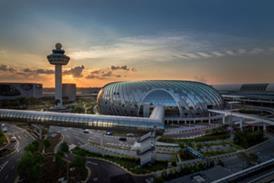
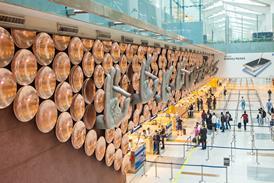


Denise Pronk, Head of Sustainability, and Sara Solis, Circular Economy Lead, Royal Schiphol Group reveal the possibilities of circular construction in airport renovation cycles.
In late 2024, Schiphol ran a small pilot with EME and Heijmans to test whether surplus building materials from airport renovations could be tracked, documented and reused – rather than skipped. Six months later, the results were surprisingly good. Here is what happened, and what comes next when you add AI.
The warehouse full of things nobody knew they had
Here is a scenario every large organisation will recognise. A renovation project strips out ceiling panels, cable trays, doors and grating. Most of it still has useful life. It gets skipped anyway – because nobody has time, mid-project, to catalogue it. Three months later, a different team on the other side of the campus orders the same items, new, from a supplier. The materials that left through the skip arrive back on a lorry, packaged in plastic, with a full carbon footprint attached. Welcome to linear construction: the world’s least efficient procurement system, hiding in plain sight.
Airports are particularly prone to this. They are essentially mini-cities – terminals, offices, technical spaces, logistics areas, roads and utilities in constant renovation cycles. As the lighthouse airport of TULIPS, an EU programme supporting airport sustainable innovations, Schiphol decided to test whether that loop could be closed. The pilot ran from October 2024 to March 2025, with two partners: Excess Materials Exchange (EME), a digital platform specialist in material reuse and resource passports, and Heijmans, one of Schiphol’s main contractors – who brought real renovation projects, real materials, and a refreshing tolerance for operational uncertainty.
What we did – and what we got back
The pilot was deliberately simple: identify surplus materials from donor projects, photograph and document each item in EME’s platform with a digital product passport and QR code, store them properly, and make them searchable for receiver projects before those projects bought anything new. The question that had to become routine was: do we already have this?

The materials were unspectacular in the best possible way – cable trays, steel grating, light fixtures, suspended ceiling elements, doors and guardrails. Not design showpieces, but the functional backbone of buildings: standard components that are repeatedly needed across projects. They are typically not the most expensive items in a renovation, nor are they visible to passengers, which makes it easy to reuse across different spaces, designs and outlets without affecting the passenger experience or the look and feel of the terminal. That matters more than it may seem. Because these are common, practical materials with recurring demand, they can move through storage relatively quickly, keeping warehouse costs manageable. In other words, they combine low aesthetic sensitivity with high reuse potential – exactly the kind of materials that make circularity operationally and financially realistic. That is precisely why they matter: circularity in construction does not always announce itself with dramatic gestures. Often, it lives in the unglamorous middle.
|
What the pilot delivered |
Six months. Limited budget. Real airport. Real results. |
|
9.4 tonnes CO2 avoided |
Materials reused instead of manufactured, shipped, and installed new |
|
3.7 tonnes of waste avoided |
Surplus materials redirected from skip back into service |
|
~€49,000 procurement savings |
Real money not spent, because existing materials were found and reused |
|
Hundreds of assets reused |
Cable trays, doors, grating, light fixtures, guardrails – all given a second life |
Nine-point-four tonnes of CO2, nearly €50,000 in avoided procurement, hundreds of assets reused – from a standing start, on a limited budget, in six months. The cable tray does not need to be bought twice. It turns out that is worth quite a lot.
Warehouses are full of ‘we might use this someday’ optimism. This pilot turned some of that optimism into a process – and a business case.
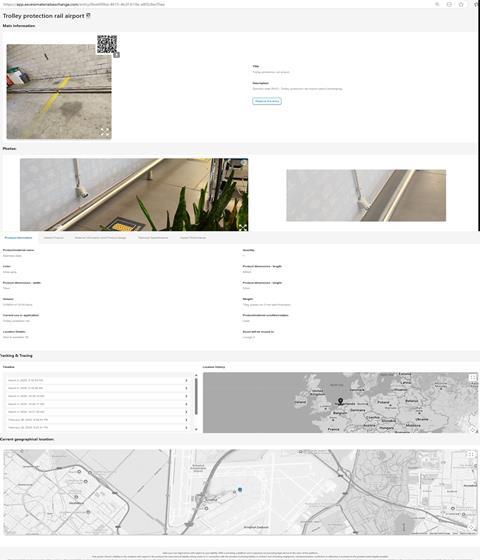
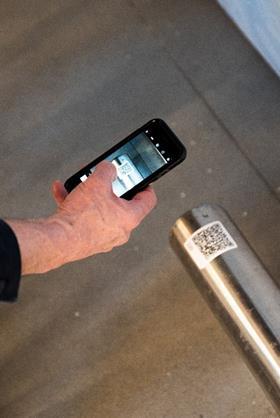
Today QR codes. Tomorrow, AI that does the matching for you.
The pilot used QR codes and manual data entry. Right starting point – but very much a starting point. The honest limitation is that the system depended heavily on people: project managers connecting supply and demand across parallel projects, and a warehouse manager functioning simultaneously as librarian, customs officer and traffic controller. That worked very well. But a circular economy that requires heroic coordination is still a circular project, not yet a circular system.
The good news is that the technology to change this already exists or is very close to existing. AI and automation would transform this model significantly – the difference between a card index and a search engine.
|
Technology |
What it unlocks for circular construction |
|
AI image recognition |
Photograph a material → auto-classify type, condition, dimensions, monetary value—no manual data entry. |
|
Agentic AI matching |
System proactively connects surplus inventory to upcoming project demand in real time – like a very organised colleague who never sleeps |
|
Digital Product Passports |
Every material carries a full lifecycle record: origin, condition, carbon value, reuse history. Soon mandatory under EU law. |
|
Active RFID / IoT tags |
Real-time warehouse tracking. No more lost grating, no more phantom inventory. |
The most exciting near-term capability is agentic AI: systems that proactively monitor inventory and incoming project demand, then surface matches automatically, before the project manager has thought to ask. Think of it as OK Cupid on steroids, but for cable trays and doors. That description is accurate, and it is not entirely a joke.
Digital Product Passports also deserve emphasis because they are about to become mandatory. The EU’s revised Construction Products Regulation introduces sector-specific passports for construction materials. Under the CSRD, the European Sustainability Reporting Standards E5 – Resource Use and Circular Economy require organisations to demonstrate material flow visibility. Airports that build traceability infrastructure now will arrive at those deadlines with a working system.
This is not just an airport story
Any organisation that operates like a mini-city – universities, hospitals, ports, rail operators and large industrial campuses – faces the same structural challenge: one project generates surplus materials while another, often nearby, procures new ones, with little structured connection between the two. The solution is similarly familiar: a visible inventory, clear decision-making and the discipline to check what is already available before ordering new.
One important nuance is that the best circular outcome is not always internal reuse. What matters is understanding the value of a material in the round – economically, logistically and environmentally. Heavy materials with a low value-to-weight ratio, such as many concrete applications, are often best reused close to where they arise, because transport can quickly erode both the financial return and the carbon benefit. Higher-value materials, by contrast, may justify transport to a more distant project or buyer, where the retained value keeps the business case positive. In practice, circularity works best when value, distance and CO2 are considered together.

Technology helps. Process decides.
Do not start with software. Start with manners. The first rule of circular construction is not “buy a platform”; it is “check the shelf before you buy new stuff.” Decide which materials are worth assessing, who signs off on reuse, when project teams must check available stock, and who owns the process. If that is unclear, the fanciest platform will just help you organise confusion more efficiently.
Make reuse mandatory, not optional. Donor projects should have to flag reusable materials before disposal, and receiver projects should have to check available stock before ordering new. Treat the warehouse as a transfer point, not a retirement home for cable trays. Materials sitting still cost money, lose value and quietly become waste with better posture.
And then build the business case properly. Reuse saves CO2, waste and procurement costs – but it also creates handling, storage and logistics costs. That is fine. Circularity does not need to be romantic to work. It just needs to make operational, financial and sustainability sense.
Small pilot, big receipts
This pilot was small, but it made something very large visible: linear construction is not inevitable. A surprising amount of waste is simply the result of not knowing what you already have, not knowing what it is worth, and not checking in time. Schiphol’s pilot showed that with a workable process, a digital trail and the right partners, ordinary materials can deliver extraordinary value.
That matters because the next phase is bigger than one airport or one warehouse. As regulation tightens, material prices rise and digital product passports become standard, organisations that can track, value and recirculate materials will have a real advantage. Circular construction is no longer just a sustainability ambition. It is becoming basic operational intelligence. And sometimes, operational intelligence looks a lot like a cable tray that did not need to be bought twice.












No comments yet