


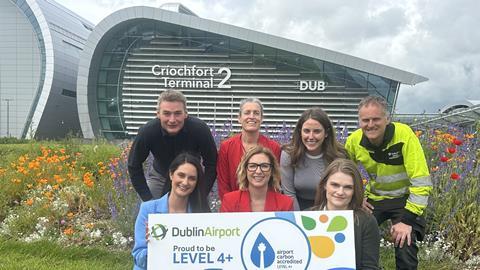

Kirsty Murphy Hughes, Senior Sustainability Manager, daa shares how investment in clean energy, close collaboration with airlines and partners, and data-led operational delivery support a pathway to net zero.
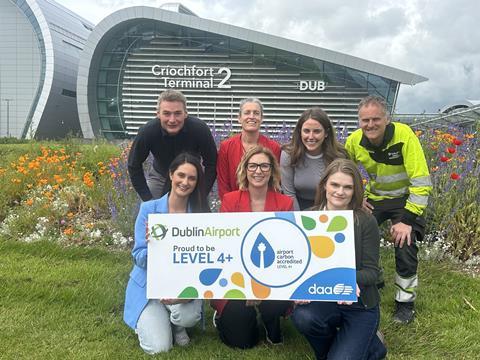
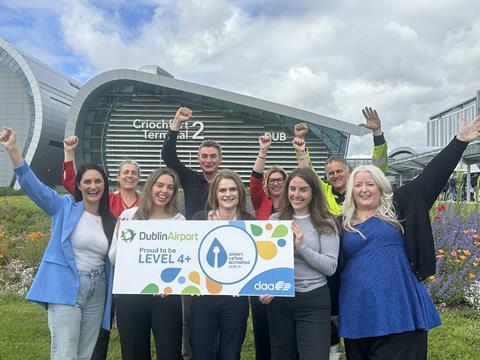
Dublin Airport’s achievement of Level 4+ under the Airport Carbon Accreditation programme marks an important milestone and reflects a wider shift across aviation towards more structured, accountable climate action. As the second-highest level currently available, it places Dublin Airport among the top 13% of performers globally for carbon management in the programme.
Awarded by Airports Council International, Airport Carbon Accreditation is the global standard for carbon management at airports. Achieving Level 4+ provides independent verification of Dublin Airport’s long-term commitment to measuring, managing and reducing emissions in line with recognised climate science.
At its core, the accreditation is about delivery rather than ambition. It confirms that Dublin Airport has set long-term, absolute emissions reduction targets validated by the Science Based Targets Initiative, supported by a clear and credible plan. This is particularly significant in an airport context, where emissions are complex and spread across a wide network of operators.
At its core, the accreditation is about delivery rather than ambition.
Operational delivery has been central to this progress. Strong carbon data management has enabled the airport to measure emissions accurately and track performance over time. This data-led approach supports better decisions and allows targeted action where it will have the greatest impact. Alongside this, a sustained programme of energy efficiency and emissions reduction measures has helped to lower the airport’s overall carbon footprint.
Reducing emissions across the airport ecosystem
Airports do not operate in isolation. A large share of aviation-related emissions sit outside the direct control of the airport authority, including airlines, ground handlers and other service providers. Achieving Level 4+ therefore, reflects not only what Dublin Airport has delivered directly, but also how effectively it has worked with partners to drive improvement across the wider ecosystem. Collaboration is essential to extending the reach of emissions reduction efforts.
Electrification and renewable energy are central to this long-term approach, and in 2025 Dublin Airport achieved 57% energy efficiency improvement and 12% of the airport’s electricity was produced by onsite renewable sources. Moving away from fossil fuels towards alternative fuels and electric systems offers a clear route to reducing direct emissions, but it must be supported by clean energy to deliver meaningful results. Investment in renewable energy, combined with continued gains in efficiency, provides the foundation for a lower-carbon operating model. Together, these elements support a pathway to net zero that focuses on reducing emissions at source rather than relying on offsetting.
As Ireland’s main international gateway, Dublin Airport plays a vital role in connectivity, trade and tourism. Demand for air travel continues to grow, meaning that expansion and environmental responsibility must progress together rather than being seen as competing priorities.
Delivering absolute emissions reductions in this context is complex. Unlike efficiency gains, which can be achieved incrementally, absolute reductions require total emissions to fall over time, even as activity increases. This creates a tension that must be actively managed and requires sustained investment, long-term planning and the flexibility to adapt to new technologies and evolving regulation. It also highlights the importance of influencing emissions beyond the airport’s direct control.
Moving away from fossil fuels towards alternative fuels and electric systems offers a clear route to reducing direct emissions, but it must be supported by clean energy to deliver meaningful results.
Transparency is critical. Independent verification, strong data systems and clear reporting frameworks are essential to demonstrate progress and maintain credibility. In this context, Level 4+ provides external validation that Dublin Airport’s emissions reductions are real, measurable and aligned with recognised standards, helping to build confidence among stakeholders.
Aligning growth with climate responsibility
Looking ahead, the focus is on maintaining momentum. Dublin Airport has set a target of net zero carbon emissions in its own operations by 2050, with significant reductions planned by 2030. Achieving this will require continued investment in electrification, renewable energy, operational efficiency and innovation, alongside deeper collaboration with airlines and partners.
Level 4+ is not an endpoint, but a platform for further action. It shows that a structured, science-based approach to carbon management is both achievable and effective in the airport sector, while also underlining the scale of the challenge ahead.
Level 4+ is not an endpoint, but a platform for further action.
In a sector under increasing pressure to respond to climate change, Dublin Airport’s experience offers a clear example of how progress can be made. By combining strong data, operational discipline, partnership and long-term investment, airports can begin to align growth with climate responsibility and deliver meaningful reductions in emissions. This is a long-haul journey, requiring sustained commitment, shared effort and a willingness to keep moving forward, step by step.








No comments yet