

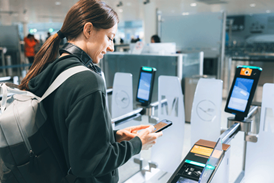

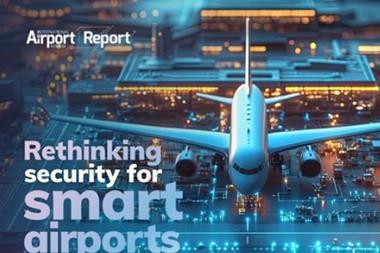
This eReport explores how airport security strategies are evolving during a time when geopolitical volatility is the new operational norm.
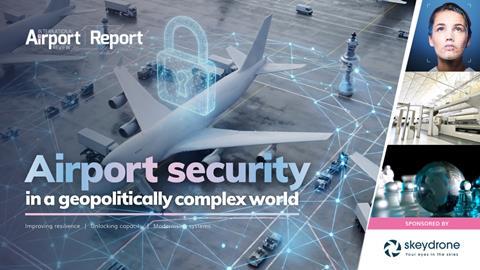
The era of treating aviation security as a simple, front-door problem is decisively over. In a reality where conflicts are at their highest level since the Second World War, the perimeter you have spent millions defending is being bypassed by cyber-attacks, remote drone incursions, and the unintended consequences of geopolitical friction.
Are you prepared to manage the consequences of threats you cannot control?
Download our exclusive eReport, Airport security in a geopolitically complex world to discover why leading airport executives are abandoning the illusion of the perimeter and pivoting toward system-wide operational resilience.
What’s inside?
This comprehensive eReport serves as a strategic blueprint for airport leaders, security directors, and operations chiefs navigating an unpredictable threat landscape. It provides a deep dive into the urgent shift from isolated prevention to integrated, operational survivability. You will discover actionable frameworks for breaking down the dangerous silos between cyber, physical, and operational security, alongside roadmaps for adopting autonomous screening and digital identity technologies that enhance both safety and passenger flow.
Key trends addressed
- The reality of geopolitical volatility: Understand how distant macro-events - from the Gulf region to Eastern Europe - instantly transform commercial airports into frontline crisis centres facing airspace closures and volatile energy markets.
- The cyber-physical security nexus: Learn why third-party IT outages can no longer be treated merely as digital issues, as cyber anomalies rapidly cascade into terminal congestion and physical vulnerabilities.
- The paradox of automation and insider risk: Discover how the relentless drive for seamless, automated passenger journeys is engineering away the crucial “soft oversight” needed to spot radicalised or financially compromised insiders.
- Moving Beyond Hardware in Drone Defence: With drone incidents increasing by 400% between 2024 and 2025, discover why relying solely on detection sensors is a dangerous misconception. Learn how integrating Unmanned Traffic Management (UTM) data and a robust Concept of Operations (CONOPS) prevents unnecessary, costly airport closures driven by uncertainty
- Autonomous security operations: Explore how AI-powered CT scanners and gender-agnostic algorithms are reducing manual searches and transforming security into a scalable enabler of airport growth.
- Global digital identity frameworks: Look beyond basic facial recognition to the scalable trust architectures, such as decentralised identifiers (DIDs) and verifiable credentials, needed to process millions of passengers securely across borders.
Expert insights and case studies
This report moves past theory, offering candid insights and proven strategies from the executives operating on the front lines of global aviation:
- Berlin Brandenburg Airport (BER): Oliver Braun and Ricardo Roth detail their pioneering “One Security” approach, revealing how a joint Cyber and Airport Security Operations Centre successfully managed the physical fallout of the September 2025 cyber-attack on aviation provider Collins Aerospace.
- Bahrain Airport Company: Patrick Cuschieri explains why airports must stop trying to independently intercept military-grade threats like drones or missiles, and instead focus on counter-UAS situational awareness and collaborative crisis governance with state agencies.
- SkeyDrone: Managing Director Stijn De Vleeschhouwer debunks the idea that airports can simply buy their way out of the drone threat with advanced hardware. He warns against the severe safety risks of deploying active drone countermeasures and outlines the three critical pillars of incident response: threat assessment, speed of action, and continuous data collection.
- Noida International Airport: Ajesh Verma unpacks the complexities of modern insider risk, highlighting how to ethically use AI and biometric identity governance to secure the space inside the perimeter.
- Airports Council International (ACI) World: Darryl Dowd shares crucial lessons in crisis governance, illustrating how the airport terminal must adapt to become a temporary shelter and communications hub when regional airspace suddenly constricts.
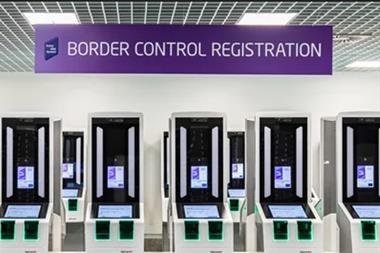
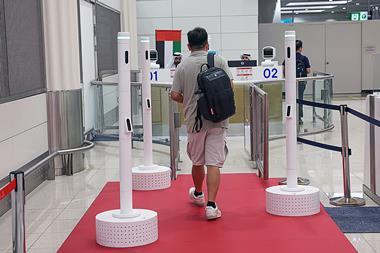
- Global innovation showcases: Read how Hong Kong International Airport increased screening capacity by 50% per lane with smart security, how Frankfurt Airport pioneered stress-free 360° walkthrough scanners, and how Singapore Changi Airport slashed immigration clearance times to just 10 seconds per traveller using passport-free technology.
Access the eReport
Access Airport security in a geopolitically complex world for free now to explore how leading airports are no longer defending an illusionary perimeter but building a truly resilient system.
Download Now








No comments yet