

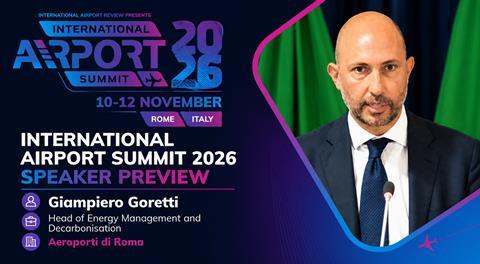
International Airport Summit 2026 speaker, Giampiero Goretti, who is Head of Energy Management and Decarbonisation at Aeroporti di Roma explains why integrated energy strategies are becoming essential for future airport development.
For more than a century, airports have been engines of economic development, connecting people, markets and opportunities across the globe. Today, they face a new challenge: accommodating growth while responding to climate change, energy insecurity risks and evolving societal expectations. In this context, resilient low-carbon energy systems are emerging as a defining characteristic of the airport of the future, creating the conditions to innovate, expand and decarbonise simultaneously.
Airports are becoming energy ecosystems
The role of airports is expanding beyond transport. As aviation moves towards a lower-carbon future, airports are increasingly becoming platforms where mobility, energy and digital infrastructure converge.
Through a combination of high-performance buildings, advanced monitoring systems and continuous optimisation of operational assets, ADR has reduced its energy intensity by approximately 60% compared with 2012 levels. This achievement demonstrates the scale of impact that efficiency measures can still deliver, even in mature and highly complex infrastructures
What were traditionally transport infrastructures are evolving into complex and interconnected energy ecosystems. The electrification of airport operations, the growth of digital infrastructure, increasing passenger expectations and the future deployment of low-carbon technologies are all driving a significant increase in electricity demand. At the same time, airports must continue to guarantee exceptional levels of reliability, safety and operational continuity, including during extreme weather and grid disruptions.
As a result, resilience and decarbonisation can no longer be addressed separately. They are becoming two dimensions of the same strategic challenge: enabling airports to accommodate future growth while reducing their environmental footprint and strengthening their ability to respond to uncertainty.
Energy efficiency first
The cleanest, least expensive and most resilient unit of energy remains the one that never needs to be produced.
This principle is increasingly guiding airport decarbonisation strategies worldwide. The most advanced programmes start by reducing demand before expanding renewable generation capacity, recognising that efficiency remains the fastest and most cost-effective pathway to lower emissions and improved resilience.
As airports progress towards net zero pathways, their role is increasingly shifting from infrastructure operator to ecosystem orchestrator
Aeroporti di Roma (ADR), the Mundys group company which manages Rome Fiumicino and Ciampino airports, offers a useful example of this approach. Through a combination of high-performance buildings, advanced monitoring systems and continuous optimisation of operational assets, ADR has reduced its energy intensity by approximately 60% compared with 2012 levels. This achievement demonstrates the scale of impact that efficiency measures can still deliver, even in mature and highly complex infrastructures.
Sustainable design standards are reinforcing this trend. Across the sector, terminals, piers and support facilities are increasingly conceived as integrated energy systems, incorporating high-performance envelopes, LED lighting, natural daylight solutions and intelligent HVAC technologies. Beyond reducing emissions, these measures strengthen operational flexibility and improve long-term resilience.
Producing energy where it is needed
The energy transition is fundamentally reshaping the relationship between airports and energy. Facilities that were once almost entirely dependent on external supply are increasingly becoming active participants in generation, storage and energy management.
Across the industry, on-site renewable generation is emerging as one of the most effective tools to strengthen energy sovereignty while accelerating decarbonisation. Large-scale photovoltaic developments are helping airports reduce exposure to market volatility, improve energy security and support the growing electrification of operations.
Rome Fiumicino Airport’s solar farm illustrates the scale of this transformation. Inaugurated in 2025, it is among the largest airport photovoltaic installations for self-consumption in Europe, with 22 MWp of installed capacity and annual production exceeding 30 GWh. Additional photovoltaic plants are currently under development in areas running parallel to the airport’s runways, with the aim of increasing on-site renewable generation and strengthening the energy autonomy of key airport assets. These initiatives are key components of ADR’s road towards achieving net zero carbon by 2030 and demonstrate how renewable generation can evolve from an environmental initiative into a strategic infrastructure asset capable of supporting both resilience and growth.
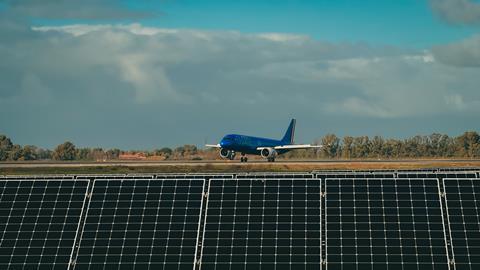
The diversification of on-site renewable generation is equally important. Increasingly, airports are integrating energy production directly into existing infrastructure. At Rome Airport, photovoltaic canopies installed over the long-stay car park provide an additional 5.6 MW of generation capacity, while simultaneously enhancing land-use efficiency and customer experience. Such projects demonstrate how airport infrastructure can deliver multiple forms of value through a single investment.
On-site renewable generation is emerging as one of the most effective tools to strengthen energy sovereignty while accelerating decarbonisation. Large-scale photovoltaic developments are helping airports reduce exposure to market volatility, improve energy security and support the growing electrification of operations
Storage turns renewables into resilience
If renewable generation represents the first phase of the airport energy transition, flexibility is rapidly becoming the next frontier.
Renewable energy is inherently variable, while airport operations require continuous, reliable and predictable power. Bridging this gap requires new approaches capable of balancing production and demand in real time.
Energy storage is emerging as one of the most effective solutions. Battery energy storage systems increase self-consumption, reduce peak demand, support renewable integration and provide the flexibility required to manage increasingly complex energy systems.
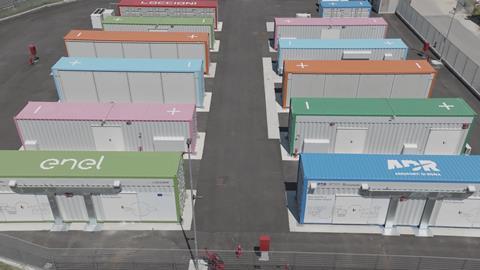
Practical examples are already demonstrating the value of this approach. At Aeroporti di Roma, the PIONEER project combines 762 second-life batteries from electric vehicles into a 10 MWh and 2.5 MW storage system capable of supporting renewable integration while advancing circular economy objectives. The project highlights how storage can simultaneously contribute to decarbonisation, resource efficiency and system flexibility.
Electrification requires a new infrastructure paradigm
Electrification is often presented as a vehicle replacement programme. In reality, it is an infrastructure transformation programme.
Airport shuttle services, operational vehicles and ground support equipment are progressively transitioning away from conventional fuels, but replacing assets alone is not enough. Electrification requires an entirely new ecosystem comprising charging infrastructure, adequate grid capacity, intelligent load management and flexible energy resources capable of supporting growing electricity demand.
The scale of investment already underway highlights the magnitude of this transformation. At Rome’s airports, more than 400 charging points have been installed to support airport operators, passengers and service providers, while airport shuttle services have been fully electrified and powered with renewable electricity.
The lesson is clear: decarbonisation cannot be achieved through isolated technologies. It requires a systemic approach capable of integrating infrastructure, operations and energy management into a coherent strategy.
Digital infrastructure enables the energy transition
As airport energy systems become more decentralised and interconnected, digitalisation is emerging as one of the strongest enablers of both decarbonisation and resilience.
The convergence of IoT platforms, predictive analytics, digital twins and advanced energy management systems is giving airport operators unprecedented visibility over energy flows and asset performance. These tools enable real-time optimisation, demand forecasting and more informed operational decision-making.
The benefits extend well beyond energy savings. Digital technologies improve reliability, increase operational agility and allow airports, such as ours, to manage increasingly sophisticated energy ecosystems with greater precision.
A resilient airport depends on a sustainable ecosystem
No airport can achieve meaningful decarbonisation in isolation.
Airports operate within complex ecosystems involving airlines, handlers, retailers, facility managers, construction companies, technology providers and numerous other stakeholders whose activities collectively shape the environmental performance of the aviation system.
For decades, airport energy strategies were designed around reliability and cost. The coming decades will require a broader ambition
While significant progress can be achieved through Scope 1 and Scope 2 initiatives, a substantial share of aviation-related emissions lies outside the direct control of airport operators. As airports progress towards net zero pathways, their role is increasingly shifting from infrastructure operator to ecosystem orchestrator.
This implies creating conditions that enable airlines, service providers and commercial partners to accelerate their own decarbonisation journeys. It includes supporting the deployment of sustainable aviation fuels (SAF), facilitating the electrification of ground operations, encouraging lower-carbon passenger access solutions and integrating sustainability considerations into procurement and investment decisions.
Many of the innovations required to achieve long-term decarbonisation will emerge from this broader ecosystem. By encouraging investment in lower-carbon materials, energy-efficient technologies and circular economy solutions, airports can amplify the impact of their own initiatives and accelerate the transition of the entire value chain.
Resilience as a licence to grow
For decades, airport energy strategies were designed around reliability and cost. The coming decades will require a broader ambition. Airports will need to become energy platforms capable of generating, storing, optimising and orchestrating increasingly complex energy ecosystems.
In this new paradigm, decarbonisation and resilience are not competing priorities. They are mutually reinforcing capabilities that determine an airport’s ability to adapt, invest and grow. Energy efficiency, renewable generation, storage, digitalisation and sustainable procurement are converging towards a model in which sustainability becomes a driver of competitiveness rather than a constraint on development. It is in this direction that Rome Fiumicino Airport’s Sustainable Development Plan is being shaped, with €9 billion in privately funded investment and a strong focus on integration with the local area, engagement with surrounding communities and the low-impact design of new airport infrastructure.
The airports that will lead the next phase of the aviation sector’s evolution will not simply be those that reduce emissions most rapidly. They will be those that manage to meet growing demand whilst adhering to increasingly ambitious climate targets, where energy resilience is therefore no longer merely a technical requirement, but is a license to grow.
I will be talking in-depth about this very topic at the International Airport Summit, during my session ‘Decarbonising airport operations: power resiliency as a licence to grow’, taking place in Rome on 10-12 November 2026. Make sure you sign up for your complimentary* ticket to ensure you are in the room for the discussion and to ask your questions of the panel and network with me afterwards.
*Complimentary aviation leader tickets are applicable to senior managers and above from airports, airlines, regulatory bodies and aviation authorities.








No comments yet