


Ahead of International Airport Summit 2026, industry leaders share how power resilience, renewable energy and electrified operations are reshaping airport sustainability strategies.
As global aviation aligns with net zero targets for 2050, airport operators are fundamentally rethinking Scope 1 and Scope 2 emissions across their campuses. Decarbonisation is no longer viewed merely as a corporate social responsibility initiative; it has become a core prerequisite for operational continuity and growth.
Without secure, low-carbon and self-sufficient energy supplies, airports risk severe vulnerability to public grid failure, rising utility costs and regulatory bottlenecks. To maintain their licence to grow, forward-thinking hubs are investing heavily in large-scale on-site renewable generation, ground support equipment (GSE) electrification and smart energy management infrastructure.
Large-scale on-site generation and microgrids for energy self-sufficiency
Securing reliable, low-carbon power at scale requires moving beyond grid purchases towards localised generation and energy storage. Airport operators are leveraging available land for massive solar, geothermal and microgrid installations that serve a dual purpose: lowering carbon footprints and hardening sites against catastrophic power outages.
Kingston Airport (Jamaica): PAC Kingston Airport Limited, operator of Norman Manley International Airport in Kingston, Jamaica, is executing an aggressive renewable transition to overcome high energy costs and fossil-fuel reliance. CEO Sitara English-Byfield explains its multi-phase solar and battery roadmap: “We currently do 2.8 megawatts of solar generation to reduce our carbon footprint. Phase one did not have battery storage, but now we’re working on phase two, which has eight megawatts of battery storage and five megawatts of generation. We believe by the end of 2026 we should be about 90% off fossil fuel energy and be almost self-sufficient.”
Beyond dramatic carbon reductions, English-Byfield highlights the economic benefit: “The maintenance for the system, though, is about one-twentieth of the cost of what we pay now for power.”
The New Terminal One at JFK: The New Terminal One facility at John F. Kennedy International Airport (JFK) is incorporating localised renewables directly into the building’s infrastructure. Vice President of Operations, Marisa von Wieding, stresses that on-site power is critical for operational stability:
“We [have] 13,000 solar panels at our facility, which enables us to have 50% of our capacity on a daily basis, but more importantly, it offers us operational resiliency if we lose power.”
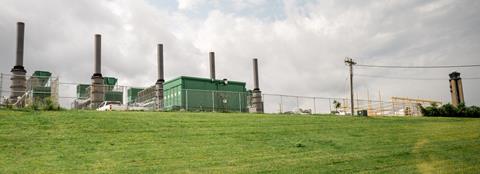
Pittsburgh International Airport (PIT): PIT has pioneered independent energy resilience by constructing a 23MW microgrid powered by 10,000 solar panels and five natural gas turbines. CEO Christina Cassotis underscores the operational necessity of energy redundancy: “We want resiliency and redundancy. We think we need it.” That investment proved its value when external grid infrastructure failed: “On 4 March, there were fires at two substations in Pittsburgh. The microgrid shut those interconnects off and powered the airport, and although the lights flickered for 10 minutes, we never lost power.”
Rethinking ground operations through fleet electrification and ecosystems
Decarbonising airside operations requires replacing fossil-fuelled vehicles with electric fleets, a transformation that demands robust charging networks and co-operative commercial models.
The world’s first pooled GSE at JFK Terminal One: Operating on a blank slate, JFK’s New Terminal One is eliminating equipment redundancies by mandating a 100% electric, shared GSE ecosystem. As von Wieding explains: “We’re the first airport in the world to have 100% GSE pooling… It’s all brand-new electric equipment, so it’s friendly for the environment, but also more efficient. So, we are able to go to market for ground handling labour only, which is really going to be a game-changer.”
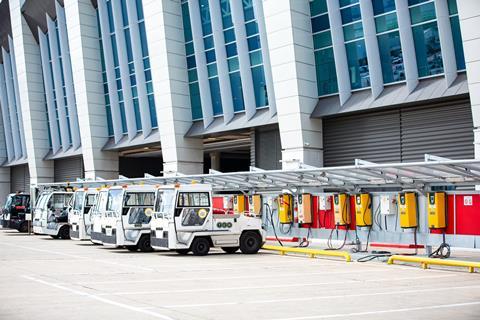
Bermuda Skyport: At L.F. Wade International Airport, leadership has instituted strict green procurement policies for company and ground handling fleets. Director of Airport Operations Jason Inniss outlines its mandate and long-term vision: “Any vehicle that we acquire now is either hybrid or fully electric. In 15 years, what I see is an airport generating more than 50% of our requirements from solar and will provide facilities for all the agencies to go electric, not only on the airside, but also on the landside.”
Zurich Airport Brazil: Implementing 400Hz power supply and pre-conditioned air (PCA) units at aircraft stands allows airlines to shut down auxiliary power units (APUs) while parked. Fernando De Castro, former Head of Business Development, Innovation and Operations Excellence, highlighted the twin benefits: “This reduces the greenhouse emissions and also enhances our aeronautical revenues. It’s win-win for all the industry.”
Smart infrastructure and demand reduction
Complementing generation and electrification, airports are deploying Internet of Things (IoT) energy management systems and smart infrastructure to curtail baseline terminal consumption by up to 30%.
Simple, high-impact efficiency retrofits, such as Bermuda Skyport transitioning 100% of its airfield runway and taxiway lighting to LEDs, yield immediate demand reductions. On a larger scale, airports such as Zurich Airport Brazil are leveraging smart infrastructure to dynamically optimise heating, ventilation and air conditioning (HVAC) systems, balancing passenger thermal comfort against energy consumption, which De Castro notes represents one of the top costs of every airport.
Join the panel discussion at International Airport Summit 2026
To examine how world-leading airport operators are navigating Scope 1 and 2 decarbonisation pathways, building microgrid resilience and scaling GSE charging ecosystems, attend this forthcoming session in Rome.
Panel session: Decarbonising airport operations: power resiliency as a licence to grow
- Event: International Airport Summit 2026
- Dates: 10–12 November 2026
- Location: Rome, Italy
Moderator:
- Ian Betteridge
Confirmed speakers:
- Johannes Huber, CEO, Forbo Group
- Giampiero Goretti, Head of Energy Management and Decarbonisation, Aeroporti di Roma
Do not miss this opportunity to connect with airport executives, discover proven investment frameworks and learn how smart infrastructure can accelerate your net zero roadmap while safeguarding operational resilience.
Register for your complimentary aviation leader ticket today.
*Complimentary aviation leader tickets are applicable to senior managers and above from airports, airlines, regulatory bodies and aviation authorities.







No comments yet