



Denise Pronk, Head of Sustainability, and Sara Solis, Circular Economy Lead at Royal Schiphol Group outline how Schiphol’s trial to trace cabin cleaning waste exposed both the operational value of origin data and the practical barriers to scaling circular solutions.
In spring 2025, Schiphol ran a data-driven pilot to trace cabin cleaning waste from aircraft door to waste facility. The pilot did not produce a model ready for immediate scale-up, but it did provide something equally important: concrete insight into what still needs to change before origin data can support better waste decisions in day-to-day airside operations.
The unglamorous waste stream nobody talks about
Nobody has ever chosen to fly via Amsterdam because the waste bags were well managed. Yet at Schiphol, cabin cleaning waste amounts to roughly 3,000 tonnes per year – newspapers, cups, packaging and the quiet residue of millions of journeys. For an airport with serious circular ambitions, treating this stream as invisible is not acceptable.
Schiphol’s circular approach follows a simple principle: avoid new materials where possible, keep existing materials in use for as long as possible, and recover them at the highest possible value when they leave the system. Straightforward enough until the material sits in a bin bag on an aircraft with only 15 minutes on stand before the same aircraft departs again.
For an airport with serious circular ambitions, treating this stream as invisible is not acceptable.
This pilot asked a deceptively simple question: can we know where a bag of cabin cleaning waste comes from, and can that origin data help us make smarter decisions about sorting and, where possible, recycling it?
Why origin data is not a ‘nice-to-have’
Cabin cleaning waste is a shared challenge at Schiphol. Generated onboard, it often combines cleaning waste with catering waste – especially on full-service flights. Under EU Regulation (EC) No. 1069/2009, catering waste from flights arriving from outside the EU is classified as Category 1 (CAT1) animal by-product material and must be incinerated.
That requirement drives the system. Airlines appoint cleaning companies to service the aircraft after arrival. The cleaning company collects the waste and delivers it to Schiphol’s airside collection facility, where Schiphol takes over. But if waste from EU and non-EU flights has already been mixed, the distinction is lost. From that moment on, all waste with potential animal by-product content must be handled as CAT1.
This is where origin data becomes critical. Waste from EU-origin flights may qualify as Category 3 (CAT3), opening the door to sorting and recycling. But only if its origin remains visible throughout the chain. Without that information, circular potential disappears.
Schiphol is therefore working with airlines, IATA and EU stakeholders to push for smarter regulation: rules that continue to protect public and animal health, while recognising that not all cabin waste carries the same risk. The forthcoming EU Circular Economy Act may create space for that shift, although its final scope remains uncertain.
Put simply: if you cannot trace where a bag came from, you cannot decide where it should go.
A chain of five partners and one bin bag
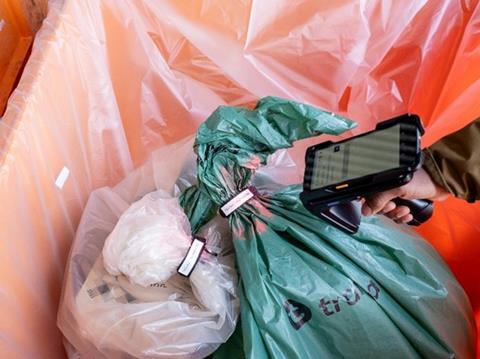
To test whether that traceability could be preserved, we designed the pilot as a genuine value-chain exercise. Schiphol acted as integrator, linking the sustainability ambition to daily operations. The cleaning company tested whether RFID tagging could work within a live turnaround, where every minute mattered and turnaround time was itself a critical KPI.
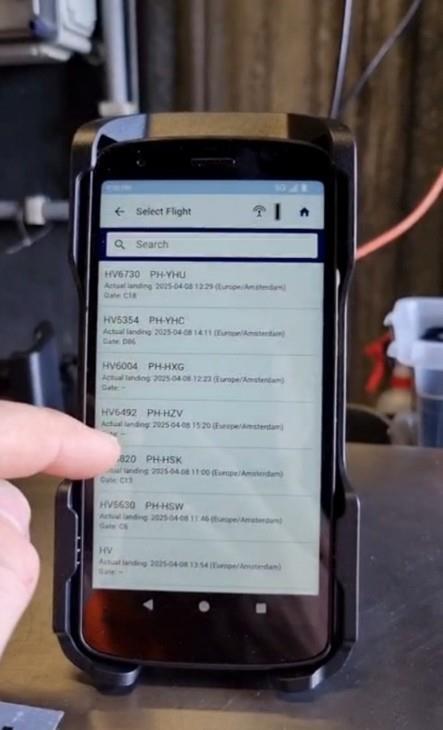
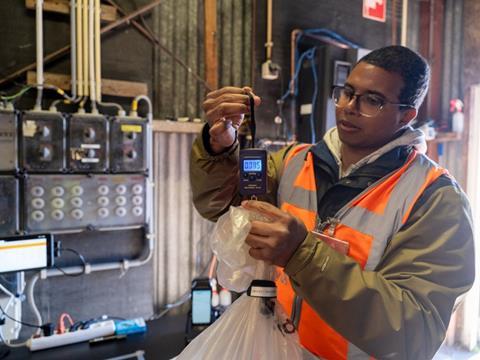
A technology partner provided the RFID tags, handhelds and digital link to flight data. Renewi, Schiphol’s waste handler, scanned, weighed and sorted the bags at the airside collection facility. Transavia joined as the lead airline in phase one, with additional airlines following in phase two.
Transavia deserves particular credit here. As an engaged partner in sustainability and innovation, the airline was willing to test the concept in live operations rather than on the drawing board. That willingness to experiment made the pilot stronger.
Five organisations, three separate systems and one waste bag trying to hold onto its identity from aircraft stand to sorting facility. That was the real test: could a fragmented chain still produce one reliable data story?
Two test windows, deliberately bounded
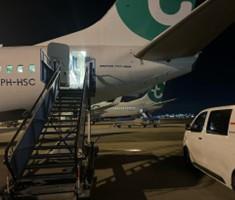
The pilot ran in two phases. The first (8-11 April 2025) focused on Transavia narrow-body flights during night shifts with lower operational pressure, more room to test something new. Schiphol staff supported the tagging process as bags were brought off the aircraft. The second (6-20 May 2025) expanded to multiple airlines and tested whether the cleaning company could manage the tagging independently – the only viable path to any future scale.
Scope was deliberately narrow: narrow-body aircraft, waste transported by van, with no container or scissor-lift flows. Success criteria were set in advance: trace bags from stand to facility, link at least 90% of tagged bags to origin data, avoid disrupting on-time performance, and generate information useful enough to inform future system design. A good pilot does not try to boil the ocean. It tries to follow the bag.
Results: genuine progress, genuine gaps
The headline result is real: more than 80% of tagged bags were identified at flight level. The first test window reached 82%; the second reached 100% for all bags processed. The basic concept works: a waste bag can carry an operational identity from stand to facility.
The data is directly actionable for airlines: bag counts per flight, kilograms of residual and recyclable waste, waste per passenger, and identification of EU-origin residual waste that may qualify as CAT3. These are not just sustainability statistics. They are management information that can inform in-flight product choices, service formats and procurement decisions. The same data can help airlines anticipate cleaning needs by route, improving planning and cost control.
| What worked? | What still needs fixing? | |
|---|---|---|
|
80%+ of bags traced to flight level (second test: 100%) |
|
Process not scalable in its current form |
|
Flight-level data: bag counts, kg of waste, kg of recyclables, waste per passenger |
|
Device reliability and RFID read issues |
|
EU-origin CAT3 material potentially identified |
|
Manual scanning; no system integration |
|
Useful input for airline circular strategy, procurement and resource allocation |
|
Turnaround-time risk if not redesigned |
The barriers on the negative side were concrete: device reliability issues, RFID read failures, manual one-by-one scanning, and no integration between the three systems. On-time performance was not demonstrably affected during the pilot windows, but operator feedback was clear that in routine conditions, the current process could add critical minutes to a turnaround. The aircraft does not wait for the choreography to be perfected.
Three lessons for any airport considering this
Start with the operation, not the technology: RFID is clever, but irrelevant if it disrupts the cleaning process. Any solution must survive the turnaround, work frictionlessly from end-to-end, and create value for each party in the chain.
Define success as circular, commercial, and operational: Higher recycling rates and better in-flight procurement are valuable only if the model also works financially and fits within the operational reality of aviation, where turnaround time is critical and every minute carries a cost. Residuals should therefore be treated strategically: as potential value streams or as opportunities to reduce rising disposal costs.
Design the process with all partners from the outset: In airport circularity, systems often fail at the handovers. In a time-critical, high-risk environment where every minute has a cost, stakeholder alignment is what turns a concept into a working capability.
What comes next: watch, advocate, stay ready
Schiphol is not rolling this out. The process needs to be faster, simpler, and properly integrated before it can be reconsidered. The logical next conversation starts with airlines – the waste originates on the aircraft, and flight-level data creates its strongest value there.
If you cannot trace where a bag came from, you cannot decide where it should go.
Two scenarios could change the picture. First, if EU Regulation 1069/2009 is revised – Schiphol’s preferred direction – airside logistics and recycling opportunities for cabin cleaning waste would change with it. Second, if residual waste costs rise or restrictions tighten, the case for origin data becomes more interesting. The forthcoming EU Circular Economy Act could help move policy in that direction by strengthening the Single Market for secondary raw materials and creating better conditions for circular solutions at scale.
Schiphol will keep advocating, now armed with real pilot evidence rather than a theoretical argument. And if conditions shift, the issues identified here – technical stability, operational simplicity and system integration – will still need to be solved before any next step makes sense.
This pilot did not deliver a scalable solution. It delivered something equally valuable: an honest, data-backed answer about what is possible, and what still needs to be true. In circular economy work, that kind of clarity is not a consolation prize. It is the work. The bags are not yet wearing digital passports – but the system now knows a little more about where they are treated.










No comments yet