
Airport baggage handling systems sit at the crossroads of engineering complexity, operational pressure and maintenance risk. They are expected to deliver peak throughput on demand, maintain near-continuous availability and process an increasingly diverse range of baggage types without interruption. Historically, this has forced airports into compromises between footprint, reliability, maintainability and passenger experience. Cross-belt sorter technology has emerged as the solution capable of addressing all of these requirements simultaneously, and Leonardo’s MBHS® (Multi Baggage Handling System) stands out as one of the most mature and technically refined solutions in the market.
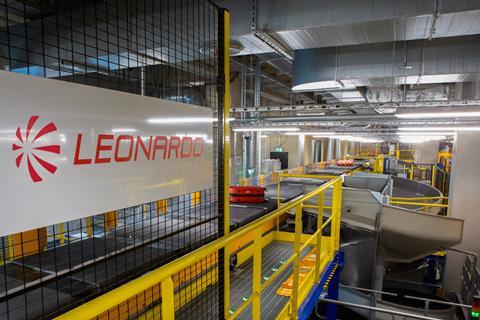
Airport baggage handling systems sit at the crossroads of engineering complexity, operational pressure and maintenance risk. They are expected to deliver peak throughput on demand, maintain near-continuous availability and process an increasingly diverse range of baggage types without interruption. Historically, this has forced airports into compromises between footprint, reliability, maintainability and passenger experience. Cross-belt sorter technology has emerged as the solution capable of addressing all of these requirements simultaneously, and Leonardo’s MBHS® (Multi Baggage Handling System) stands out as one of the most mature and technically refined solutions in the market.
Leonardo’s cross-belt heritage
Whilst there are some cross-belt suppliers entering the market, many newer offerings remain at an earlier stage of development, where design assumptions have yet to be fully validated under live airport conditions. In baggage handling, many of the most critical issues only emerge over time: reliability of the components designed, unusual baggage behaviour, long-term wear patterns, integration with legacy infrastructure and response to peak-load surges. These are not challenges that can be fully resolved in laboratory testing alone.
Leonardo’s MBHS, certified both CE and UL, benefits from close to 20 years of continuous operational refinement in airport environments and has travelled over eight million kilometres in total – equivalent to 10 round trips to the moon and back! This experience has enabled the system to evolve through real-world learning, with successive improvements in control logic, mechanical design and maintainability. Recently, Leonardo received its 50th cross-belt sorter order for airports internationally including the United States, Europe, the Middle East and the Far East, a milestone that reflects both the maturity of the technology and the confidence placed in it by airport operators worldwide.
This depth of operational experience directly reduces project risk. Engineering teams gain a solution that has already been proven in complex environments, maintenance teams benefit from a design optimised for rapid intervention and minimal wear, and operations teams can rely on stable performance even under demanding conditions. All teams also benefit from our operational and predictive maintenance tool, SortSight. In an industry where downtime is measured not only in minutes but also in missed flights, passenger disruption and airline penalties, that maturity becomes a critical differentiator.
Leonardo’s MBHS simplifies complex layouts and modifications
From an engineering perspective, one of the most persistent challenges is system layout complexity. Conventional conveyor-based and other systems often evolve into extensive networks of belts or tracks, diverters and switching mechanisms and transfer interfaces, where resilience is achieved by adding more equipment and longer conveyor or track routes. The consequence is a large physical footprint and a system that becomes progressively harder to operate, modify, optimise, model and maintain. Some of these difficulties can also be present when you want to modify the inherently closed ICS system. Leonardo’s MBHS Cross-belt technology reduces the number of intermediate transfer points and provides an open system allowing easy modification as airport requirements change or develop. For example, it has no mechanical actuators to eject bags to chutes, so a quick software change will allow modification of an exit position or allow you to add an additional exit to the sorter. It enables compact layouts, particularly where space is constrained. For example, baggage can be actively discharged even on curves, or can also incline at 15 degrees to make use of other levels or floors, therefore airports are not limited to long straight unloading sections and on one level, allowing the sorter to fit more naturally into existing terminal footprints and retrofit projects. Also, without the reliance on carts being returned or requiring different carts for different sized baggage, it removes further complexity and can be more space efficient. It also allows 100% tracking with Leonardo’s MBHS in particular having been approved and used at some airports to sort both dirty and clean baggage on one sorter, reducing complexity further – and typically the need for extra EBS machines with huge savings for airports!
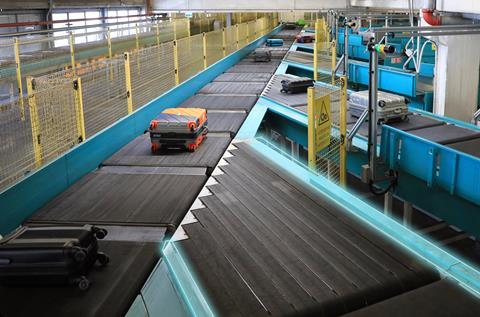
One of the most practical advantages of the MBHS lies in how it handles real-world baggage. Airports are not processing uniform baggage; they handle suitcases with wheels, straps, handles, loose buckles, plastic wrapping, soft-sided bags and oversized sports equipment. In tilt-based systems, these irregular features can create points where baggage may snag or stick, particularly straps or loose handles that can catch in the gaps, edges or tilting mechanisms of trays. By contrast, the cross-belt cell offers a continuous flat conveying surface with no tilting elements and no exposed mechanical gaps within the carrying surface itself. This significantly reduces any risk of straps becoming trapped or bags being caught during discharge. In practical terms, this means fewer jams, fewer damaged bags and less operator intervention.
This is particularly important during high-demand periods, where even a single jam can cascade into wider operational delays. A suitcase with a loose shoulder strap, for instance, which might become trapped in the pivot point of a tilting tray, remains securely supported on a continuous cross-belt cell until it is actively discharged in a fully controlled movement.
The system also addresses another common operational challenge: oversized and irregular baggage. Larger items such as golf bags, ski bags or long sporting equipment can occupy two adjacent cells operating in synchronisation. This means such items remain within the automated flow rather than being diverted to manual sorting streams. Not only does this reduce labour dependency, but it also helps address a common bottleneck from the baggage handling process, preserving throughput and consistency across the system.
Little maintenance
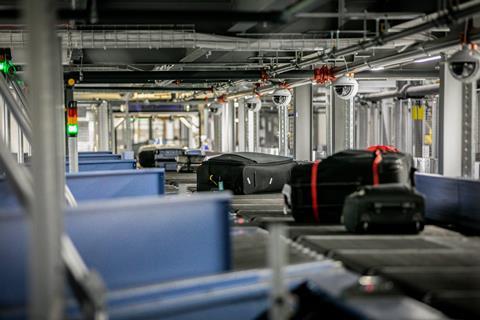
For maintenance teams, reducing wear points is often the single most important factor in improving long-term availability. Traditional systems rely heavily on mechanical contact components such as chains, belts, drive couplings and sliding electrical contacts, all of which require regular inspection, adjustment and replacement. The MBHS has been engineered to minimise these failure points through the use of contactless technologies. Linear synchronous motors provide propulsion without physical drivetrain connections, inductive power transmission delivers power without sliding contacts, and industrial-grade Wi-Fi supports communication between PLC’s on the moving cells and the control system whilst also all benefitting from no affect from dust or dirt. The result is a significant reduction in mechanical wear, with the wheel-to-rail interface becoming the only remaining physical contact point.
Redundant-by-design
More importantly, the system’s redundant-by-design architecture means faults remain isolated. This has a direct impact on maintainability. Individual cells can be individually deactivated until a maintenance window or removed and replaced rapidly allowing interventions to be carried out in just minutes. Propulsion is delivered by multiple linear motors arranged with extra linear motors for redundancy, meaning if one motor becomes unavailable, the surrounding motors compensate automatically. Independent trains, distributed control logic and linear motor redundancy ensure that a localised issue does not become a system-wide failure.
Operational benefits
Operational efficiency is another area where cross-belt technology offers clear advantages. Unlike fixed-speed systems that must run at full design speed regardless of demand, the MBHS dynamically adjusts speed based on real-time baggage flow. During off-peak periods, the sorter reduces speed, lowering both energy consumption and component stress. During peak flight periods, it ramps up seamlessly to full throughput. This adaptive behaviour improves both efficiency and component longevity.
A major differentiator, however, lies in the way baggage is ejected. Because the MBHS uses motor-rollers for belt-driven discharge rather than passive gravity-based methods, the trajectory of each bag can be precisely controlled. This dynamic ejection enables baggage to be distributed far more evenly within the chute. Rather than multiple bags landing in the same position and piling unevenly, the active discharge allows for controlled placement across the available chute width and depth, improving chute fill efficiency and reducing the risk of recirculation and localised blockages.
This level of control also creates significant engineering benefits in system density. Since the discharge trajectory is actively managed, the exit openings from the sorter can be made smaller than those typically required in passive systems. Smaller exits allow more destinations to be placed within the same linear footprint, increasing destination density and enabling more compact sorter layouts. In practical terms, this means airports can achieve a greater number of chute positions within a constrained area, improving both flexibility and space utilisation, leaving space for other activities or perhaps even an early bag system.

James Moody is a Product Marketing Specialist at Leonardo with extensive experience delivering airport baggage handling and sortation solutions for complex aviation environments. His expertise spans systems design, technical solution development, and strategic support for major airport projects. During his time at Leonardo, James has performed roles in systems engineering, proposal planning, sales engineering, and test engineering, combining technical knowledge with operational insight to support the evolving needs of airports and the wider automation sector.