

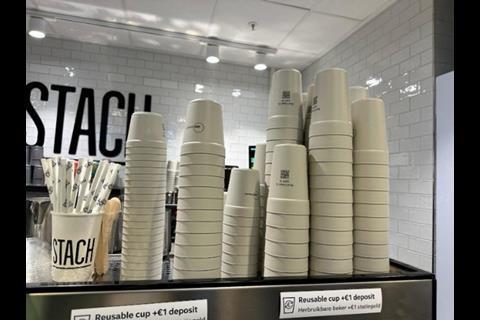
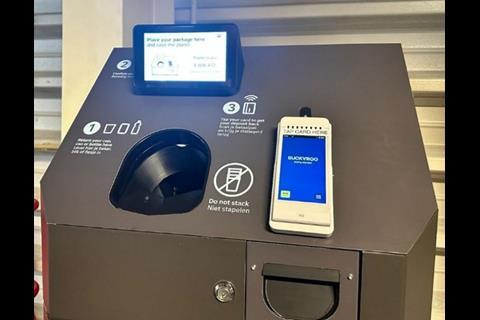
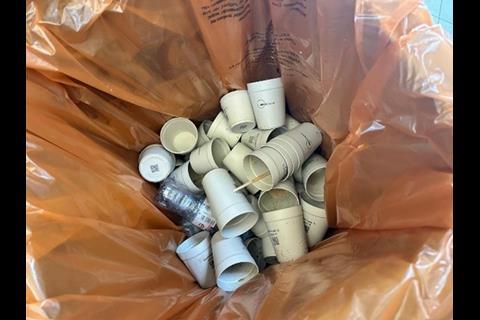
Denise Pronk, Head of Sustainability and Sara Solis, Circular Economy Lead, Royal Schiphol Group explain what it really takes to make reusable cups work airside at an airport.
Check out the first use case we published last month on Schiphol’s trial to trace cabin cleaning waste.
In February 2026, Schiphol ran a professionally designed, one-month pilot to test whether a deposit-based reusable cup loop could genuinely work in a live airport lounge. The results are remarkable – and they raise an exciting question: what if reuse at airports is not just possible, but scalable?
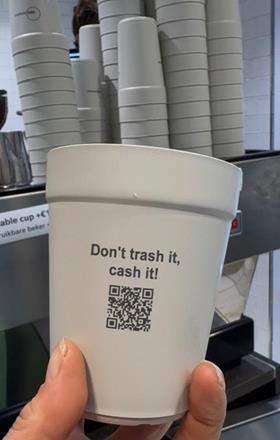
A small item with an outsized footprint
Every day, large volumes of hot beverages are served across Schiphol’s terminals. The majority of these drinks arrive in a disposable cup, are used for roughly 10 minutes, then tossed. Easy to ignore. Easy to underestimate. But not, it turns out, easy to dismiss.
Disposable hot cups currently account for approximately 8% of the contents of general waste bins across the terminal. Most end up as residual waste: the composite materials – paper bonded to a plastic lining – are notoriously difficult to separate and recycle. They fill bins quickly, increase cleaning frequency, and contaminate other recyclable streams. Remove that 8% through a shift to reusables, and the avoided waste potential is immediately significant. Scale that logic across the world’s major hub airports, and what looks like a minor operational detail becomes a major sustainability lever.
For Schiphol, this is also about something bigger: improving the passenger experience by translating circular economy ambitions into practical solutions that work on the ground, in one of the most operationally complex environments imaginable. In doing so, Schiphol advances its broader ambition to create “happy travellers, airlines and employees in balance with our environment,” ensuring that sustainability efforts directly enhance comfort, clarity and quality throughout the passenger journey while reducing environmental impact.
A reusable cup loop is a shared system, and it only functions when every part of the value chain commits”
Why airports make this harder – and why succeeding here matters
Airport terminals are one of the toughest environments in which to introduce any operational change as there is high footfall, a predominantly transient user-base, strict airside safety and security requirements, multiple independent food and beverage (F&B) operators – each working under separate contracts, and, above all, a passenger experience that must remain seamless at all times. Operational friction that slows a queue or confuses a traveller is simply not an option.
That complexity is also precisely what makes success here so meaningful. If a reusable cup system can operate reliably in a live Schengen lounge at one of Europe’s busiest hub airports, the proof of concept is compelling for many other sectors.
The F&B partners are especially critical in this context. They are the ones facing the passenger at the exact moment the cup changes hands – the moment the concept either lands or falls flat. Their operational readiness, the quality of their staff training, and their genuine buy-in are not supporting factors in a reuse programme. They are foundational to it.
Designing this pilot meant treating it like a new product launch: define the problem clearly, appoint a project lead, establish the hypotheses, and commit to iterating quickly when reality diverges from the plan. Agile thinking is not just for technology teams. In a live airport environment, the right approach is to design, launch, observe and adjust – together. The first iteration rarely produces the final answer; it produces the insight that makes the next one smarter.
A coalition effort: the ecosystem behind one reusable cup
This brings us to perhaps the most important lesson of the entire exercise: a reusable cup loop is a shared system, and it only functions when every part of the value chain commits. Schiphol does not own the full chain. Neither does any single partner. The loop closes only when each stakeholder chips in – and when the handovers between them are designed with the same care as any other critical airport operation.
For this pilot, that meant assembling and aligning a coalition of several organisations, each playing an irreplaceable role:
- Airport operator (Schiphol): defined the strategic direction and roadmap for circular operations (including goals and KPIs), while end-to-end delivering pilots through innovation cycles and ensuring alignment with commercial, passenger experience, and partner requirements within the terminal environment.
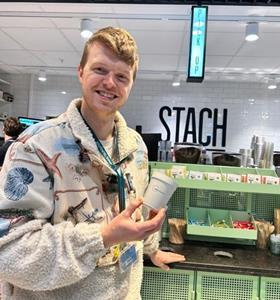
- F&B operators, Lounge 4 (Avolta and Vermaat): managed point-of-sale activation, trained staff, and handled clean cup distribution.
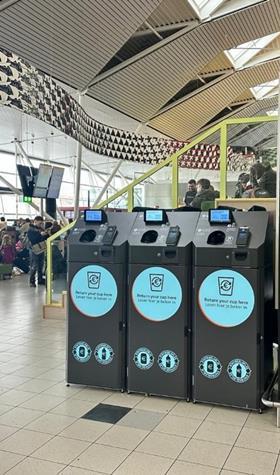
- Reverse vending machines and payment system provider (Packback): provided the digital deposit-and-refund system, and the passenger feedback prompt after each return.
- Cup washing and external logistics partner (Cupstack): managed cup washing and external logistics – supplying clean cups, collecting used cups, and tracking returns.
- Waste handler (Renewi): handled internal logistics, emptying reverse vending machines and transporting cups to the logistics hub.
- Cup provider (Circulware): designed and produced the reusable cups.
This was a genuinely shared endeavour, and all organisations chipped in to realise the pilot.
What was tested and how?
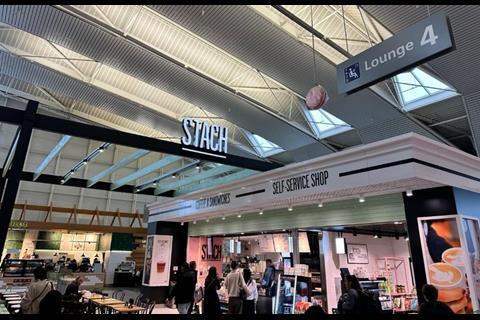
The pilot ran for one month, from 3 February to 3 March 2026, in Lounge 4 (Schengen). A bounded terminal environment was deliberately chosen because it allowed all participating outlets to align around a single, consistent customer journey, and it kept the scope manageable for a first operational test before any wider rollout.
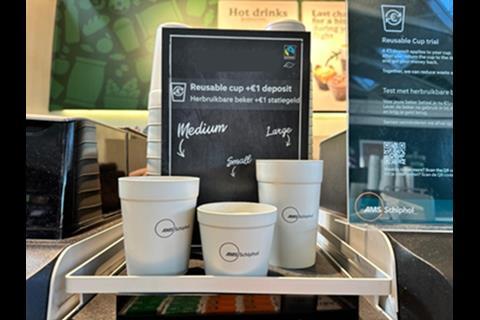
Passengers paid a €1 deposit per beverage, refunded within 24 hours of returning the cup to one of seven reverse vending machines across four locations. Cups were activated at the point of sale via a scanner. Three cup sizes were available. Mid-pilot, signage was updated to improve wayfinding and return rates – a textbook example of in-flight iteration working as it should.
The results: genuinely encouraging and honestly caveated
The headline results are genuinely encouraging. Over the course of the month, reusable cups were used extensively during the pilot. Cup wash counts, used as a practical proxy for returns into the loop, reached 93.4% of reusable cups served. By comparison, cups physically returned and recorded via the reverse vending machines averaged 81.6%, highlighting a measurable gap between total loop returns and machine-captured returns. The average passenger rating following a successful return was 4.54 out of 5. Staff observed markedly fewer abandoned cups on tables and less bin overflow in the pilot area. Crucially, there was no evidence of a negative impact on sales.
| Indicator | Result |
|---|---|
| Cups washed – proxy for returns | 93.4% of the reusable cups served |
| Reverse vending machine-counted returns | 81.6% of the reusable cups served |
| Passenger rating after return | 4.54 / 5 (n = 2,061) |
| Refund transaction success rate | 90.6% |
| Estimated non-activation rate at the checkout | ~5.2% |
These are remarkable results for a first pilot – and they deserve to be recognised as such. At the same time, they must be read with honesty. This is a pilot, not yet a proof of scale. One month, one area, more iterations, across different terminal environments and longer timeframes, are needed before anyone can call this a replicable operational model.
Several technical gaps also remain:
- · Refund success (90.6%) too low for scale
- · Checkout non-activation (~5.2%)
- · Reverse vending machines filled faster than planned
- · Reverse vending machine visibility/wayfinding insufficient at launch
- · Multi-lingual onboarding needed.
These are solvable problems. They simply have not been solved yet – and the next iteration will be designed to solve them.
What comes next? Staying curious, staying agile
The pilot has delivered exactly what a good pilot should: a credible operational foundation, honest data, and well-defined questions to carry into the next phase. What it has not delivered, nor was it designed to, is a final answer. That will take more time, more testing, and more collaboration.
Before any reusable cup system can be considered ready for broader application, further research and controlled testing is needed: validating the concept across different terminal conditions, refining the logistics model, and verifying that the solution meets business and sustainability objectives simultaneously. A system that works operationally but does not stack up commercially will not endure. One that looks good on paper but creates friction for passengers or partners is equally incomplete.
Two additional factors make agility essential. The technology underpinning reuse systems – deposit management, reverse vending, digital refunds, washing logistics – is evolving rapidly. EU frameworks on single-use plastics and extended producer responsibility are tightening too. Both may influence which design approach makes most sense, and when. Remaining open to adapting the route is simply good practice.
The direction, however, is not in question. Schiphol’s mission is to be a home for world travellers – a place where passengers feel welcome at every step of their journey. Its Vision 2050 is equally clear: happy travellers and a healthy environment belong together. A cup system that passengers embrace, partners can sustain, and that measurably reduces waste is a natural expression of both. The path may evolve. The destination is set.

No comments yet