


Austin airport continues on the road of carbon reduction
- Like
- Digg
- Del
- Tumblr
- VKontakte
- Buffer
- Love This
- Odnoklassniki
- Meneame
- Blogger
- Amazon
- Yahoo Mail
- Gmail
- AOL
- Newsvine
- HackerNews
- Evernote
- MySpace
- Mail.ru
- Viadeo
- Line
- Comments
- Yummly
- SMS
- Viber
- Telegram
- Subscribe
- Skype
- Facebook Messenger
- Kakao
- LiveJournal
- Yammer
- Edgar
- Fintel
- Mix
- Instapaper
- Copy Link
Posted: 6 December 2019 | International Airport Review | No comments yet
By reaching Level 2 Carbon Accreditation in ACI’s programme, the City of Austin’s Aviation Department has further demonstrated its commitment to sustainability.
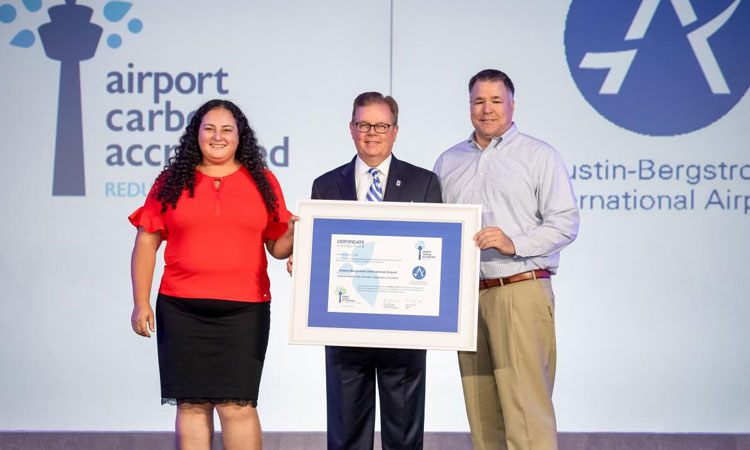
Ghizlane Badawi (left), City of Austin, Department of Aviation Assistant Director for Enterprise Business Services, and Shane Harbinson (right), Assistant Director, Airport Planning and Development, accepts the accreditation certificate from ACI
While serving almost 17 million passengers, Austin Bergstrom International Airport (AUS) has continued to work with ACI’s Airport Carbon Accreditation (ACA) programme, with the goal to reach carbon neutrality in 2020.
This multi-step international programme assesses and recognises an airport’s efforts in managing and reducing CO2 emissions. AUS was recently awarded for becoming re-certified at the second level of the four-step process.
In 2019, Dallas Love Field was also recognised for achieving Level 2 Carbon Accreditation. Out of all North American airports, the only airports that have achieved Level 3+ accreditation – meaning carbon neutrality has been reached – are San Diego International Airport (SAN) and Dallas/Fort Worth International Airport (DFW). Both AUS and Dallas Love Field are committed to joining this elite group by 2020.
Also focused on reducing carbon emissions, two of Texas’ largest cities and three of the state’s largest airports have created the Texas Airport Climate Alliance to collaborate, share resources and accelerate action on climate change.
Austin’s airport has used a variety of tactics to reduce its carbon footprint including using wind and solar-energy sources, alternative fuel vehicles, conservation awareness campaigns and purchasing carbon offsets. Electrical power for all AUS buildings is supplied by Austin Energy’s GreenChoice programme, generated by west Texas wind turbines.
AUS has utilised 100 per cent renewable electricity since 2012, preventing over 93,000 metric tonnes of carbon dioxide from entering the atmosphere. The use of this power source has been extended from the terminal to the airfield to power aircraft ground service equipment (GSE) and aircraft ground power units.
Related topics
Airport Carbon Accreditation (ACA), Emissions, Sustainability, Sustainable development




 Chief Executive Officer
 CEO
CEO Chief Operating Officer
 Head of Operations, Safety and Emergency
 Chief Strategy Development Officer
 Head of Operations
 Airport General Manager
 CEO
CEO Chief Executive Officer