


Spotless and crowd-free: How flow analytics helps airports manage restroom safety and cleaning efficiency
- Like
- Digg
- Del
- Tumblr
- VKontakte
- Buffer
- Love This
- Odnoklassniki
- Meneame
- Blogger
- Amazon
- Yahoo Mail
- Gmail
- AOL
- Newsvine
- HackerNews
- Evernote
- MySpace
- Mail.ru
- Viadeo
- Line
- Comments
- Yummly
- SMS
- Viber
- Telegram
- Subscribe
- Skype
- Facebook Messenger
- Kakao
- LiveJournal
- Yammer
- Edgar
- Fintel
- Mix
- Instapaper
- Copy Link
Posted: 1 February 2022 | Christian Bugislaus Carstens | No comments yet
Restrooms must now be kept clean and free of crowds. Christian Bugislaus Carstens, outlines how Veovo can help airports manage this.

Never have the restroom habits of travellers been of quite as much interest to airport operators as they have become over the last two years.
While airports have always had to maintain high hygiene standards, the pandemic has forced a renewed focus on how high-touch, high-traffic areas are used, cleaned, and sanitised.
Previously, for example, it was enough to ensure that all facilities were regularly cleaned, on a schedule, to maintain a pre-determined standard of hygiene. Now, the challenge is significantly more complex. Restrooms must be kept clean and free of crowds. An influx of passengers can no longer be left to their own devices to find their way to the nearest facilities.
Airports must, ideally, understand facility usage, react quickly to ensure sanitation and reduce crowding, and have the ability to plan custodial tasks more efficiently.
Distributing passengers to prevent crowding at facilities
Many airports are turning to a combination of sensors and machine learning to track and analyse people’s movements within the airport to manage restroom usage.
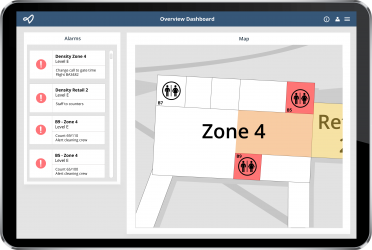
Occupancy and density analysis enables operators to understand how many people may use a specific restroom at a particular time, based on counting and controlling the situation of each bathroom in real-time.
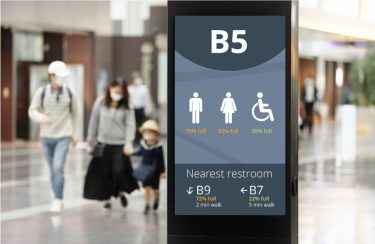
When presented with live occupancy data, passengers can make informed decisions about which restrooms to use – including information on the walking times to alternative, less crowded facilities.
By combining live occupancy data with passenger flow analytics, operators can also measure and predict crowding events ahead of time. This enables the airport to direct the flow of passengers across restroom facilities before they become too busy – for example, including messages on digital displays to encourage dwell time in less active zones or dynamic directions via wayfinding apps.
Shifting to need-based cleaning
Rather than a static, rota-based cleaning and sanitising schedule, airports would benefit from moving to a needs-based system.
Armed with historical usage insights, custodial service managers can align cleaning plans to forecasted usage and flight schedules while monitoring staff activity for accurate cleaning-time display.
Deploying custodial resources to the busiest facilities, as needed, makes sense. Therefore, services that can adapt easily to being responsive, even predictive, to shifting flight schedules and people movements will be the most efficient and effective.
A straightforward extension for passenger flow platforms
For many airports, especially those that already have passenger flow systems in use, it’s a simple matter of expanding their data-capture capabilities to include restroom facilities or, in many cases, integrating existing sensor outputs into one common platform.
This extension fits neatly with the already-proven benefits of airport flow management, including real-time responsiveness to handle challenges on the go, predictive analysis that improves efficiency, and cost savings by ensuring resourcing matches demand.
For example, airports can understand the impact of gate changes on restroom crowding. They can predict how security bottlenecks affect lounge dwell time and facility usage and determine the optimal custodial response.
Understanding how events affect passengers’ show-up profiles, movement, dwell habits, and facility usage throughout the airport makes it possible to automate the appropriate responses.
Smarter, safer journeys
By connecting airport-wide passenger flow analytics, occupancy, and density analysis with operations, airports will have the appropriate tools for more intelligent, predictive decision-making, from passenger arrival to departure and at every point in between.
Armed with precise data, airports can act confidently to ensure passengers have easy access to clean, uncrowded restrooms – lifting the overall airport experience and passenger confidence.
Christian Bugislaus Carstens, PR & Digital Marketing Manager at Veovo.
Christian is the quintessential marketing and PR professional, with a strong background and experience in creative content and digital marketing, design, advertising, and social media. He is a believer in continuous improvement, staying up to date with the latest techniques and trends in marketing and brand-building, and applying these to his position as PR & Digital Marketing Manager for Veovo, a leading technology company that helps airports globally run more efficiently.




 Chief Executive Officer
 CEO
CEO Chief Operating Officer
 Head of Operations, Safety and Emergency
 Chief Strategy Development Officer
 Head of Operations
 Airport General Manager
 CEO
CEO Chief Executive Officer