


Global airport industry hard at work to reduce and eliminate its CO2 emissions
Posted: 8 May 2017 | Airports Council International | No comments yet
189 airports across the world now certified at one of the 4 levels of Airport Carbon Accreditation report ACI Europe.
- These airports welcomed 2.5 billion passengers a year – that’s 38% of global air passenger traffic
- 30 airports are now carbon neutral – the latest are Bangalore International and Sunshine Coast Airport
- There are now 25 carbon neutral airports in Europe, 4 in Asia-Pacific and 1 in North America
Brussels, Hong Kong, Casablanca, Washington DC, Panama and Montreal: With international airline emissions soon to be subject to the CORSIA° agreement struck at ICAO last year, the global airport industry today issues a reminder of the progress it has been making in addressing its CO2 emissions, through the independent and voluntary global programme, Airport Carbon Accreditation.
Angela Gittens, Director General, ACI World commented:

“An impressive 2.5 billion air passengers now travel through airports certified at one of the 4 levels of Airport Carbon Accreditation – a testament to how much the programme has helped mobilise airport operators towards addressing their carbon footprints. Airport Carbon Accreditation is enabling a multi-speed effort now involving 189 airports across the world and it’s inspiring to see the level of innovation and diversity with which ** airports are contributing to the fight against Climate Change.”
She added:
“I would particularly like to congratulate Bangalore International and Sunshine Coast on becoming carbon neutral airports. We are also hugely encouraged by the latest accreditations in Africa – this really sends a message to the wider world that carbon management is a valid consideration for every business no matter where they are located.”
REGIONAL BREAKDOWN (in alphabetical order)
AFRICA
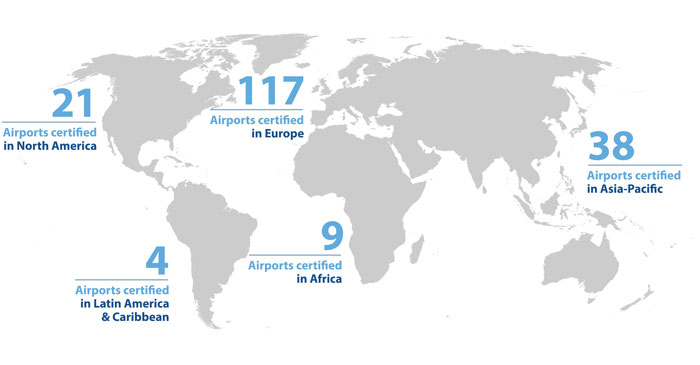
Recent months have seen a significant spike in interest in Africa, where several new airports have come on board, nearly doubling the participation on the African continent. Cape Town International, King Shaka International (Durban), Port Elizabeth International and O.R. Tambo International (Johannesburg) – 4 airports in South Africa have all successfully entered the programme at Level 1 Mapping. This brings the total number of African airports in the programme up to 9.
ASIA-PACIFIC KEEPS RISING
Meanwhile in the Asia-Pacific region, Sunshine Coast Airport and Bangalore International Airport (India) has just become the 3rd and 4th airports in the region to achieve carbon neutrality (Level 3+).
Peter Pallot, Airport general manager, Sunshine Coast Airport said “The team has worked incredibly hard to make Sunshine Coast Airport the most sustainable airport in Australia. To date our initiatives have delivered a 24% reduction in Scope 1 and 2 carbon emissions, 9% reduction in electricity consumption per passenger and an 11% reduction in waste-to-landfill per passenger.”
Sanjay Reddy, Managing Director, Bangalore International Airport said “This is a big moment for our airport. BIAL’s approach to sustainability incorporates understanding and learning from experience, and we have progressively developed capabilities to respond to industry best practices. As one of the early adopters to become Airport Carbon Accredited when the programme first launched in Asia-Pacific 6 years ago, our journey to carbon neutrality has been steadily well-documented as we rose through the 4 levels of Airport Carbon Accreditation. BIAL continues to work in collaboration with its partners within the eco-system to improve and reduce energy, constantly working towards carbon neutrality. We hope our example inspires other airports to be as ambitious in the way they manage their carbon emissions.”
Elsewhere in the Asia-Pacific region, Suvarnabhumi Airport (Bangkok) and Adelaide Parafield and Sydney Airport have both successfully moved up to Level 3 Optimisation.
There are now 38 airports certified in Asia-Pacific with recent entrants including Gold Coast Airport and Hobart International (both in Australia) as well as Muscat International Airport and Nadi International Airport (Fiji) – which have all started their journey to active carbon management, becoming accredited at Level 1 Mapping. Nadi International’s accreditation is significant as it is the first airport from an island nation under threat from climate change, to participate in the programme.
EUROPE
In Europe, where Airport Carbon Accreditation started out in 2009, there are now 117 airports participating in the programme, 50 of which are at the top 2 levels of the programme. The most recent movers within the programme are Düsseldorf and Naples airports – each of which successfully make the jump from Level 2 Reduction, to Level 3 Optimisation. Madeira, Marseille and Porto Santo airports have moved up to Level 2 Reduction while Switzerland’s Bern Airport became the latest newcomer in Europe, entering the programme at Level 1 Mapping.
NORTH AMERICA
It’s been two and a half years since the programme was launched in North America, but already an impressive 21 airports have become certified in this region. These airports currently account for 32.4% of air passenger traffic in North America.
LATIN AMERICA
In addition, the programme has 4 airports in the Latin America and Caribbean region.
With 4 different levels of accreditation covering all stages of carbon management (Mapping, Reduction, Optimisation and Neutrality), Airport Carbon Accreditation is independently administered, institutionally-endorsed¹ and has the support of the United Nations Framework Convention on Climate Change (UNFCCC), United Nation Environment Programme (UNEP), the International Civil Aviation Organisation (ICAO), US Federal Aviation Administration and the European Commission (EC).
18.9 billion passengers are coming. Is your airport ready for 2026? ✈️
Access the FREE Airport Industry Intelligence Handbook for expert strategies on scaling sustainably, modernising ATM, and securing cargo logistics.
Featuring insights from ACI World, TIACA, CANSO, and ACI EUROPE.
Related topics
Airport Carbon Accreditation (ACA), Emissions, Sustainability, Sustainable development





 Chief Executive Officer
 CEO
CEO Airport General Manager
 Head of Operations
 Chief Strategy Development Officer
 Head of Operations, Safety and Emergency
 Chief Operating Officer
 CEO
CEO Chief Executive Officer