
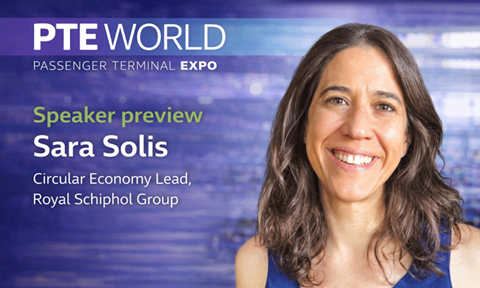
Ahead of her participation in PTE World in London, Sara Solis, Circular Economy Lead, Royal Schiphol Group explains how innovation, AI and stakeholder collaboration are turning sustainability ambition into measurable business value, while transforming airports into resource-efficient, resilient hubs.
What does a circular economy mean in the context of airport operations, and how is Schiphol implementing it?
In airport operations, a circular economy is not a single programme but a systems approach to managing resources across their full lifecycle – from design and procurement to use, recovery and reintegration – while maintaining operational continuity, passenger experience and economic performance.
At Schiphol, we translate this ambition into action through four guiding principles:
- Avoid unnecessary materials
- Choose low-impact alternatives
- Extend asset lifespans
- Recover materials at their highest possible value.
These principles are applied consistently across terminals, offices, airline-related activities, and construction and infrastructure projects.
Crucially, circularity is embedded into operational decision-making and investment choices rather than treated as a parallel sustainability track. This allows circular solutions to deliver measurable environmental impact and tangible business value – a prerequisite for scaling in complex airport environments.
Which areas of the airport offer the greatest potential for circular practices?
The greatest potential lies upstream, where design and procurement decisions lock in impacts for decades. Avoidance is the most powerful lever: eliminating unnecessary materials in daily operations immediately reduces waste volumes, emissions and costs.
In construction and infrastructure, the opportunity is even larger. Circular design, low-carbon material choices, modularity and traceability fundamentally change how assets perform over their lifetime. Airports are long-lived systems, so decisions made at the design stage have disproportionate influence on future circularity outcomes.
The strongest results come from combining these upstream choices with improved operational practices – linking design, use and end-of-life strategies into one coherent approach.
How do you measure success in circular economy initiatives – cost savings, carbon reduction, or resource efficiency?
We deliberately avoid framing success as a trade-off between business performance and circularity. Impact is created when both are achieved simultaneously.
Depending on the use case, business metrics may include cost reduction, operational efficiency, or passenger experience, while circularity indicators focus on carbon footprint, material use, recycling quality and resource efficiency.
To ensure credibility and scalability, we align with established measurement frameworks while tailoring indicators to operational reality. This combination of standardisation and pragmatism allows us to steer based on evidence, compare initiatives, and demonstrate value clearly to decision-makers – which is essential when moving from pilots to business-as-usual.
What challenges do airports face when transitioning from linear to circular models?
The primary challenge is alignment. Circularity only works when sustainability objectives reinforce business priorities – and achieving that requires careful scoping, prioritisation and governance.
The primary challenge is alignment. Circularity only works when sustainability objectives reinforce business priorities.
Airports operate within highly complex value chains, where influence over materials and assets varies widely. Transitioning from linear to circular models, therefore, requires breaking silos, collaborating across organisational boundaries, and aligning incentives with airlines, concessionaires, suppliers and contractors.
In practice, this change in mindset, roles and ways of working is often more challenging than the technical solutions themselves. Circularity is as much an organisational transformation as it is an environmental one.
How does innovation support Schiphol’s circular economy goals?
Innovation is essential because circularity requires fundamentally different ways of working – not incremental optimisation of linear systems.
One critical area is the use of data and AI to improve decision-making. Automated waste scans and AI-supported post-sorting are improving insight into residual streams and increasing recycling performance. When these insights are linked to relevant indicators, they inform smarter procurement choices and support business partners in avoiding problematic materials. This field is still emerging, but its potential is significant.
Innovation is equally important in circular design and construction. Advances in low-impact materials, including concrete and asphalt, combined with new approaches to assembly, disassembly and material tracking are changing how infrastructure is designed and managed. At the same time, new circularity metrics are enabling better steering and accountability in construction projects. Measuring circularity itself is a relatively new but critical innovation.
What role do partnerships with suppliers and stakeholders play in achieving circularity?
Circularity is fundamentally about closing loops, and loops cannot be closed by one organisation alone. Every stakeholder, from suppliers to operators to service providers, plays a role at different stages of the material lifecycle.
Progress depends on partnerships built around shared objectives, transparency and aligned incentives.
Progress depends on partnerships built around shared objectives, transparency and aligned incentives. At Schiphol, we see strong potential where environmental ambition overlaps with commercial interests, creating a foundation for joint solutions rather than impact shifting.
Effective partnerships move circularity from aspiration to implementation – especially in complex, multi-actor environments such as airports.
AI is evolving from predictive analytics to agentic models that can act autonomously. How could this accelerate circular economic initiatives at airports?
AI has the potential to move circularity from reactive optimisation to proactive system management.
In operations, AI can support circular procurement by linking passenger preferences with sustainable product choices, analysing residual waste streams to provide targeted feedback to retailers and caterers, and enabling industrial-scale post-sorting to maximise material recovery.
In construction and asset management, AI-enabled digital twins and material passports support predictive maintenance, extend asset lifespans, enable circular demolition planning, and facilitate marketplaces for reused materials. This effectively transforms buildings from static assets into dynamic material banks.
Do you see opportunities for AI to optimise waste management, resource allocation and energy efficiency in real time?
Absolutely. By combining sensor data, operational systems and machine learning, AI enables real-time insight and intervention across waste flows, material use, asset performance and energy consumption.
This allows airports to dynamically allocate resources, reduce inefficiencies and anticipate issues before they occur – shifting sustainability from a reporting obligation to an integrated decision-support capability embedded in daily operations.
What barriers exist to deploying advanced AI for sustainability, and how can they be overcome?
Key barriers include unclear scope, uneven maturity of AI solutions, fragmented systems, and the perception that sustainability-driven AI lacks a compelling business case.
Overcoming these challenges requires a pragmatic approach: start with proven use cases, link sustainability outcomes directly to cost and performance benefits, pilot before scaling, and prioritise integration over isolated tools. Equally important are governance, data quality and organisational readiness. Without these foundations, even advanced AI will struggle to deliver value on a scale.
What will your focus be at PTE? What are you there to talk about/present on?
My focus at PTE is on what comes after pilots and EU programmes such as TULIPS – how airports transition from experimentation to scalable, future-proof solutions.
In the panel on EU Green Deal initiatives, I will reflect on lessons learned from TULIPS and discuss how circularity can be embedded into airport business models, infrastructure, procurement and operations. The emphasis will be on translating ambition into action, measuring impact, and enabling cross-airport learning beyond project boundaries.
In the joint session on AI-Rports of the future, I will explore how AI and data are already supporting smarter material flows, asset management and circular decision-making, and how governance, collaboration and digital maturity will shape the next generation of resilient, low-impact airports.
What are you looking forward to learning from other airports at PTE?
I’m particularly interested in how different airports are prioritising resources today – and how they balance sustainability objectives with passenger experience and operational constraints.
PTE is also a valuable opportunity to exchange practical lessons on circularity, AI and sustainability more broadly, and to understand how peers are moving from pilots to scalable, business-as-usual solutions.
Sara is speaking on the below sessions at PTE World:
‘EU Green Deal initiatives: between waste management and circularity’
17 March 2026 at 15:00-15:40 GMT
‘AI-rports of the future: where tech meets circularity’
18 March 2026 at 15:00-15:30 GMT
 Sara Solis is the circular economy lead at Royal Schiphol Group, where she drives the transition toward fully circular airports. With a background in industrial engineering and an MBA in sustainability, she combines strategy, data and innovation to make circularity practical and impactful. Passionate about technology and collaboration, Sara explores how AI can help build smarter, greener airports.