


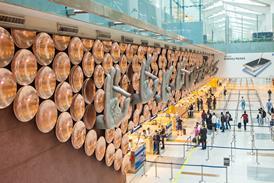


This eReport maps the shift from fragmented terminal automation to Total Airport Management, showing how integrated data, cybersecurity and digital identity unlock capacity without new construction.

Walk through any modern terminal and you will find self-service kiosks, eGates, and biometric boarding points. Yet, despite billions invested in “smart” technology, most operations remain fundamentally fragmented. Departments operate as digital islands, isolating critical data in legacy silos and causing high data latency across the aviation network.
With global passenger demand projected to double by 2050, the traditional, CAPEX-heavy playbook of physical terminal expansion is now obsolete due to skyrocketing supply chain costs, labour constraints, and environmental pressures.
Aviation leaders must therefore achieve “virtual expansion” - squeezing maximum performance, throughput, and capacity out of existing terminal footprints.
This exclusive eReport provides the strategic roadmap for CIOs, CTOs, CDOs, and COOs to transition their organisations from disconnected, reactive automation to proactive, system-wide Total Airport Management (TAM).
READ FOR FREE NOW BY LOGGING IN OR BECOMING A MEMBER.
What’s inside?
This comprehensive industry briefing serves as an operational blueprint to help you orchestrate people, assets, data, and decisions into a single, highly resilient intelligent ecosystem.
- The TAM maturity framework: A step-by-step breakdown of transitioning your hub from Level 3 operational visibility to Level 4 (Total Airport Management) and Level 5 (the self-optimising airport).
- The Zero Trust cybersecurity playbook: Technical strategies to protect converged IT, IoT, and operational technology (OT) networks from cascading supply chain failures.
- Decentralised identity architectures: A guide to designing GDPR-compliant, reusable, self-sovereign digital identity (SSI) wallets that put passengers in control of their data.
- The connected sustainability roadmap: How to transform environmental goals into core operational capabilities using digital twins, Building Information Modelling (BIM) data, and smart engineering.
Key trends addressed
1. From siloed automation to “Total Airport Management” (TAM)
Stop managing independent departments and start orchestrating connected passenger, baggage, and aircraft flows. Discover how integrating airside, landside, and terminal data into a dynamic Airport Operations Plan (AOP) enables your teams to predict disruptions and automatically adjust schedules before queues form.
2. The cybersecurity “perimeter paradox”
The convergence of physical security and IP-connected legacy OT (baggage handling, HVAC, boarding bridges) has drastically expanded your digital attack surface. With new regulations like the UK’s Cyber Security and Resilience Bill holding airport operators legally liable for external supplier networks, learn how to implement strict network micro-segmentation and continuous verification to prevent a single third-party breach from crippling your entire operation.
3. “Look-and-go” passenger journeys
Ditch the repetitive, friction-laden stop-and-check document checkpoints. Explore how trusted digital identity and biometrics function as an invisible layer of digital infrastructure, creating a continuous, frictionless terminal flow where passengers simply travel with a smile.
4. Sustainability as a connected capability
Move beyond green compliance checklists. Learn how market leaders use interconnected IoT sensor networks and predictive analytics to continuously optimise energy and water consumption per passenger in real time.
Expert insights and case studies
- Hartsfield-Jackson Atlanta (ATL): CIO Chris Crist shares how deploying enterprise-scale computer vision overlays across 2,000 cameras slashed manual investigation workflows by 75% - reducing search times from four hours to just one.
- Aeroporti di Roma (ADR): SVP Emanuele Calà details how Fiumicino Airport integrated real-time passenger flows with airfield computer vision to reduce average departure delays by six minutes and recover precious gate capacity.
- Denver International (DEN): Senior Director Tracy Whitling reveals how DEN utilises a competitive “bake-off” methodology to build and test predictive irregular operations (IROPS) models, providing teams with predictive operational foresight.
- Bordeaux Airport (BOD): Head of Innovation, Pierre Dejean explains their deployment of a 17-sensor LiDAR platform across 1,200 square meters to monitor queue dynamics in real time while strictly preserving passenger privacy.
- Oslo and Portland Airports (OSL & PDX): Technical breakdowns of how Oslo used native BIM standards to cut terminal energy consumption by over 50%, and how Portland’s aquifer heat pump slashed terminal heating plant fossil fuel use by 90%.
Four compelling reasons to access this eReport today
- Unlock 10% to 20% in hidden capacity: Learn how a joined-up, predictive approach to flows allows less efficient airports to unlock massive capacity gains without pouring a single cubic meter of concrete.
- Capture the 1% efficiency dividend: System co-ordination is the new executive KPI. A mere 1% improvement in operational efficiency at a major hub translates directly into $15–25 million in annual savings.
- Overcome the stakeholder co-operation barrier: SITA data shows that 57% of airlines and 44% of airports identify stakeholder co-operation as the primary bottleneck to scaling digital identity. Acquire the collaborative framework needed to build interoperable trust layers.
- Avoid passenger friction pitfalls: Read the cautionary tale of Incheon Airport’s “Smart Pass” app, which suffered a 1-star rating on the Google Play Store due to passport NFC and facial verification friction, highlighting why technology must be co-designed with operational and user feedback.
Access the eReport
Access The orchestrated airport: Transitioning from connected to intelligent operations for free now to explore how leading airports are achieving virtual expansion without laying a single new brick.
Equip your C-suite with the strategic foresight required for 2026, 2027, and beyond.
Download Now





















No comments yet