


Airport charges steady despite airfares surging alarmingly and threatening industry recovery
- Like
- Digg
- Del
- Tumblr
- VKontakte
- Buffer
- Love This
- Odnoklassniki
- Meneame
- Blogger
- Amazon
- Yahoo Mail
- Gmail
- AOL
- Newsvine
- HackerNews
- Evernote
- MySpace
- Mail.ru
- Viadeo
- Line
- Comments
- Yummly
- SMS
- Viber
- Telegram
- Subscribe
- Skype
- Facebook Messenger
- Kakao
- LiveJournal
- Yammer
- Edgar
- Fintel
- Mix
- Instapaper
- Copy Link
Posted: 12 June 2023 | International Airport Review | No comments yet
Airport charges remain steady, post-pandemic, while airfares have soared allowing major airlines to reap record profits.
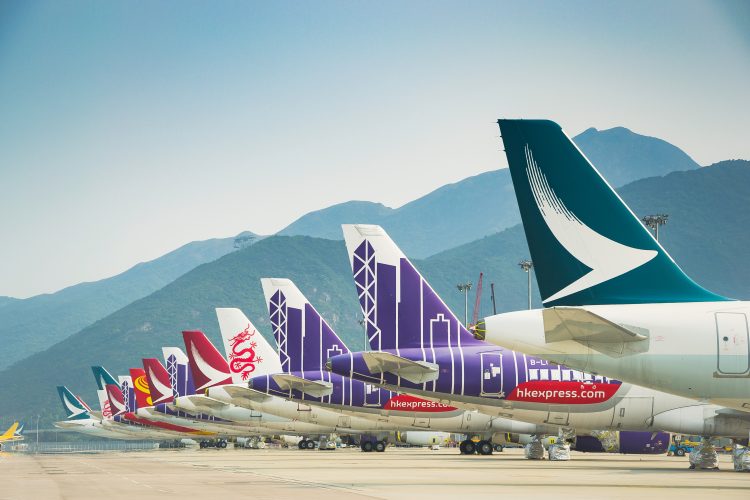
Airfares continue to surge despite airport charges remaining steady.
Airport charges have remained steady since the pandemic, while airfares have soared above pre-pandemic levels allowing major airlines to reap record profits. This has the potential to hamper the aviation industry recovery, reveals ACI Asia-Pacific’s study on airfare trends in the region.
The comprehensive study, undertaken in collaboration with Flare Aviation Consulting, examined around 36,000 routes in the top 10 aviation markets in Asia-Pacific and the Middle East, reveals an alarming increase in international airfares by up to 50%, while domestic routes went up by less than 10%. The markets that saw the highest airfare increase are India (41%), United Arab Emirates (34%), Singapore (30%) and Australia (23%).
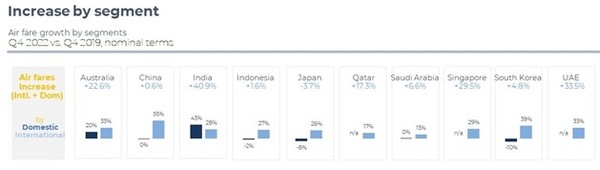
Air fare growth by segment. CREDIT: ACI ASIA PACIFIC
Unexpectedly, in the first quarter of 2023, despite a progressive increase in traffic, domestic airfares have continued to increase in several of these markets, including India, Indonesia, Saudi Arabia, South Korea and Japan, only decreasing marginally on international routes.
Airlines are capitalising on low competition and pent-up demand to increase profits and recover losses incurred during the pandemic, while airports continue to provide enhanced services to passengers despite incurring heavy operational and capital expenditures.
Expressing concerns about the high-pricing practice, Mr. Stefano Baronci, Director General of ACI Asia-Pacific, said, “these excessive airfares threaten the industry’s long-term recovery and may have a far-reaching influence on the associated industry by reducing demand for air travel and increasing the financial burden on the already stressed sector. Airlines should exercise fair pricing that supports recovery and safeguards consumers’ interests. A supply-demand imbalance should not be exploited by airlines at the expense of customers by restricting the capacity, especially international one which is a key driver of social and economic growth and a major source of revenues for the airport sector. We urge airlines to carefully consider the long-term impacts of their pricing decisions. At the same time, governments must consider liberalising markets through policies such as open skies, which will allow competition while keeping airfares under control,’ Mr. Baronci added.
Factors behind airfare increases
Fuel prices and inflation are responsible for a significant portion of airfare increase. Fuel prices went up 76% in 2022 compared to 2019. The airlines’ costs increased as the Consumer Price Index saw an average 10% increase over the same period.
It is worth noting that several major international airlines recently announced record profits for the year 2022 financial year. However, airport operators have been reporting negative EBITDA margins for the last 10 consecutive quarters, particularly in China, Japan, Thailand and India.
Airport Charges vs Airfares
Despite a decrease in passengers and continuous financial losses, airports have made tremendous efforts to support airline partners during the crisis. They accomplished this by freezing or reducing airport charges, including landing, parking, and passenger fees, and providing incentives at the peak of the pandemic.
This is despite the fact that airports have made significant investments in capital expansion and technology during this period to ensure a secure and smooth airport experience.
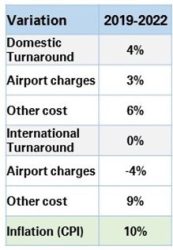
While the quantum of airport charges has always been a matter of debate, it has typically been attributed to increases in airfares. For the record, airport charges are unlikely to have a major cascading impact on airfares as they account for less than 4% of the airline cost base and the ACI Asia-Pacific study demonstrates no correlation between airport charges and airfares.
Airport charges are determined predominantly based on objective items of the airport’s cost base, comprised of operating expenses, depreciation, and cost of capital. These charges cover the cost of operations, maintenance, and development of airport infrastructure. Airlines, however, enjoy absolute market freedom to adjust pricing according to operational costs.
“One fact is clear. As it has been largely the case in the past, airport charges are not the reason for airfares increase in Asia-Pacific and the Middle East. Airport charges in 2019-2022 remained stable or decreased in nominal terms in Asia & Middle East by 4% on international routes; and increased only by +3% on domestic routes. The few airports that increased charges did it significantly below CPI levels after COVID in both domestic and international markets. Unlike airlines, airport operators do not have the privilege to set airport charges capable of covering the full cost of the service. And this is not only because their prices are heavily regulated, but also because market driven factors, such as competition and/or a dominant buyer power exerted by airlines prevent them from doing so,” Mr. Baronci said.
Moreover, during the COVID-19 pandemic, airlines benefited from the additional revenue generated by higher cargo rates. Airports, on the other hand, lacked the opportunity to capitalise on the positive cargo trend due to regulated charges.
Related topics
Related organisations
Airports Council International Asia-Pacific and Middle East (ACI APAC & ME)





 Chief Executive Officer
 CEO
CEO Chief Operating Officer
 Head of Operations, Safety and Emergency
 Chief Strategy Development Officer
 Head of Operations
 Airport General Manager
 CEO
CEO Chief Executive Officer