
The study showed 100% SAF to both engines of commercial aircraft could significantly reduce the climate-warming effect of condensation trails.
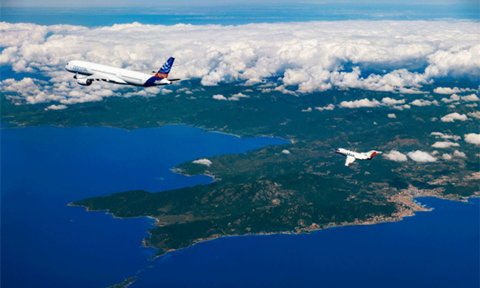
A significant reduction in soot particles and formation of contrail ice crystals are the results from a new in-flight study.
The ECLIF3 study analysed the impact of using 100% sustainable aviation fuel (SAF) in both engines of a commercial aircraft, compared to using conventional Jet A-1 fuel. It showed the number of ice crystals per mass of unblended SAF was reduced by 56%, compared to a reference Jet A-1 fuel.
The study was the product of a collaboration between Airbus, Rolls-Royce, the German Aerospace Center (DLR) and SAF producer Neste, measuring the effect of using 100% SAF to emission from both engines of an Airbus A350 powered by Rolls-Royce Trent XWB engines and followed by a DLR chase plane.
Global climate model simulations, conducted by DLR, were used to estimate the change in the energy balance in Earth’s atmosphere – also known as radiative forcing – by contrails. The impact of contrails was estimated to be reduced by at least 26% with 100% SAF use compared to the Jet A-1 reference fuel used in ECLIF3. These results show that using SAF could significantly reduce the climate impact of aviation in the short term by reducing non-CO2 effects such as contrails, in addition to reducing greenhouse gas emissions, such as CO2 emissions over the life cycle of SAF when compared to using fossil jet fuel.
“SAF is widely recognised as a crucial solution to mitigate the climate impact of the aviation sector, both in the short term as well as the longer term," commented Alexander Kueper, Vice President Renewable Aviation Business at Neste.
"The results from the ECLIF3 study confirm a significantly lower climate impact when using 100% SAF due to the lack of aromatics in Neste’s SAF used, and provide additional scientific data to support the use of SAF at higher concentrations than currently approved 50%.”
The research team has reported its findings in the Copernicus journal Atmospheric Chemistry & Physics (ACP) as part of a peer-reviewed scientific process, and provides the first in-situ evidence of the climate impact mitigation potential of using pure, 100% SAF on a commercial aircraft. The ECLIF3 program, which also includes researchers from the National Research Council of Canada and the University of Manchester, conducted in-flight emissions tests and associated ground tests in 2021.
The full report can be read here.