


Distortions mask modest cargo improvement
- Like
- Digg
- Del
- Tumblr
- VKontakte
- Buffer
- Love This
- Odnoklassniki
- Meneame
- Blogger
- Amazon
- Yahoo Mail
- Gmail
- AOL
- Newsvine
- HackerNews
- Evernote
- MySpace
- Mail.ru
- Viadeo
- Line
- Comments
- Yummly
- SMS
- Viber
- Telegram
- Subscribe
- Skype
- Facebook Messenger
- Kakao
- LiveJournal
- Yammer
- Edgar
- Fintel
- Mix
- Instapaper
- Copy Link
Posted: 2 April 2013 | IATA | No comments yet
IATA released February data showing that air cargo maintained the modest improvement…

The International Air Transport Association (IATA) released February data showing that air cargo maintained the modest improvement in demand that began in the fourth quarter of 2012.
Seasonally adjusted cargo volumes are 2.5% above the October 2012 low point. Comparisons with February 2012 performance however show a 6.2% decline. This is severely skewed as a result of two factors (1) February 2012 has an extra day owing to the Leap Year and (2) Chinese New Year (which is accompanied by many factory closings in Asia) occurred in January 2012 and in February 2013. After adjusting for these abnormalities, however, air cargo was actually up 2% in February compared to the previous year.
“February’s air cargo performance has sustained the weak recovery that began in the fourth quarter of 2012. This is welcome news after two consecutive years of contraction. It is even better news that this growth is expected to pick up moderately as the year progresses. But improvements cannot be taken for granted. Events in Cyprus have reminded us that the Eurozone crisis is far from over. Any resulting loss of business confidence could shift the outlook for the worse,” said Tony Tyler, IATA’s Director General and CEO.
Air cargo volumes declined by 0.6% in 2011 and a further 1.5% in 2012. Markets stabilized and began a weak recovery trend in the last quarter of 2012.
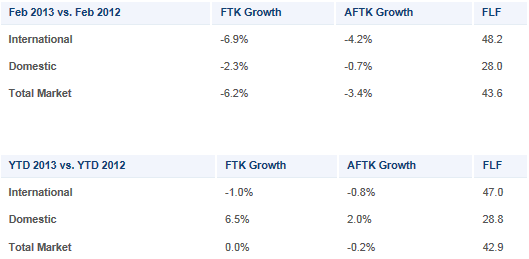
Regional performance
Regional performance was highly skewed by Chinese New Year and the 2012 Leap Year.
Asia-Pacific carriers saw a 14.7% fall in freight traffic compared to February 2012. This is almost entirely owing to impact of factory closures during the Chinese New Year holiday. Chinese business confidence levels are increasing and are being supported by rising employment and trade activity.
North American freight demand declined 3.1% and capacity was down 4.2%. There was a strong month-on-month increase of 1.6%, which particularly reflects robust domestic demand.
Europe saw a 5.4% fall in air freight, as Eurozone weakness persisted. European carriers reduced capacity by just 3.0%.
Middle East airlines recorded strong growth again, with 12.3% year-on-year, and 0.8% month-on-month. Airlines in the region continue to benefit from increased trade activity with emerging economies in Asia and Africa.
Latin America and African carriers saw air freight demand rise by 2.9% and 2.0% respectively. Africa’s growth is underpinned by expanding national economies, while Latin America remains very volatile due to seasonal factors. Carnival in Brazil would have had a dampening effect on demand, but to a much less extent than Chinese New Year. Overall, after adjusting for seasonal factors Latin America declined by 0.2% on international freight markets in February compared to January.
Modal Shift Reinforces Need to Boost Air Cargo Competitiveness
International economic indicators are suggesting that the global economy bottomed out in the third quarter of 2012. Industrial production and business confidence measures have been improving since then. “Demand for sea shipments already reflects the recovery in some parts of the world. But we are not yet seeing the positive impact of this in air cargo markets. While it remains to be seen if this is a long-term modal shift, it is clear that sea shipping is becoming a stronger competitor to air cargo,” said Tyler.
“The air cargo value chain is embracing the technological change needed to make e-Freight a reality. For example, we are targeting 100% e-Air Waybill (e-AWB) utilization by 2015, a major stepping stone to going paperless. This would boost to the competiveness of air cargo with more efficient processing and faster deliveries. More efficient connectivity in turn will foster economic growth. The industry is united in its efforts to modernize business practices. But we need governments, regulators and customs authorities on board too. The e-Freight system cannot happen while regulators insist on seeing paper copies of documents,” said Tyler.
A major step towards implementation of e-Freight was achieved in March with the endorsement by the Cargo Services Conference of the Multilateral e-AWB, which avoids the need for bilateral e-AWB agreements between airlines and freight forwarders. This new agreement will play a major role in increasing take-up of the e-AWB to reach the industry target of 100% utilization by 2015.
View full February air freight results (pdf)

 Chief Executive Officer
 CEO
CEO Chief Operating Officer
 Head of Operations, Safety and Emergency
 Chief Strategy Development Officer
 Head of Operations
 Airport General Manager
 CEO
CEO Chief Executive Officer