

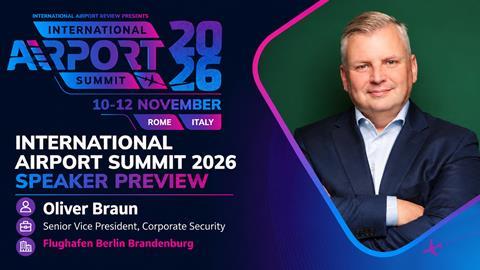
Oliver Braun, Senior Vice President Corporate Security at Flughafen Berlin Brandenburg (BER), an International Airport Summit 2026 Roundtable Co-chair, shares why he feels the industry’s greatest challenge is not technological adoption, but preserving the human judgement, expertise and resilience that underpin effective security operations.
I believe in the automated checkpoint, and I support its gains without reservation. This article turns to what is discussed far less than technology or regulation, the part automation quietly reshapes: the people who remain.
The scanner has changed, but the question underneath it has not
For years, the debate around security screening has been framed as a race towards throughput. Computed tomography (CT) for cabin baggage, artificial intelligence (AI)-assisted image analysis and automated tray-return lanes have genuinely moved that race forward. Detection is more consistent, passengers keep more in their bags, and the checkpoint feels less like an interrogation and more like a process. Under the European framework, defined by Regulation (EC) 300/2008, its implementing measures and the performance logic behind European Civil Aviation Conference (ECAC) Doc 30, these technologies are not gadgets. They are how we now meet the standard.
So I want to be clear at the outset: I am not a sceptic of automation. As an operator, I welcome it. But the honest conversation is not about whether the technology works. It is about what changes around it: operationally, financially and, above all, in our people.
The paradox of the disappearing buffer
Here is the point that vendor presentations rarely make. Every business case for automation contains a workforce assumption: fewer officers, or the same officers doing more. That assumption is reasonable. But it removes something we have relied on for decades without naming it: human compensation.
For as long as checkpoints have existed, people have quietly absorbed the failures of the system. Faced with a hesitant image, an ambiguous alarm or a lane that stalls at peak, a trained officer would step in, reroute, recover. That slack was invisible precisely because it always worked. As we automate and thin out staffing, we spend that slack. And once it is gone, it does not come back at the next incident.
The consequence is counter-intuitive but unavoidable: automation does not lower the quality demand on the technical process chain; it raises it. When there is no longer a person to catch the failure, the reliability of the equipment, the software and the integration between them has to approach a Six Sigma standard. We are asking machines to be not just good, but dependable to a degree we never demanded when a human was standing behind them. That is a governance question, not a procurement one, and it belongs on the board’s agenda, not only in the technical annexe.
The machine may resolve the image, but the officer still owns the decision.”
Resilience is a human property
There is a related truth that automation makes more, not less, important. Algorithms and machine learning are quality drivers that improve the average. But resilience is about the exception: the day the network degrades, the sensor drifts, the threat does not resemble the training data or two incidents arrive at once. In those moments, security does not need a better average. It needs someone who can troubleshoot, improvise within the rules and intervene.
This is why, at BER, I treat the capacity to intervene, our Interventionskraft, as a protected asset rather than a cost line. Under our ONE SECURITY approach, integrated across aviation security, the airport fire service and crisis management, the deciding principle is simple: the machine may resolve the image, but the officer still owns the decision. Final authority in an ambiguous or escalating situation stays human. Automation should widen the space in which that judgement operates, not quietly remove the judgement altogether.
The skill we are training away
There is a cost to automation that shows up slowly, and we are already seeing it today. When the system pre-selects, highlights and clears the routine, the officer loses daily contact with the image. Expertise in security screening is not knowledge you acquire once; it is a perishable skill, maintained by repetition and confrontation with real ambiguity. Take that repetition away and competence erodes, not through any failing of the individual, but as a predictable effect of the design.
The uncomfortable implication is that the very technology meant to support the officer can deskill them. If we are not deliberate, we end up with a workforce that is excellent at supervising a system on a good day and underprepared for the day the system needs them.
The answer is not to slow automation down. It is to design competence back in: structured continuing training, threat-image projection that keeps the eye current, deliberate rotation between automated and manual tasks, and clear currency requirements so that “qualified” means “recently practised”, not “certified once”. Maintaining professional expertise has to become an explicit line in the operating model, funded, scheduled and measured, rather than an assumption.
Trust cannot be automated
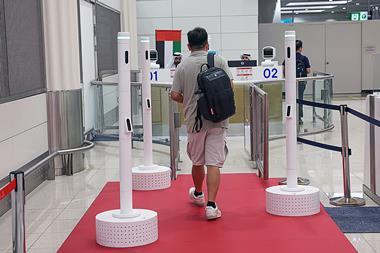
None of this works without the passenger. As screening becomes more automated and more biometric, we are asking travellers to place trust in a process they cannot see and increasingly cannot question at the lane. Human passenger versus automated decision is not only a technical distinction; it is a matter of confidence, civil liberties and the social licence to operate these systems at all.
That trust is earned operationally. It means explainability when a passenger is selected, dignity when they are searched, and staff who can bridge the gap across language barriers, changing rules and the entirely human habit of still unpacking the whole bag when the sign says you no longer need to. The officer who reassures a confused traveller is not a legacy cost to be optimised away. In an automated environment, that visible human presence is often the only thing standing between efficiency and alienation.
Technology should raise the ceiling of what our people can do, not lower the floor of what we can rely on when it fails.”
Managing the trade-offs honestly
For operators, the hard part is that these goals compete. Throughput key performance indicators (KPIs) pull against detection assurance. Service-level agreements pull against the time needed to keep skills current. And where screening is outsourced, we carry the additional duty of ensuring a contracted workforce delivers the same standard, and the same judgement, as our own. Automation does not dissolve these tensions. It sharpens them, because the margins are thinner and the consequences of a weak link travel further.
The leadership task
The temptation, faced with capable technology, is to let the business case write the workforce strategy. I would argue for the reverse. Decide first what human capability you must never lose: the ability to intervene, to decide, to reassure. Then let automation take everything around it. Technology should raise the ceiling of what our people can do, not lower the floor of what we can rely on when it fails.
Beyond the scanner, that is the real operation: not machines instead of people, but a security system in which sharper technology and sharper judgement are engineered to hold each other up.
I will be speaking about this topic in more depth during my roundtable discussions at the International Airport Summit.
I am leading a discussion on ‘Beyond the scanner: how CT, AI, and automation are changing the security operation’ on Day 1 and ‘The human factor: where judgment, experience, and trust still matter in an automated security operation’ on Day 2.
Make sure you register for the roundtable to hear our discussion first hand and network with us afterwards.
Register for your complimentary aviation leader ticket today.
*Complimentary aviation leader tickets are applicable to senior managers and above from airports, airlines, regulatory bodies and aviation authorities.




No comments yet