


Technology can boost security checkpoint capacity, but only as part of a wider transformation, writes Hamad AlZayani, Assistant Manager, Airport Security Operations & Training at Bahrain Airport Company.
Airports can unlock major checkpoint capacity through computed tomography (CT), automation and artificial intelligence, but only when technology, infrastructure, regulation and frontline operations are redesigned as one system, rather than treated as separate projects.
Throughput is a system outcome
For airports seeking to increase throughput per lane per hour, the instinct is often to focus on scanner or belt speed. That is only one part of the equation. Real throughput is determined by the slowest point in the end-to-end process: passenger preparation, divestment, tray availability, image review, secondary search, equipment recovery/reliability and lane design.
A computed tomography scanner placed into an unchanged conventional lane may simply move the queue downstream. The correct starting point is therefore a detailed operational baseline. Airports should measure trays and passengers per hour, divestment time, alarm and reject rates, secondary-search duration, lane downtime, staff interventions and passenger repacking time. Performance should also be assessed under peak-period conditions, rather than relying solely on results from a controlled test environment.
Designing around ageing terminals
Many existing terminals were not designed for the weight, heat output, power demand and maintenance requirements of modern CT systems. Installation can require structural assessment, upgraded electrical supply, additional cooling, new data connections, and modified fire and evacuation routes.
Lane design and geometry are equally important. CT and automated tray-return systems generally need more space than conventional equipment layouts. Where space is constrained, an airport may need to remove one lane to create fewer but more efficient lanes. The capacity case must therefore be based on total checkpoint throughput, not simply the number of machines installed.
Phased delivery and proper training reduce operational risk. A representative lane should first be installed and tested under real passenger conditions. The airport can then refine its layout, signage, passenger instructions, staffing and alarm-resolution procedures before converting the remaining lanes. This approach is slower on paper but often faster in practice because it prevents repeated redesign and provides on-the-job training opportunities for equipment operators.
The C3 lesson
Explosive Detection Systems for Cabin Baggage (EDSCB) meeting the C3 performance standard allow cabin baggage to be screened with laptops and liquids remaining inside the bag, subject to the applicable regulatory requirements and approved configuration. This can reduce divestment complexity; the number of trays required per passenger and potentially improve both security and passenger experience.
However, the European Commission’s announcement of 31 July 2024 demonstrated why airports should not treat equipment approval as permanent assurance that every system configuration will continue to meet all operational requirements. Effective 1 September 2024, the Commission temporarily reinstated the 100 ml maximum container size at affected EU airports using certain Explosive Detection Systems for Cabin Baggage. The Commission described this as a precautionary measure addressing a temporary technical issue, rather than a response to a new threat, and confirmed that it was working with Member States and the European Civil Aviation Conference (ECAC) to develop technical solutions.
The lesson is not that CT has failed. It is that advanced screening must be managed as a continuously evolving capability. Equipment configurations, software versions, detection algorithms and operating procedures must remain subject to testing, regulatory approval and controlled change.
Airports should therefore include contractual protections covering software and hardware upgrades, re-testing, regulatory changes, spare-parts price controls and performance remediation within the original equipment procurement. Approved equipment status should also be monitored throughout the system’s operational life.
Performance evaluations can be configuration-specific, while approval or certification for operational use remains the responsibility of the appropriate national aviation security authority. Airports should therefore monitor both the technical status of the equipment configuration and its continuing regulatory acceptance throughout its operational life.
Automation should streamline the process
Automated screening lanes and tray return systems can improve flow by circulating empty trays, separating cleared and rejected bags, and allowing several passengers to prepare simultaneously. Parallel loading, automated tray return and remote image processing can all contribute to a more efficient checkpoint.
Yet automation only produces value when the complete lane is balanced. Tray starvation, poorly positioned divestment stations, slow reject resolution or insufficient repacking space can create bottlenecks and congestion elsewhere in the process.
Airports should model the interaction between tray cycle time, passenger behaviour, scanner belt speed, image-decision time and secondary search. The target should be stable flow across the entire process, rather than brief periods of high throughput that create bottlenecks elsewhere.
Remote image review and multiplexing can provide further gains by directing images from several lanes to the next available qualified screener. This reduces the likelihood that a conveyor stops while one officer completes an image decision. It also creates opportunities to separate image-analysis rostering from physical lane staffing, although resilience, communications and fallback procedures must be designed from the outset.
Controlled AI implementation
Artificial Intelligence (AI) can assist image analysis, threat recognition, queue prediction, lane allocation and preventive maintenance. Its strongest early role is decision support: highlighting areas of interest, prioritising images, identifying abnormal process patterns or predicting where capacity may be lost.
Airports should be cautious about moving directly from AI-assisted decision-making to fully autonomous clearance. In a security-critical environment, the consequences of an incorrect decision can be significant, so any AI system must operate within a clearly defined assurance and governance framework. This should include validated performance standards, appropriate human oversight, robust cyber protection, complete audit trails and strict controls over how models are updated, retrained or reconfigured. Human operators should remain able to understand, challenge and override system recommendations where necessary, particularly in ambiguous or higher-risk cases. Airports and regulators also need clear accountability for decisions made with AI support, including visibility of the data, software version and system outputs that contributed to an outcome.
Equally important is change control. AI performance is not necessarily static: modifications to training data, detection thresholds, algorithms or software can alter how a system behaves in operation. A software update that changes detection behaviour should therefore be governed with the same discipline as a significant material equipment modification, including testing, validation, approval and documented assurance before deployment. This approach allows airports to benefit from AI while ensuring that improvements in automation do not weaken security, accountability or regulatory confidence.
ICAO has recognised both the potential and risks of AI in aviation security and has highlighted the need for standardised certification frameworks and AI-specific performance-evaluation methodologies. The ICAO aviation-security community has also established an AVSEC Panel Task Force on AI to develop implementation strategies for the technology.
The operating model should also distinguish between AI used for security decisions and AI used for resource optimisation. Queue forecasting and maintenance prediction may be introduced with lower regulatory risk, allowing airports to gain operational value while more demanding certification frameworks for security functions continue to mature.
People determine capacity
Technology changes frontline work; it does not remove the need for skilled and well-trained people. CT images are more information rich than conventional two-dimensional X-ray images. Officers therefore require structured initial training, supervised practice, recurrent assessment and protected time to maintain concentration.
Rostering should be designed around actual demand profiles and mental workload. Airports should define roles for passenger preparation, divestment support, image review, secondary search, tray management and technical response. Cross-training creates flexibility, but only when competency requirements remain clear.
Change management must start before installation. Frontline teams should participate in trials, layout reviews and procedure design. Their observations often identify issues that technical specifications miss. Staff who help design the process are also more likely to understand and support the resulting operating model.
Regulation that supports improvement
Regulators must remain independent and focused on security outcomes, but regulation should also recognise that checkpoint technology can evolve faster than traditional approval cycles. A realistic model combines firm security requirements with controlled operational flexibility.
This can include configuration-specific approvals, supervised trials, temporary operating permissions, defined performance thresholds and rapid review of validated software updates. Airports, regulators and manufacturers should maintain a joint evidence base covering detection performance, false alarms, operational reliability, cybersecurity, human factors and passenger impact.
The objective is not relaxed regulation. It is more responsive regulation, one that can intervene quickly when operational demands emerge, while also allowing proven improvements to be deployed without unnecessary delay and without compromising security in the process.
Continuous optimisation
The next-generation checkpoint is not a capital project with a fixed completion date. It is an operating system that must be measured and improved continuously.
To deliver a successful next-generation checkpoint tailored to the specific needs of an airport, a permanent checkpoint-performance function should be established, bringing together security, operations, engineering, IT, training, procurement, the screening contractor and the regulator. This cross-functional team should have clear responsibility for monitoring performance across the entire checkpoint process, identifying emerging constraints and coordinating continuous improvement. Daily operational data should be translated into practical weekly actions, with clearly assigned ownership, defined timelines and measurable outcomes.
CT, automated tray-return systems (ATRS) and AI can deliver substantial improvements in throughput, but technology alone will not produce them. Capacity is unlocked when the airport redesigns the whole process, prepares and trains its people, modernises its infrastructure and works with the regulator through validation rather than assumption.
The scanner is only the visible component. The operating model and well-trained workforce is what ultimately determines performance.
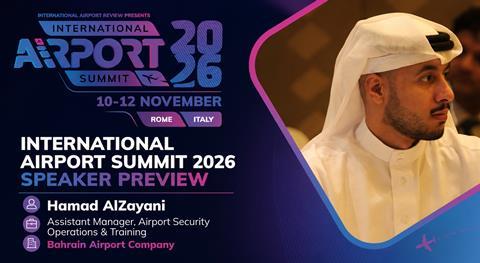
Hamad will be speaking on this very topic at the International Airport Summit 2026 taking place in Rome on 10-12 November.
Make sure you are in the room during his panel discussion ‘Delivering throughput with CT, automation and realistic regulatory models’ on 11 November, so you can hear Hamad’s insights first-hand and network with him afterwards.
Register for your FREE* VIP pass today.
*Free aviation leader tickets are applicable to senior managers and above from airports, airlines, regulatory bodies and aviation authorities.








No comments yet