

Emanuele Calà , Senior Vice President Transformation & Technology of Aeroporti di Roma argues that the next generation of airports will be defined by integrated, intelligent ecosystems that unify data, AI and human expertise to drive performance.
The next generation of airports will not be defined by individual technologies, but by their ability to orchestrate people, assets, data and decisions as one intelligent ecosystem, turning digital innovation into measurable operational, customer and business outcomes.
Beyond digital transformation
For more than a decade, airports have invested heavily in digital technologies. New operational systems, automation platforms, biometrics, mobile applications and data solutions have significantly improved efficiency and passenger services.
Yet many airports still face a common challenge: despite substantial investments, operations often remain fragmented. Information is distributed across multiple systems, decisions are taken in organisational silos, and technology frequently optimises individual processes rather than the airport ecosystem as a whole.
This is why the conversation must evolve beyond digital transformation. The challenge is no longer deploying technology. The challenge is creating an airport capable of continuously sensing, understanding and responding to operational conditions in real-time.
At Aeroporti di Roma, we believe the industry is entering a new phase: the transition from the “smart airport” to the “intelligent airport” – an airport where artificial intelligence (AI), connected data, automation and human expertise work together to create a living operational system, capable of anticipating events and continuously optimising performance. At the heart of this evolution stays the human being: it is people who govern complexity, interpret ambiguity and give direction to technology. AI does not diminish this role – it amplifies it, becoming ever more natural and effortless to interact with, even as the intelligence working beneath the surface grows increasingly sophisticated. The simpler the experience, the more powerful the capability it places in human hands.
Intelligence starts with integration
The aviation industry has historically built technology around functional domains: airport operations, infrastructure, security, commercial activities, passenger services and corporate functions. While this approach enabled specialisation, it also generated data fragmentation. The next competitive advantage will not come from adding more systems. It will come from connecting them.
Every flight, every passenger, every asset generates data that compounds over time into an advantage no late mover can simply purchase.
In our vision, the airport becomes a connected platform where operational, commercial and infrastructure information converge into a common decision-making environment that serves every phase of the operation – from long-term planning and capacity design, to real-time operations, to what-if scenario simulation that stress-tests decisions before they are taken, through to post-ops analysis that turns each day’s outcomes into learning for the next. At ADR, this is the rationale behind our investment in correlating data that integrates signals from new operational systems – from Outsight LiDAR sensors tracking real-time passenger flows and dwell times across the terminal, to Aeroficial Intelligence monitoring aircraft movements across the entire airfield, to a new IoT platform covering thermal, electrical and mechanical assets. The same integrated data foundation feeds all of these phases, so that insight generated in operations informs planning, and lessons from post-ops sharpen future scenarios. Every flight, every passenger, every asset generates data that compounds over time into an advantage no late mover can simply purchase.
The ability to combine information from multiple sources allows airports to move from reporting what has happened to predicting what is likely to happen next. This shift from descriptive to predictive operations represents one of the most significant transformations underway in aviation.
Ultimately, intelligence is not generated by algorithms alone. It emerges when data, processes and people become connected.
AI must move beyond experimentation
The aviation sector has entered a period of intense experimentation with AI. The challenge now is scaling AI from isolated use cases into core operational capabilities. At ADR, we view AI not as a standalone technology but as a capability embedded within operational processes.
Computer vision enhances airside visibility. Machine learning improves forecasting and resource allocation. Generative AI transforms how passengers interact with airport services. Advanced analytics anticipate disruptions and support operational decision-making. Yet the real value does not come from any individual application: it emerges when AI becomes part of the daily operating model, supporting frontline employees and decision makers with timely, contextual and actionable insights.
A concrete example is Assaia ApronAI, an AI-powered computer vision platform that leverages our existing CCTV infrastructure to monitor aircraft turnaround operations in real-time. It automatically detects every key turnaround event, predicts actual departure-ready time and flags safety hazards, offering valuable insights to our operators. The results are tangible: a six-minute reduction in average departure delay year-over-year and a 1-minute earlier loading bridge connection – figures that, at Fiumicino’s scale, compound into thousands of minutes of recovered capacity every day, with cascading benefits on passenger experience, gate utilisation, incremental revenue and safety.
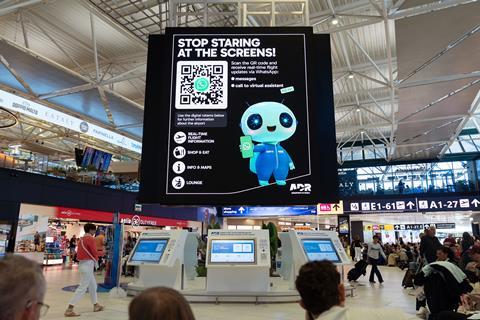
Another example is our Virtual Assistant, a GenAI-powered conversational platform to provide information to passengers available on WhatsApp, web and voice, handling over 100,000 conversations per month with a 4.6/5 passenger satisfaction rating. During the July 2025 weather disruption at Fiumicino, usage spiked +73% in a single day: passengers instinctively turned to the assistant as their primary source of real-time information, and the system absorbed the entire demand surge autonomously.
The future airport will not operate through fully autonomous systems replacing people. It will rely on augmented intelligence, where technology enhances human expertise. In this model, technology becomes a teammate rather than a tool.
Building the airport’s digital nervous system
As airports become increasingly complex, resilience becomes a strategic capability. Passenger growth, climate-related disruptions, operational volatility and stakeholder interdependencies require airports to react faster than ever before.
To address this challenge, airports must develop what can be described as a digital nervous system. Just as the human nervous system continuously collects signals, interprets conditions and co-ordinates actions, the intelligent airport must continuously monitor its environment, identify emerging patterns and support coordinated responses across multiple actors.
The ability to combine information from multiple sources allows airports to move from reporting what has happened to predicting what is likely to happen next. This shift from descriptive to predictive operations represents one of the most significant transformations underway in aviation.
This is precisely the ambition behind our transformation programmes for airport processes: rather than layering an AI dashboard on top of existing ways of working, we are rethinking how the airport operates from the ground up – mapping every operational flow, identifying where predictive decision-making can replace reactive monitoring, and re-engineering the operating model end-to-end. The goal is not to digitise processes as they are, but to redesign them around data and intelligence, so that each function evolves from executing tasks to anticipating needs. This is where technologies such as AI, digital twins, connected operational platforms and advanced analytics become strategic enablers rather than isolated innovation initiatives.
The objective is simple but ambitious: enabling the airport ecosystem to act as one co-ordinated organisation, even when involving dozens of stakeholders with different priorities.
A human-centred vision
Despite rapid technological progress, one principle remains fundamental: airports are human systems. Passengers experience journeys, not algorithms. Airlines benefit from smoother operations, not data platforms. Employees need better support, not more technology.
The future intelligent airport will not be measured by the sophistication of its technology stack, but by its ability to improve operational performance, elevate passenger experience, empower employees and create sustainable growth.
The airports that succeed will not be those that deploy the most technology. They will be those that most effectively integrate technology, data and human expertise into a single intelligent ecosystem. That journey, in many ways, is only just beginning.
This article appeared in International Airport Review’s Smart Airports eReport published in September 2026. To read the full report featuring articles from Bordeaux, Vancouver, Quito and Denver international airports, click here.






No comments yet