


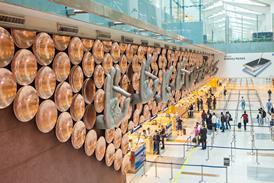

As demand for air travel soars, and our skies are busier than ever, will the cutting-edge world of quantum computing provide a new avenue for optimisation? Quantum researcher Amy Leete explores how this new technology is already showing promise – and could fast overtake AI in tackling increasingly complex aviation challenges.

There’s no doubt about it: demand for air travel is remarkably resilient, with many airports seeing record numbers of passengers. Whilst Europe remains the world’s top tourist destination, it is also home to half of the world’s most congested airports, according to ACI EUROPE – a challenge growing in size and severity, with geopolitical tensions, adverse weather, and air traffic control capacity shortfalls also limiting overall airspace capacity, often unexpectedly.
Artificial intelligence (AI) has long been considered a potential avenue of optimisation and delay reduction for air traffic flow management (ATFM), with the objective being to quicken safe decision-making through higher levels of streamlining and automation, allowing human operators to focus on safety-critical tasks. Yet while AI technology is improving leaps and bounds, the complexity of optimising airspace grows with it: and as demand grows, so does the overall size of the problem. This has led many researchers to question not only whether AI can produce an answer to complex problems, but whether it can do so fast enough to be tactically useful in real operations.
Quantum: the next leap for aviation?
Where does quantum fit into this? While the word is certainly growing in innovation spheres, most presume it is a concept of science fiction – and still light years away from affecting our lives. This is far from the truth, but perhaps a good place to start is how quantum computing works.
Whilst classical computers – the kind readers are likely to be on right now – work through binary code (millions of tiny switches blinking on and off, in a series of 1s and 0s, to create electrical pulses that power our world today), quantum computers differ. A quantum computer, in the simplest terms, uses quantum bits – or qubits – that are capable of existing as a combination of both states at the same time. This strange property is known as superposition, and it is what sets classical and quantum computers apart. It also makes them significantly more powerful.
The quantum advantage: a different way of solving the problem
That state of superposition allows quantum computers to represent and process many possible solutions simultaneously, rather than examining each individually. Modern classical computers are incredibly powerful, but as problems – such as ATFM – become larger and more complex, the number of possible solutions grows exponentially too. It is that growth that pushes even the most advanced systems to their limits, leading many industries and organisations to seek out-of-the-box solutions.
This has led to what is known as the ‘quantum race’ – with technology giants, governments, and organisations investing billions in the pursuit of ever more powerful quantum computers. Whilst these machines do remain in their infancy, this investment is already showing significant potential in a variety of industries. D-Wave’s latest quantum annealer, the Advantage2 system, is already in use in real operations: from reducing vehicle dispatching time for North Wales Police from four months to four minutes, to reducing the distance travelled on Mitsubishi Estate Co.’s waste collection routes in Japan from 2,300km to 1,000km.
In my own research, I set out to solve one of aviation’s most persistent challenges: air traffic delay
Clearly, complex optimisation challenges – and particularly transport – are where quantum optimisation can already shine. But what about aviation?
Taking quantum from theory to the flight deck
In my own research, I set out to solve one of aviation’s most persistent challenges: air traffic delay. Every day, air traffic controllers, airports and airlines must balance thousands of flights against a limited geographical airspace, potentially made smaller at any time by weather disruptions, staffing constraints and military restrictions. Finding a balance between that capacity and reducing delay is a giant, and hugely complex, optimisation problem – the kind that D-Wave’s quantum computer is built for. I sought to thoroughly explore whether, today, quantum holds potential for aviation – and if it already outperforms similar AI solutions.
I decided to utilise D-Wave’s Advantage2 hybrid system, and benchmark it to a popular AI algorithm already established within aviation research – simulated annealing. I gave both the quantum and AI algorithms the exact same problem to solve.
Using real flight data gathered from the OpenSky Network over the London flight information region, I built a realistic dataset containing 4.5 hours of busy summer airspace: 2,325 aircraft and more than 96,000 individual recordings of those aircraft locations and times. I reconstructed each aircraft’s trajectory and divided the airspace into a grid of representative sectors, each with a defined capacity.
The optimisation challenge was straightforward in principle, but difficult in practice: how can delays be distributed across flights to keep aircraft moving efficiently, whilst ensuring that no sector becomes overloaded? I allowed the algorithm one variable: each flight could be assigned an additional departure delay of 0, 5 or 10 minutes, with the model balancing the total delay against breaches of sector capacity. For me, a holistic approach was imperative – a fast solution, yet unsafe, is no solution at all. Assigning sector capacity parameters would give a clear signal as to whether both the AI and quantum algorithm could reflect the complex, yet safety-first, operational approach aviation prioritises.
That was also my reasoning behind introducing three scenarios: normal operations, reduced capacity around London Heathrow Airport (LHR), and a complete closure of the same area, representing disruption such as severe weather or restricted airspace. Just as with the safety parameters, I wanted to test each algorithm’s ability to react to sudden and unexpected delays – knowing that this would be the true indicator of its potential to optimise real ATFM scenarios. I compared not only the quality of the solutions – measuring delay and sector overload – but also how quickly each algorithm could find them. This distinction is crucial for aviation: an optimisation solution is only useful operationally if it can be produced quickly enough to support decision-making.
Fast and furious
The results were striking. Both the AI algorithm and the quantum annealer could find the same optimal solution, reducing delays whilst avoiding sector overload more than 98% of the time. This alone is an encouraging result, demonstrating that quantum-optimised algorithms can pull their weight when it comes to classical computer counterparts.
Quantum was at the finish line before the AI heard the starting shot
But the real difference emerged when looking at time. The classical AI algorithm consistently reached the project’s 10-minute runtime limit without fully completing its search process. While it found the best answer, it never did so the required number of times – no matter how many times I ran the algorithm. D-Wave’s hybrid quantum annealer did so – in four seconds. Quantum was at the finish line before the AI heard the starting shot. Having offered both computers a smaller test dataset to see just how slow they become as the problem increases in size, the difference became more evident. By looking at the scaling behaviour of both systems, it’s possible to see how both would operate in practice. Europe’s airspace routinely handles around 30,000 flights on a busy summer day. The AI algorithm would require more than 35 hours at its current rate to solve that many flights – whereas the quantum approach would need less than 10 seconds. Whilst such projections should be treated with caution, and as estimates rather than observed results, such research hints at where quantum annealing’s greatest value may lie in time saved. Quantum might offer aviation the power of AI optimisation – at a speed that can keep up operationally.
Ready for take-off – with turbulence ahead?
These great results come with a caveat. Quantum research is scarce, largely due to how novel this technology is – the Advantage2 System was released only a few months before this research began. But if this new, yet ground-breaking, research is anything to go by, the future looks bright for quantum in aviation.







No comments yet