


Airport leaders from Quito and Dubai share practical lessons on scaling digital innovation, integrating airport systems and turning technologies such as AI, biometrics and digital twins into operational benefits.
Airports are moving beyond technology trials to focus on how artificial intelligence (AI), biometrics and connected data systems can deliver measurable improvements to everyday operations. But turning digital ambition into reality requires more than deploying new technology. It demands collaboration across the airport ecosystem, robust data foundations and a clear focus on resilience, cyber-security and passenger trust.
That was the central message of International Airport Review’s webinar, Smart Airports: turning digital transformation into operational reality, which brought together Santiago Andrade, IT and Telecoms Director, Quito International Airport; Ersin Iankul, Senior Vice President – Business Technology, Dubai Airports; and Gaurav Gupta, Senior Vice President, Global Head of Sales, Travel & Transport, IDEMIA Public Security.
The panel explored what it means to be a smart airport in 2026 and beyond, sharing practical lessons on scaling technology, integrating airport systems, implementing biometrics and managing the risks of an increasingly connected operation.
The smart airport is about outcomes, not technology
For the panellists, the definition of a smart airport is changing. Rather than measuring progress by the number of technologies deployed, airports should focus on how effectively those technologies work together to improve operational performance and the passenger experience.
Gaurav argued that the smartest airports will be those where passengers barely notice the technology because their journey simply works. Achieving this requires airports, airlines, ground handlers, security teams and border authorities to share trusted information, anticipate disruption and co-ordinate decisions in real time.
Santiago compared a smart airport to an audio equaliser, with each slider representing a different airport touchpoint, from parking and check-in to security, immigration, retail and airside operations. Changing one element affects the others, meaning airports need to understand and manage the wider operational picture rather than optimise individual processes in isolation.
Ersin highlighted the growing role of AI in this connected environment. While automation has been a focus for years, AI is increasingly influencing how airports work, make decisions and develop their operating models. Real-time information, AI-enabled decision making and digital twins can help airports create a more seamless journey from home to gate.
The common thread was clear: digital transformation should make airport operations more co-ordinated, responsive and predictable, with technology supporting people rather than adding complexity.
Moving beyond pilots to measurable operational value
One of the biggest challenges facing airports is deciding when a promising proof-of-concept is ready to become part of live operations.
Santiago emphasised that pilots are valuable because they allow airports to test solutions in context, understand the requirements of different stakeholders and build a stronger business case before committing to wider implementation. However, a successful demonstration does not automatically translate into a successful operational deployment.
He outlined four practical considerations for moving into production: positive technical and operational test results, ownership by the teams who will use the technology, the ability for airport staff to operate the solution without constant vendor support, and evidence that it addresses a genuine operational problem or delivers a tangible benefit.
Ersin reinforced the importance of defining those benefits at the beginning of a project. At Dubai Airports, pilot projects involve engagement with business units and stakeholders to establish use cases, validate expected returns and understand what data the solution will produce. This is particularly important in a high-volume environment, where introducing an unproven technology can have wider operational consequences.
Gaurav made a further distinction between proving that a technology works and proving that the operating model around it can work at scale. A pilot may involve a limited number of passengers, selected airlines and dedicated support teams. A full deployment must accommodate different passenger profiles, multiple airline systems, legacy infrastructure, operational peaks and disruption.
As a result, airports should measure pilots against outcomes such as reduced processing times, improved throughput, simpler passenger journeys and more efficient use of infrastructure. The most valuable technologies are not necessarily those that look most impressive in a demonstration, but those that deliver consistent, measurable results in daily operations.
Collaboration is essential to unlocking the benefits of integration
The discussion also highlighted how digital transformation can generate benefits beyond the process a technology was originally designed to improve.
Santiago shared Quito International Airport’s experience of implementing biometric boarding for flights to the United States in partnership with IDEMIA. He explained that the main challenge was not the biometric technology itself, but co-ordinating the requirements of government agencies, airlines and passengers.
By addressing these wider processes, the airport reduced boarding time by an average of 15 minutes, according to Santiago. The additional time passengers spent inside the terminal also created opportunities for retail, food and beverage outlets and VIP lounges.
The example illustrated why airports should assess technology in the context of the wider passenger journey and commercial operation. Improvements to one touchpoint can create benefits elsewhere, provided the relevant systems and stakeholders are connected effectively.
Dubai Airports is applying a similar principle through its digital twin initiative. Ersin described work involving seven or eight stakeholders over approximately nine to 10 months, with more than 50 use cases identified alongside police, customs, immigration and other partners.
The ambition is to use real-time data, sensors and cameras to support what-if scenarios and move towards a total airport management approach. Rather than functioning solely as a visualisation dashboard, the platform is intended to help improve on-time arrivals and departures and integrate information across the operation.
Both examples underline that successful digital transformation is as much about organisational alignment and shared objectives as it is about technology.
Designing for resilience in an increasingly connected airport
Greater connectivity creates opportunities for efficiency, but it also introduces dependencies that can make airport operations more vulnerable when a system fails.
Santiago warned that the distinction between physical security and cyber-security is becoming increasingly blurred as systems supporting boarding, baggage handling, air conditioning and access control become connected to IP networks. Airports bring together numerous organisations, suppliers and technologies, each with different standards, budgets and levels of cyber-security maturity.
This makes resilience an industry-wide responsibility rather than an issue that an airport operator can solve alone.
Ersin highlighted two priorities as AI becomes more widely available across airport teams: governance and cyber-security. Giving employees the ability to use AI tools, develop applications and generate reports can improve productivity, but airports also need to establish how data is governed, how tools are used consistently and how intellectual property and systems are protected.
Gaurav advised airports against connecting systems simply for the sake of connectivity. Instead, integration should be driven by a specific operational or passenger outcome, with open standards, application programming interfaces (APIs) and modular architectures allowing individual components to evolve without creating unnecessary dependencies.
The panellists also stressed the importance of planning for exceptions and failure from the outset. If a system becomes unavailable, the wider operation must be able to continue. That means establishing clear fallback processes, maintaining operational ownership and ensuring that airport teams know how to respond when technology does not work as intended.
Santiago added that cyber-security should be considered throughout the technology lifecycle, from procurement and contract design to the end of a supplier relationship. Cyber incidents should also feature in airport emergency planning, reinforcing that cyber-security is an operational issue, not simply an IT responsibility.
The message was that a smart airport must also be a resilient airport. Connectivity delivers lasting value only when the wider operation can withstand disruption.
Biometrics: making the journey seamless without compromising trust
Biometrics offers airports a way to reduce friction across passenger processing, but scaling the technology requires careful attention to interoperability, exception handling and passenger confidence.
Gaurav explained that biometric systems can perform well in a controlled pilot but encounter additional challenges when deployed across multiple airlines, departure control systems and passenger groups. Airports need to plan for situations where a passenger cannot complete a biometric journey or where a connected system becomes temporarily unavailable.
Clear alternative processes, operational monitoring and collaboration between airports, airlines and government agencies are therefore essential.
Trust is equally important. Gaurav stressed that making technology invisible to passengers must not mean making the use of their personal information opaque. Passengers should understand what they are consenting to, how their identity is used and stored, and how information is shared. Privacy, security and data protection should be built into the system from the beginning, alongside alternatives for passengers who cannot or do not wish to use biometric processing.
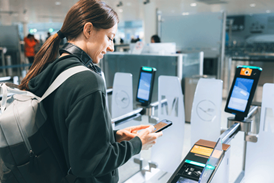
Dubai Airports provided a practical example through its red carpet biometric corridor. Ersin explained that the project began as a proof-of-concept on selected flights and was designed to allow eligible passengers to walk through a corridor without stopping to present documents. The process takes approximately three to four seconds, with the airport planning to expand the approach as the trial develops.
He emphasised that the project depends on collaboration and data-sharing between stakeholders, rather than cameras and algorithms alone. The same approach is also informing other initiatives involving digital twins and AI.
At Quito International Airport, Santiago reported that biometric processing had reduced the passenger process from two minutes and 10 seconds to 45 seconds. However, he also highlighted legal and regulatory restrictions that can limit expansion across international routes, as well as the importance of clean, consistent passenger data.
These examples demonstrate that biometric technology can improve passenger flow, but its success depends on much more than speed. Reliable data, clear governance, regulatory compliance and visible transparency are fundamental to building a trusted experience.
Building the foundations for the next phase of AI
Looking ahead, the panel discussed how AI could support both operational decision making and more personalised passenger services.
Ersin described opportunities to use AI for forecasting, resource allocation and operational optimisation, including predicting aircraft arrival and departure timings. AI could also help guide passengers through the airport, providing relevant information and assistance at different stages of their journey.
However, these applications depend on a strong data foundation. Dubai Airports has been working to bring together data from more than 40 to 50 systems, supporting hundreds of digital services and creating opportunities to improve the passenger experience across physical and digital touchpoints.
The panellists agreed that airports must establish clear rules around data quality, ownership, access and use before expecting AI to deliver its full potential. Legal obligations and data protection requirements also need to be considered early, particularly when biometric information is involved.
Ultimately, AI should support better decisions and more intuitive journeys, while leaving airport teams equipped to intervene when necessary. The objective is not to automate every interaction, but to reduce friction and complexity while maintaining the human support passengers need when something goes wrong.
Turning digital ambition into operational reality
The discussion returned to a central principle: digital transformation is not a collection of individual technology projects. It is the process of building a connected airport ecosystem that can share information, co-ordinate decisions and deliver measurable benefits without compromising resilience or trust.
For airport leaders, this means starting with clearly defined operational challenges, involving end users and partners from the outset, and assessing technologies against outcomes rather than their novelty. It also means designing systems that can work together without becoming unnecessarily dependent on one another, while embedding cyber-security, data governance and passenger transparency into every stage of implementation.
As airports continue to explore AI, biometrics and digital twins, the strongest results will come from aligning technology with the people, processes and partnerships that make the airport work.
Want to explore these challenges in more detail? Watch the webinar on demand to hear Santiago Andrade, Ersin Iankul, and Gaurav Gupta discuss their experiences and practical lessons for turning digital transformation into operational reality.





No comments yet