



As digital ambitions accelerate, leaders at the International Airport Summit shared why trust, governance and collaboration must sit at the heart of airport data strategies.
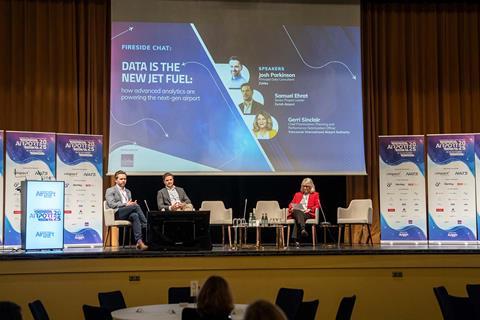
As airports accelerate their digital ambitions, data is increasingly positioned as the strategic asset that will unlock efficiency, resilience and better passenger experiences. Yet despite years of investment, many organisations still struggle to translate growing volumes of information into meaningful operational outcomes. That tension sat at the heart of ‘Data is the new jet fuel: how advanced analytics are powering the next-gen airport’, a fireside chat held as part of the International Airport Summit 2025 in Berlin, which brought together senior airport leaders and data specialists to challenge prevailing assumptions about how value is really created from data.
Moderated by Gerri Sinclair, Chief Prioritisation, Planning and Performance Optimisation Officer at Vancouver International Airport Authority, the panel featured Josh Parkinson, Principal Data Consultant at Zuhlke, and Samuel Ehrat, Senior Project Leader at Zurich Airport. Together, they explored why airports continue to talk about data as transformational, while often failing to embed it effectively into everyday operations.
Is data really the ‘new jet fuel’?
Sinclair opened by questioning whether the session title itself was misleading. Data, she argued, is not new to aviation. Airports and airlines have relied on financial, operational and flight data for decades. What has changed is the ability to connect data across systems and organisations, and to derive insight quickly enough to influence decisions.
If the data isn’t reliable, if the context is missing, how can AI work on top of that?”
She also challenged the popular analogy of data as jet fuel. Unlike fuel, which is consumed and gone, data grows in value when it is reused, combined and governed properly. Framing data as something to be burned through risks encouraging short-term thinking rather than long-term capability building.
Parkinson agreed, warning that the industry often becomes distracted by whatever “new X” data is compared to, whether oil, fuel or currency. In his view, this creates a fear of missing out that drives technology-led initiatives ahead of foundational work.
“There’s a tendency to chase the new thing,” he said. “But the core problems haven’t changed in a thousand years. What does the data mean, and can I trust it when I didn’t create it myself?”

Samuel Ehrat speaking at International Airport Summit in Berlin. Credit: IAR[/caption]
Trust, context and the long tail of fundamentals
To underline that point, Parkinson drew an unexpected parallel with the Domesday Book of 1086. Commissioned to catalogue land and assets across England, it faced challenges that remain familiar today, namely inconsistent definitions, unreliable sources and long delays in data collection. Despite centuries of technological progress, organisations still struggle with the same historical underlying issues.
For Ehrat, those challenges are very real inside airport organisations. While dashboards and visualisations are easy to showcase, the harder work lies in data governance, ownership and shared understanding.
“It’s difficult to explain to senior leadership why you need to spend money on fundamentals,” he said. “But without those, the shiny dashboards don’t really deliver value.”
Ehrat offered an alternative interpretation of the jet fuel metaphor. Fuel alone achieves nothing without an aircraft. In the same way, data requires a complex supporting environment of processes, systems and people before it can generate value.
AI ambition versus data reality
The conversation inevitably turned to artificial intelligence (AI). Sinclair cited a recent study suggesting that most enterprise AI projects fail to deliver meaningful value. The panel was clear on why.
“If the data isn’t reliable, if the context is missing, how can AI work on top of that?” Sinclair asked.
An organisation that doesn’t control its metadata can’t control its data.”
Parkinson described the current moment as a hype cycle, where the temptation is to label every initiative as AI-driven. In practice, many use cases simply make data accessible to people who previously could not see it.
“The insight comes from availability,” he said. “Not because AI was present.”
That is not to dismiss AI’s role entirely. Parkinson acknowledged its strengths in optimisation and classification, particularly in operational contexts. However, he stressed the importance of honesty at the use case selection stage. Overselling AI risks eroding trust within the business and undermining future investment.
From dashboards to decisions
When asked how airports can move from static dashboards to genuinely actionable insight, Ehrat pointed to the importance of understanding end-to-end processes and sharing data across stakeholders.
At Zurich Airport, boarding pass scanner data is combined with predictive models to forecast passenger volumes at security three to six hours in advance. This information is shared with airport operations, police, airlines and ground handlers, enabling proactive staff allocation and improved throughput.

Gerri Sinclair speaking at IAS. Credit: IAR[/caption]
“The police can change their breaks, dispatchers can shift resources,” Ehrat explained. “It’s about common situational awareness.”
Crucially, this data is not restricted to a single function. Airlines can see where their passengers are in the journey, while security benefits from improved planning. In return, Zurich’s home carrier now shares booking data to improve model accuracy, creating a feedback loop where all parties benefit.
Sharing data without sharing risk
As data sharing expands, so too does concern about security and compliance. Parkinson argued that metadata is the missing piece in many airport data strategies.
“An organisation that doesn’t control its metadata can’t control its data,” he said.
Clear classification, ownership and role-based access are essential when multiple stakeholders and systems are involved. Rather than treating data as an amorphous asset managed by IT, the panel advocated for explicit business ownership, with named data owners responsible for access decisions.
Ehrat added that Zurich deliberately separates operational decision systems from situational awareness platforms, reducing risk while maintaining transparency. Trust, he noted, is built when data owners understand who can access their data and why.
Who owns the data?
The session closed with a question that rarely has a simple answer in airports: who owns the data? Airlines, airports, ground handlers and passengers all generate and depend on information, often about the same entities.
Parkinson suggested that airports must accept the complexity of shared ownership and focus on building master data frameworks that synthesise inputs from multiple sources. Without that, organisations remain trapped negotiating access on a case-by-case basis.
Ehrat was pragmatic. Building awareness of data governance takes time, but progress is possible when managers accept that ownership also means enabling others to create value.
The panel left a clear message behind. Data may be the fuel everyone is talking about, but it is trust, governance and operational focus that ultimately determine whether airports can take off.