


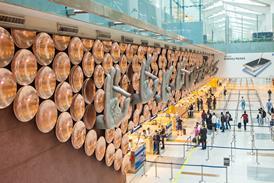
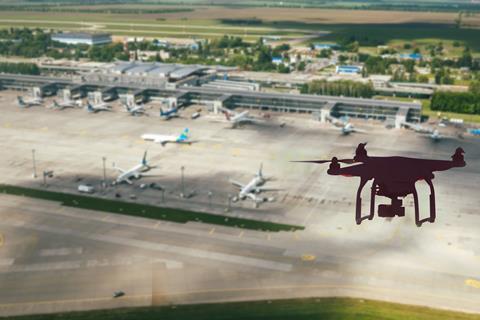
Airports face escalating drone threats that outpace regulation and technology, forcing urgent investment in detection, coordination and strategy to prevent costly disruption and safeguard operational resilience.
Airports across Europe are confronting a rapidly shifting threat landscape, where drones have evolved from a nuisance into a credible and complex security risk. What was once the domain of hobbyists having, in a matter of months, become entangled with geopolitical tension, technological acceleration and regulatory ambiguity. For transport decision-makers, the question is no longer whether to act, but how quickly systems, governance and investment can catch up with the threat.
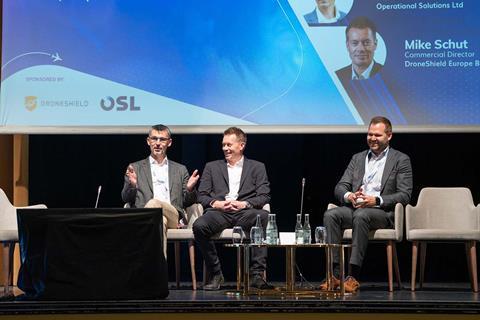
Speaking during a closing panel at the International Airport Summit in Berlin, security leaders and technology providers outlined a stark reality. The pace of drone innovation is outstripping both airport preparedness and regulatory clarity, leaving operators exposed to operational disruption, financial loss and reputational damage.
Oliver Braun, Head of Security at Berlin Brandenburg International Airport, set the tone with a candid reflection on recent challenges. “We have seen breaches by climate activists, cyber-attacks, even drone incidents. But the one threat keeping me awake is unmanned aerial systems. Our adversary is fast, agile and dynamic, and we are not keeping pace.”
A fundamental shift in the threat profile
The nature of drone incursions has changed dramatically. According to Dominic Walker, Director of Business Development at Operational Solutions Ltd, the industry has moved beyond accidental misuse.
“When we started, the threat was typically a teenager with a quadcopter trying to take a photo,” he explained. “That was still a safety issue, but it was manageable. Now we are dealing with something entirely different. The drones are larger, often operating silently, and the potential actor could be anything up to a state-level operator.”
This shift has profound implications. Traditional detection systems, designed to identify commercially available drones using radio frequency signals, are increasingly ineffective against newer platforms. Silent drones, autonomous navigation and non-standard control methods mean that legacy systems can fail to detect incursions entirely.
Walker summarised the challenge clearly: “This is not an incremental change. It is a fundamental shift in risk, and it requires a fundamental shift in response.”
Who is responsible at what moment? When a drone moves from civilian space into airport airspace, does responsibility shift to the airport, the police or the military? That is still unclear.”
Operational reality: disruption without certainty
For airports, the immediate consequence of drone activity is operational disruption. Yet one of the most pressing challenges is uncertainty. Without reliable detection, decision-making becomes reactive and risk-averse.
Koen De Cleyn of Brussels Airport Company provided a recent example. “We had to suspend arrivals and departures because there was a drone reported near the airport. But our system did not detect anything,” he said. “We relied on visual confirmation from security teams to verify it was real.”
The incident escalated over several days, with repeated sightings causing intermittent shutdowns. “You are caught between two risks,” De Cleyn added. “Do you continue operations and risk safety, or do you suspend traffic based on uncertain information? Without detection, you are effectively blind.”
The financial implications are significant. A single evening of disruption at Brussels Airport was estimated to cost around €2 million. Beyond the direct economic impact, there are cascading effects on passenger experience, airline operations and airport reputation.
Detection is only half the equation
A key theme emerging from the discussion was that detection alone is insufficient. Airports require high-confidence verification and the ability to confirm when airspace is clear.
Walker emphasised the importance of layered detection systems. “No single sensor will solve this. Radio frequency detection, radar and cameras all have strengths and weaknesses. You need to combine them to achieve high confidence.”
He continued: “Detection is important, but so is knowing when the drone is gone. That is what allows you to reopen safely and minimise disruption.”
This layered approach introduces complexity and cost, but it is increasingly viewed as essential. Airports must also consider how these systems integrate into existing operational environments, particularly within Airport Operations Centres.
Integration without overload
Modern airport operations rely on data-rich environments, but there is a risk of overwhelming operators with excessive or unreliable information.
De Cleyn highlighted the importance of usability. “Keep it simple. If operators receive too many false alarms, they will ignore the system. You need the right information, at the right time, for the right people.”
This requirement extends beyond technology into organisational design. Effective response depends on seamless coordination between air traffic control, airport security, police and potentially military stakeholders.
“In our case, we had crisis calls every 30 minutes,” De Cleyn said. “You need multi-stakeholder coordination that works instantly. You do not have time to figure out roles during an incident.”
Walker added that some airports are exploring managed detection services, where external experts filter data and provide only actionable intelligence. “You can keep the system highly sensitive, but only pass on what matters. That reduces the burden on airport teams.”
Perhaps the most unresolved issue is ownership. Who ultimately takes responsibility for drone defence at airports?”
The regulatory gap
While technology continues to advance, regulation remains fragmented, particularly across Europe. Questions around responsibility, jurisdiction and authority remain unresolved.
Mike Schut, Commercial Director at DroneShield Europe B.V., pointed to the core issue. “Who is responsible at what moment? When a drone moves from civilian space into airport airspace, does responsibility shift to the airport, the police or the military? That is still unclear.”
This ambiguity extends to countermeasures. While detection is broadly accepted as an airport responsibility, active intervention raises legal and safety concerns.
“Defeating a drone, even with non-lethal methods, is still the use of force,” Schut stated. “That typically sits with police or military, not airport operators.”
De Cleyn reinforced this point with a practical example. “We were offered military support to shoot drones out of the sky. But you cannot simply do that at an airport. There are aircraft, fuel infrastructure and people. The risk of intervention can be greater than the threat itself.”
Towards a layered defence strategy
The consensus among panellists was that airports need a comprehensive, layered approach that combines detection, verification and, where appropriate, response capabilities.
Schut outlined the importance of staying ahead of evolving threats. “You need to continuously update your understanding of drone technology. That includes classification, detection methods and intelligence gathering. It is not a static problem.”
Walker expanded on the concept of a portfolio approach. “You need multiple layers not just for detection, but also for response. Electronic countermeasures, cyber takeover and, in some environments, kinetic options all have a role.”
However, he acknowledged that many of these measures are not suitable for civil airports. “The challenge is adapting these capabilities to a civilian context without introducing new risks.”
Building the business case
One of the barriers to investment is demonstrating value in the absence of frequent incidents. Yet the financial impact of even a single disruption is forcing a rethink.
De Cleyn was direct: “When you can quantify the cost of disruption, the business case becomes clear. Millions of euros can be lost in a few hours. Investing upfront starts to make sense.”
Walker suggested that airports can maximise return by extending the use of detection systems. “These systems can also support bird detection, perimeter security and even the safe operation of authorised drones. It is about getting multiple benefits from a single investment.”
Ownership and leadership
Perhaps the most unresolved issue is ownership. Who ultimately takes responsibility for drone defence at airports?
Walker offered a pragmatic perspective. “There is no single answer. In some cases, airports take the lead because they bear the economic risk. In others, it is driven by air navigation service providers or the state.”
He added, “What we often see is that whoever feels the most pain takes action first.”
Schut agreed, noting that a hybrid model is likely. “Detection may sit with the airport, while intervention sits with national authorities. It requires collaboration.”
From reactive to proactive
The discussion made clear that airports can no longer afford to be reactive. The combination of evolving threats, regulatory uncertainty and operational impact demands a proactive approach.
Braun’s opening remarks captured the urgency. The threat is not hypothetical, and it is not static. It is evolving faster than traditional aviation security frameworks.
For transport decision-makers, the path forward involves difficult but necessary steps: investing in layered detection systems, strengthening multi-agency coordination, clarifying roles and responsibilities, and building a robust business case for resilience.
As De Cleyn concluded, reflecting on Brussels Airport’s recent experience: “We had plans, but we never thought we would need them. Now we know we do.”
The drone threat may be new in its current form, but the lesson is familiar. In aviation, readiness is not optional. It is fundamental.









No comments yet