

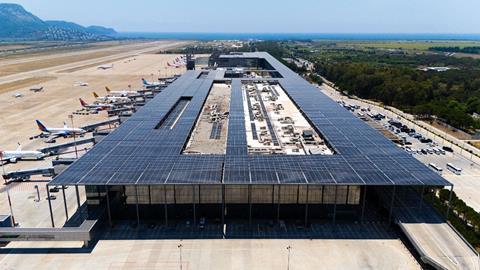

Yiğit Laçin, Chief Executive Officer of YDA Dalaman Airport, explains how 25,500 rooftop solar panels now meet all of the terminal’s annual electricity demand.
A strategic objective
The rooftop solar programme was developed to turn our sustainability commitments into a practical and measurable investment. Our aim was not only to increase the use of renewable energy, but also to reduce carbon emissions, improve long-term energy performance and make better use of an existing airport asset: the terminal roof.
This approach directly supports our vision of operating a safe, secure and sustainable airport while providing an innovation-driven, high-quality and stress-free passenger experience on the Turkish Riviera. It also shows that environmental responsibility and operational efficiency can progress together.
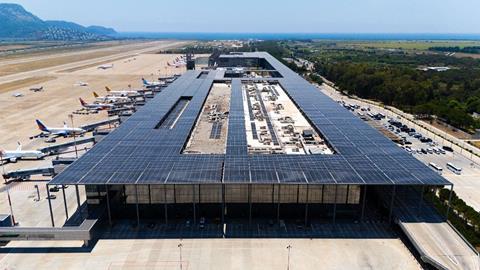
Using the roof rather than additional land was an important objective. Airports have complex land-use requirements, and available areas must support aviation operations, safety zones and future development. By installing the system on the terminal buildings, we were able to create a major renewable energy facility without increasing the airport’s physical footprint.
Reaching 100% terminal electricity
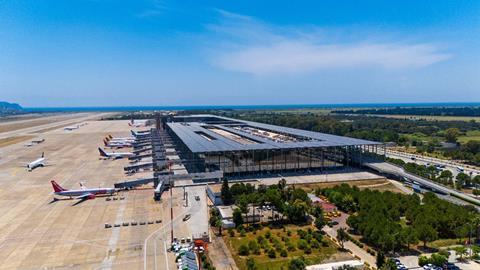
The programme was delivered in phases, allowing us to expand capacity while learning from operational data and technical experience. The completed installation has an installed capacity of 14.45MWp and includes 25,500 solar panels across around 74,000 square metres of terminal roof area.
The system is designed to generate more than 20,000MWh of electricity each year. On an annual basis, this is sufficient to meet 100% of the electricity demand of the terminal building.
Achieving this result required more than simply placing panels on available roof space. The project involved detailed engineering, production modelling and careful alignment between generation capacity and the terminal’s actual energy profile. Structural suitability, roof access, waterproofing, electrical integration, safe maintenance routes and the continuity of terminal operations all had to be considered.
Benefits beyond renewable generation
The most visible environmental benefit is the reduction in emissions. The programme prevents approximately 8,500 tonnes of CO2 emissions each year, an impact comparable to the annual carbon absorption of around 380,000 trees.
There are also clear operational benefits. On-site generation reduces the airport’s exposure to energy price volatility and lowers its reliance on externally supplied electricity. It provides a more predictable foundation for long-term energy planning and makes energy performance a more visible part of airport management.
The rooftop model also avoids the environmental and planning impacts that can arise from using additional land. This is especially important in airport environments, where land has operational, ecological and development value.
Improving terminal efficiency
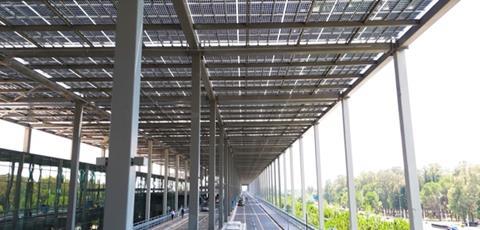
The panels contribute to energy efficiency as well as electricity generation. By covering a large part of the terminal roof, they create a shading effect that reduces direct solar heat gain on the building.
This is particularly valuable at Dalaman, where high summer temperatures and strong solar exposure increase cooling demand during the busiest months of the year. The additional shade provided by the solar installation helps reduce the heat load on the terminal and supports an estimated reduction of around 10% in cooling-related energy demand.
This combined benefit was central to the project. The roof is not only producing clean electricity; it is also helping the building use less energy. It demonstrates why renewable energy projects should be assessed as part of the overall building and operational system, rather than as stand-alone installations.
The roof is not only producing clean electricity; it is also helping the building use less energy.”
Working within a live airport
Integrating a large solar installation into an operational airport terminal required careful planning. The terminal had to remain fully functional throughout the project, with no compromise to passenger safety, service continuity or aviation security.
Construction activities therefore had to be phased and coordinated around airport operations. Access to roof areas, the movement of materials, electrical works and contractor activities were managed through detailed planning and close cooperation between technical, operational, safety and security teams.
Another important challenge was integrating the new system into the existing terminal structure and electrical network. Airports operate continuously and depend on stable power for critical systems. Installation and connection works therefore required controlled implementation, testing and coordination to avoid disruption.
Maintenance was also considered from the design stage. Safe access, inspection routes, cleaning requirements and performance monitoring are essential to protect output over the lifetime of the system.
Supporting wider decarbonisation
The rooftop solar programme is a major part of Dalaman Airport’s wider decarbonisation and sustainability strategy, but it is not an isolated project. Our broader approach includes energy efficiency, responsible waste and water management, recycling, environmental performance monitoring and the reduction of unnecessary consumption.
The project also supports our work under the Airport Carbon Accreditation programme. Dalaman Airport has achieved Level 3+ accreditation, and we continue to assess the next steps in our carbon management journey. The scale of the rooftop solar investment gives us a strong platform for deeper emissions reduction and more advanced energy management.
More importantly, it helps make sustainability part of daily airport operations. Energy data, technical performance and environmental impact can be followed more closely and used to guide future investment decisions.
Lessons for other airports
A key lesson is that roof space can be a strategic asset. However, every airport is different, and not every roof will be suitable for a project of this scale. Structural capacity, roof geometry, local climate, grid conditions, energy demand and operational restrictions must all be assessed carefully.
Another important consideration is to start with reliable data. A clear understanding of electricity consumption, seasonal peaks and the terminal’s operating profile is essential when defining the right system capacity.
A further aspect is to involve operational teams early. Renewable energy projects at airports cannot be treated only as engineering projects. Safety, security, maintenance, information technology, procurement, finance and airport operations all have an important role.
Finally, airports should look beyond the electricity generated. Shading, cooling performance, land-use efficiency, maintenance requirements and long-term operating costs can materially affect the overall value of the project.
Renewable energy projects at airports cannot be treated only as engineering projects.”
Next priorities
Our next priorities are to build on this renewable energy foundation through stronger energy monitoring, automation and data-led optimisation. We are also assessing how artificial intelligence and advanced control systems can help identify consumption patterns, improve equipment performance and support faster operational decisions.
Further energy-efficiency measures, continued improvements in water and waste management, and the next stages of our carbon accreditation journey will remain important. We will also continue to assess sustainable infrastructure investments according to their measurable environmental and operational value.
For Dalaman Airport, achieving 100% of terminal electricity demand through rooftop solar is an important milestone, but not the end of the journey. It provides a practical example of how airports can use existing infrastructure, technology and cross-functional cooperation to deliver meaningful progress towards a lower-carbon future.




No comments yet