


As President of VINCI Concessions, Nicolas Notebaert is overseeing a global portfolio of infrastructure assets while navigating rising traffic demand, major capacity projects and the transition to more sustainable aviation. Speaking to International Airport Review, he explains how diversification, operational efficiency and long-term partnerships with governments are shaping his vision for the future of airports.
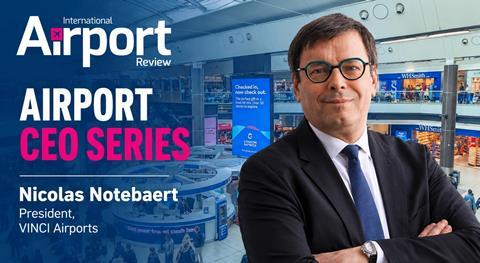
Airports are under increasing pressure to deliver more capacity, improve the passenger experience and reduce their environmental impact, often within the constraints of existing infrastructure. For Nicolas Notebaert, President of VINCI Concessions, which includes VINCI Airports, VINCI Autoroutes, VINCI Highways, VINCI Railways, VINCI Stadium, as well as various public-private partnerships, meeting these demands requires a combination of targeted investment, operational excellence and long-term partnerships with governments.
Speaking to International Airport Review, Nicolas outlined how VINCI Airports is approaching these challenges across its international portfolio, from major capacity projects at London Gatwick and Lisbon, to the deployment of technology, operational improvements and initiatives to reduce carbon emissions.
Nicolas is overseeing a broad infrastructure portfolio spanning aviation, highways, high-speed rail, solar energy and electric vehicle charging infrastructure.
His vision for aviation centres on a clear principle: sustainable growth depends not only on building capacity, but also on making existing infrastructure work harder and ensuring airports deliver long-term value for the countries and communities they serve.
Building resilience through a diversified network
Global aviation remains exposed to geopolitical tensions, shifting airline capacity and economic uncertainty. Yet Nicolas believes VINCI Airports’ geographical diversity provides an important buffer against volatility in individual markets.
He points to the group’s presence across Europe and the Americas, alongside its distinctive footprint in Asia, as a key differentiator.
“We have a highly diverse and resilient network, which is unique globally,” he explains.
The performance of individual airports can vary considerably, depending on local market conditions and airline strategies. Nicolas cites traffic reductions in Santiago de Chile, linked to capacity reductions by a local carrier, as an example of how developments in one market can affect results. Elsewhere, strong demand across Portugal, Budapest, Belgrade, Edinburgh, Belfast, Mexico and the Dominican Republic has helped support the wider portfolio.
Leisure tourism and visiting friends and relatives (VFR) travel have been particularly important drivers of demand. The recovery of Asian traffic following the pandemic, alongside momentum around Osaka Kansai Airport in the lead-up to Expo 2025, also contributed to the network’s performance around that time.
Nicolas acknowledges that geopolitical developments can affect specific markets and routes. However, he argues that the group’s limited direct exposure to the Middle East, combined with its broad geographical spread, helps balance fluctuations across the portfolio.
For him, the ability to draw on different markets is fundamental to the business model. Rather than relying on a single region or traffic segment, VINCI Airports can benefit from demand across multiple markets to help offset localised challenges.
However, resilience is not simply a question of geographical reach. It also depends on the ability to work with airline partners, respond to changing demand and ensure that airports can accommodate growth efficiently.
Making growth work operationally
As passenger demand increases, airports must ensure that additional traffic does not come at the expense of operational performance. Nicolas identifies workforce excellence, effective processes and close collaboration with airlines as essential components of managing growth.
One area in which VINCI Airports has sought to apply lessons across its network is security screening. Strategies developed and refined at Edinburgh Airport and London Gatwick are being deployed at other locations, including in Japan and Budapest.
The objective is to increase throughput while improving the passenger experience.
“Implementing high-throughput security lanes significantly improves the passenger experience, which is our top operational priority,” he says.
The approach reflects a broader principle: operational improvements developed at one airport can create value elsewhere when adapted to local requirements. For a global operator, sharing expertise across airports offers opportunities to improve performance without treating every location as an isolated operation.
Commercial performance is another part of the equation. VINCI Airports has upgraded food and beverage, parking and retail offerings across its portfolio, with Nicolas highlighting the strength of luxury duty-free sales per passenger at Kansai Airport.
These investments illustrate how operational and commercial priorities intersect. Improving passenger flows and the airport environment can support a more effective journey while creating opportunities for commercial growth.
Yet Nicolas is clear that expansion must be supported by robust operational planning. Airports are complex environments in which the performance of one organisation depends on many others, from airlines and ground handlers to border agencies and air traffic control.
He likens an airport to an orchestra. While VINCI Airports manages its own workforce, the overall operation depends on multiple stakeholders working in co-ordination.
“Meticulous planning is essential,” he says.
At major airports such as Gatwick and Lisbon, peak summer operations are planned three months in advance. Contingency arrangements are also important, including measures to protect passenger welfare and ensure access to food and water during disruption.
For Nicolas, resilience begins before passengers enter the terminal. Reliable surface transport, sufficient parking and smooth arrivals are just as important as flexible security queues and staffing inside the building.
This whole-airport perspective is increasingly important as operators seek to accommodate more passengers while maintaining service standards during peak periods.
Expanding capacity while making better use of existing infrastructure
Although technology can improve efficiency, Nicolas does not view digital transformation as a complete substitute for physical investment. Instead, he sees the future of airport development as a combination of targeted expansion and better use of existing assets.
VINCI Airports’ major infrastructure priorities for 2027 include the development of London Gatwick’s Northern Runway, a new airport for Lisbon, expansion at Budapest, and a new passenger terminal in Santo Domingo in the Dominican Republic.
Gatwick is a particularly important project within the group’s UK portfolio. Nicolas describes the Northern Runway as a significant opportunity to add capacity within the airport’s existing perimeter.
The airport’s current single-runway operation is optimised to handle approximately 50 aircraft movements per hour. Bringing the Northern Runway into routine use would provide additional capacity without requiring an entirely new airport site.
At Edinburgh, a new major investment plan will address capacity constraints at an airport Nicolas describes as being at full capacity.
In Portugal, VINCI Airports is committed to designing, financing and constructing the new Luís de Camões Airport in Lisbon using private capital. Nicolas argues that this model can help deliver essential infrastructure, while reducing the burden on public finances.
These projects reflect the scale of the challenge facing airport operators: demand continues to grow, but development must account for planning requirements, financing, operational continuity and the long-term needs of the markets being served.
Nicolas also stresses the importance of improving the use of existing airport infrastructure before committing to extensive physical expansion.
In Europe, where population growth is relatively flat, tourism and VFR travel continue to support increasing aviation demand. He believes improvements to air traffic management, including initiatives involving SESAR and Eurocontrol, can help unlock capacity, alongside more efficient airport operations.
Technology is central to this approach. AI-powered Smart Stand software, for example, can optimise aircraft turnarounds, stand allocations and gate usage. By improving co-ordination between aircraft movements and available infrastructure, airports can make better use of existing capacity.
“Modern airport management is no longer about the 1960s or 70s approach of building sprawling physical structures; it is about marrying targeted physical expansion with cutting-edge technology and operational efficiency,” he says.
For airport leaders, the implication is clear: infrastructure planning and digital transformation should not be treated as separate strategies. The greatest opportunities may come from combining carefully selected capital projects with technologies that improve the performance of the airport as a whole.
Technology that improves the passenger journey
The same philosophy underpins VINCI Airports’ approach to passenger experience.
Nicolas identifies flow optimisation, digital passenger services and predictive maintenance as three core areas of innovation.
At Edinburgh, direct luggage tagging and automated injection into baggage handling systems are intended to streamline processes. Long, multi-position security lanes and AI-supported stand allocation also form part of the group’s efforts to improve throughput and operational co-ordination.
For passengers, digital tools can help reduce uncertainty and waiting times. VINCI Airports has introduced interactive AI information kiosks, including its agentic AI robot at Lyon Airport, alongside its mobile application ecosystem.
Biometrics, self-service bag drop and mobile technology offer further opportunities to make airport journeys more seamless, reducing stress and freeing passengers to spend more time in retail and relaxation areas.
Nicolas also recognises that digital adoption is shaped by the regulatory environment. Discussing biometrics, he notes that European airports face particular considerations around data protection, including the General Data Protection Regulation (GDPR).
He believes that digitalisation can help airports accommodate demand more efficiently, but sees it as part of a wider approach that includes airspace management, operational improvements and targeted physical investment.
The vision extends beyond passenger-facing technology. Digital twins and Internet of Things sensors are also being deployed across electromechanical systems to support predictive maintenance and real-time disruption monitoring.
These technologies can help airport teams identify potential issues earlier and manage assets more effectively. Their value lies not simply in introducing new digital tools, but in using data to support better operational decisions.
The challenge is to integrate these systems into the wider airport environment, ensuring that improvements in one area translate into more reliable and efficient operations across the entire passenger journey.
Sustainability as a business imperative
Decarbonisation remains another central element of VINCI Airports’ strategy. During the interview, Nicolas highlighted six airports across the group’s network that had achieved Airport Carbon Accreditation Level 5, the programme’s net-zero level. He also pointed to Salvador de Bahia in Brazil, which he described as the first airport at this level in the Americas.
The group is committed to achieving net-zero carbon emissions across its European airports, London Gatwick and Edinburgh by 2030.
Nicolas also highlighted progress in reducing direct emissions. According to the figures he cited during the interview, VINCI Airports had cut its Scope 1 and Scope 2 carbon emissions by 65% across its entire perimeter since 2018.
For him, the environmental agenda is inseparable from the long-term business case for aviation.
“Despite broader political debates, addressing climate change is an essential business imperative,” he says.
The next challenge is Scope 3 emissions, which extend beyond the airport operator’s direct activities. Sustainable Aviation Fuel (SAF) is an important part of the wider aviation industry’s transition, and Nicolas believes airport operators can play a practical role in helping the market develop.
VINCI Airports is working with innovative start-ups, including Ketjen in Lyon and Belfast, to catalyse local production of e-SAF. Rather than acting as a direct equity investor in fuel refining, the group aims to bring together airlines, technology providers and energy producers.
This approach positions the airport as a facilitator, connecting the organisations and infrastructure needed to support new fuel production and uptake.
Alongside aviation decarbonisation, VINCI Airports is investing in renewable energy. Nicolas points to solar installations at Belfast International Airport and Lyon Airport, where the group has developed what he describes as the world’s largest airport rooftop solar farm.
Waste management and biodiversity are also part of the programme. He says VINCI Airports has achieved 76% recovery waste and -87% pesticide use.
Taken together, these initiatives reflect an approach that encompasses both the airport operator’s own environmental footprint and its potential influence across the wider aviation ecosystem.
Airports as drivers of economic development
Beyond operational performance and environmental targets, Nicolas sees airports as essential contributors to national economic growth and international connectivity.
He describes airports as “peace engines”, highlighting their ability to connect communities, open markets and support tourism.
His example of Belfast International Airport illustrates the wider significance of connectivity. At a VINCI Airports corporate convention in Belfast, Northern Ireland’s First Minister and Deputy First Minister jointly advocated for the airport’s expansion, despite their parties’ historical political differences.
For Nicolas, this demonstrates the shared interest governments and airport operators can have in improving access to international markets.
He also points to VINCI Airports’ investments in Cape Verde, where improved connectivity has supported tourism and economic development.
This relationship with public authorities is central to his approach to the group’s future growth. During the interview, he noted that VINCI Airports had recently secured the concession renewal for Rennes Airport in Brittany, while further expansion opportunities would depend on competitive government tenders and public-sector decision-making.
Nicolas describes the alignment between the operator’s long-term business model and national priorities as “bonding”.
“The foundation of our success is what I call ‘bonding’,” he says. “Countries need international connectivity, economic growth, and sustainable development.”
For private airport operators, this means demonstrating that investment can deliver value beyond the airport itself. Projects must support the needs of governments, local communities and businesses while remaining commercially and operationally sustainable over the long term.
Nicolas also emphasises the importance of working alongside industry bodies such as Airports Council International (ACI). While ACI represents the wider industry’s policy and advocacy interests, VINCI Airports works directly with governments through long-term concession agreements to deliver infrastructure and operational projects.
A long-term vision for airport leadership
Looking ahead, VINCI Airports’ priorities combine major infrastructure delivery with continued improvements in operational efficiency, technology adoption and environmental performance.
The Northern Runway project at Gatwick and the new Lisbon airport represent significant opportunities to increase capacity.
At the same time, the group is seeking to improve the way airports operate today, from security screening and aircraft stand management to passenger information, predictive maintenance and disruption planning.
For Nicolas, these priorities are connected. Growth must be supported by reliable operations; technology must improve the use of infrastructure; and sustainability must be embedded in the long-term development of the airport network.
Crucially, the ability to deliver this vision depends on collaboration. Airlines, governments, airport teams and technology providers all have a role to play in creating the conditions for sustainable aviation growth.
As airports face increasing pressure to accommodate demand while managing costs, capacity and carbon emissions, Nicolas’s message is that success will depend on balancing investment with efficiency, and commercial ambition with the wider needs of the communities airports serve.

No comments yet