



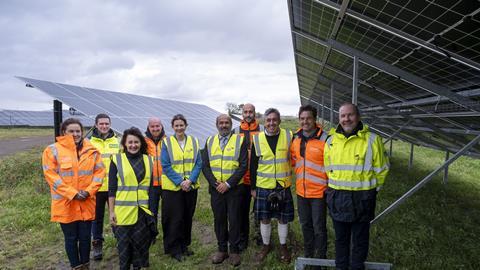
AGS Airports’ new Horizons strategy launches as Glasgow Airport’s 10MW solar farm begins meeting around 25 per cent of on-site electricity demand.
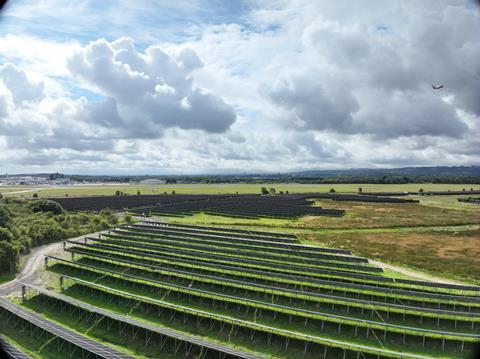
AGS Airports has launched Horizons, its new sustainability and environmental, social and governance (ESG) strategy, as the solar farm at Glasgow Airport (GLA) begins generating enough renewable electricity to meet around 25 per cent of the airport’s on-site demand.
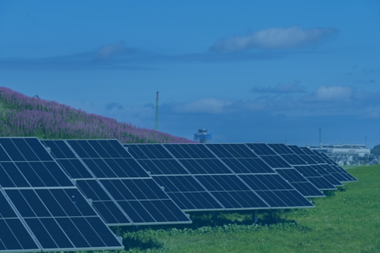
The multi-million-pound project was developed by AGS Airports in partnership with energy transition adviser and developer Ikigai Group. The 10MW farm, located on Glasgow Airport land near Barnsford Road, was funded and delivered by Zestec Renewable Energy, which will manage and optimise the infrastructure over the long term.
Glasgow solar farm meets 2026 renewable target
Comprising more than 14,300 photovoltaic panels, the installation generates renewable energy to help power airport operations and reduce Glasgow Airport’s reliance on electricity from the grid.
Its completion means AGS Airports has achieved its target of generating 25 per cent of on-site renewable energy for its own use at Glasgow by the end of 2026. Based on grid electricity emissions, the solar farm is expected to save around 1,100 tonnes of carbon dioxide equivalent (tCO2e) per year.
Kam Jandu, Chief Executive Officer at AGS Airports, said: “By generating clean energy on-site, we are reducing our carbon footprint, strengthening our energy resilience and creating long-term value for the airport and the communities we serve.”
Toby Smith, Chief Operating Officer at Zestec, said: “We are pleased to have delivered this significant renewable energy project for Glasgow Airport. With the solar farm now operational, we look forward to managing and optimising it over the long term, helping the airport make the most of the renewable energy it generates.”
Helena Anderson, Chief Operating Officer at Ikigai, said: “We supported Glasgow Airport from inception to energisation, jointly developing the onsite generation project and securing the most competitive investor. It is rewarding to see that collaboration now delivering clean, competitively priced electricity for the airport.”
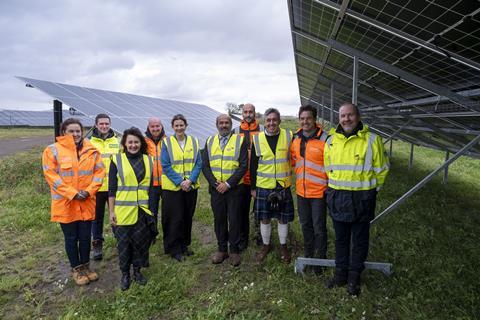
The project was also supported by SP Energy Networks (SPEN), the electricity network operator for central and southern Scotland. Martin Maxwell, SPEN’s District General Manager for Ayrshire and Clyde South, said the network operator was proud to have played its part in bringing the solar farm to life.
Horizons strategy targets net zero by 2035
The solar farm is a key initiative within Horizons, subtitled “Looking ahead, acting together”, which sets out the group’s long-term ambitions across four strategic pillars covering net zero, communities, people and innovation. Under the strategy, AGS Airports has reaffirmed its commitment to achieving net zero for its own emissions by 2035.
Fiona Smith, Executive Director of ESG and Sustainability at AGS Airports, said: “The launch of Horizons marks an important moment for AGS Airports as we set out a clear vision for building a more sustainable future for our airports. Looking ahead, acting together captures our belief that meaningful progress can only be achieved through collaboration. The solar farm is an example of that approach in action and a major milestone on our sustainability journey.”
Battery storage to shape Aberdeen and Southampton plans
AGS Airports is now examining how the Glasgow solar model can be replicated at Aberdeen International Airport (ABZ) and Southampton Airport (SOU). However, Fiona Smith told International Airport Review that the group was “in the very early stages of the process” at both airports, with specific schemes, grid requirements, generation capacities and delivery timescales yet to be confirmed.
“What we do know is that our commitment to achieving net-zero emissions from our own operations by 2035 means we must continue to explore every viable opportunity to generate more renewable energy on-site and reduce our dependence on the grid,” she said.
“Projects like these support decarbonisation, strengthen energy resilience, help ensure our airports are less exposed to energy market volatility and are better able to meet future operational demand.”
According to AGS Airports, a key consideration as it evaluates opportunities across the group will be how renewable generation works alongside battery energy storage. The group said storage technologies are likely to form an important part of future assessments at all three airports.
Fiona Smith added: “While there is no confirmed target date for achieving a similar level of on-site generation at Aberdeen or Southampton, we will continue to assess what is technically and commercially achievable at each location as part of our wider journey towards net zero.”
Laying the foundations for zero-emission flight
The group has also set its sights on helping to deliver the UK’s first scheduled zero-emission passenger route. Earlier this year, AGS Airports supported the UK’s first real-world electric aviation demonstration programme, which saw BETA Technologies’ all-electric ALIA aircraft complete flights across Scotland. According to AGS Airports, the trials showed how zero-emission aircraft could operate from existing airport infrastructure in the years ahead.
Fiona Smith said: “As zero-emission flight technologies mature, access to reliable, low-carbon electricity will become increasingly important. While the industry is still at an early stage and no specific routes or infrastructure requirements have been confirmed at our airports, we want to ensure we are building the foundations that will allow us to support these technologies as they become commercially viable.”
AGS Airports noted that this future demand could span electric aircraft charging, hydrogen infrastructure and the wider airport ecosystem. In the near term, however, the group expects the most immediate need for additional clean electricity to come from the electrification of airport operations themselves, including heating and cooling systems, ground support equipment, vehicle fleets, charging infrastructure and the requirements of airlines, tenants and other campus users.
“Investing in renewable energy, and potentially battery storage, helps us to meet this growing demand for additional clean energy across our airports while creating the flexibility and resilience needed to support future zero-emission aviation technologies as they emerge,” said Fiona Smith.
Jandu added: “Horizons reflects our ambition not only to reduce our environmental impact but also to help shape the future of sustainable aviation. Horizons and the targets we have set ensure AGS Airports continues to lead by example.”








No comments yet