

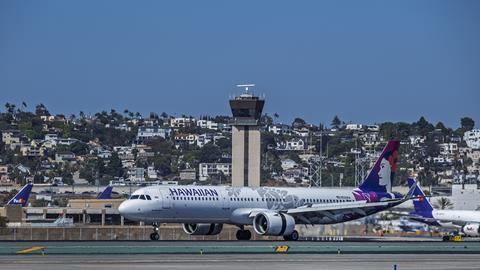

At San Diego International Airport, managing aircraft noise means balancing a busy single-runway airport with the needs of surrounding communities. SAN’s Manager of Planning, Noise, & Environment, Chris Walker, explains how collaboration, monitoring and transparency help support quieter operations and build community trust.
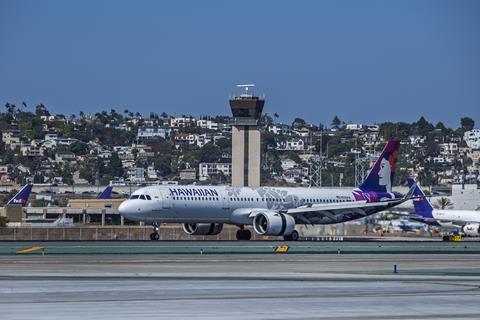
Recognising airlines for quieter flight operations is an important part of SAN’s overall aircraft noise management strategy. Through the San Diego County Regional Airport Authority’s annual Fly Quiet Awards, we acknowledge airlines that demonstrate outstanding operational performance, including commitment to our night-time departure curfew, and the operation of quieter aircraft.
Recognition serves as a positive incentive that encourages continuous improvement. It reinforces that airlines play an important role in minimising community noise impacts and highlights operators that consistently demonstrate responsible practices. The Airport Authority recognises winning airlines through complimentary electronic advertising at the airport, showcasing their efforts and publicising their win through local news outlets and social media. Public recognition also promotes transparency by showing surrounding communities that airline performance is actively monitored and that operators committed to noise reduction are acknowledged for their efforts.
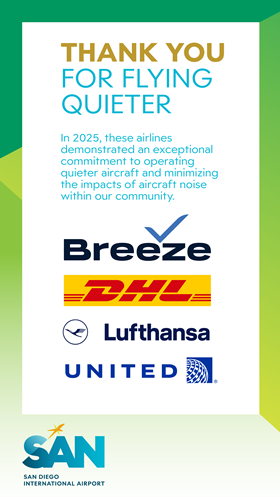
Ultimately, the programme strengthens collaboration between the Airport Authority and our airline partners while supporting our broader goal of balancing efficient airport operations with community well-being.
Collaboration is central to aircraft noise management at SAN. Because the Federal Aviation Administration (FAA) has sole authority over aircraft operations and airspace, meaningful progress depends on strong partnerships between the Airport Authority, airlines, the FAA, and the communities we serve.
The Airport Authority regularly meets with airline representatives to discuss operational trends, curfew performance, and future concerns. These conversations allow us to better understand operational challenges and identify practical solutions.
In addition, the Airport Authority maintains an active dialogue with the community through our Aircraft Noise Advisory Committee (ANAC), which was established in 1981, in which two seats are dedicated to members of the airlines. These dedicated spots are reserved for an (active) airline pilot and airline flight operations representative. This allows the ANAC to have a well-balanced discussion where our airline partners can be a part of the solution.
Curfew and Noise Dots limit night-time noise exposure
The primary operational measure that has contributed to quieter aircraft operations at SAN is our curfew. The curfew, which was grandfathered prior to the passage of the 1990 Airport Noise and Capacity Act (USA), prohibits departures between 23:30 and 06:30, except under limited circumstances. By minimising departures during night-time hours, the curfew significantly reduces aircraft noise exposure for surrounding communities when ambient noise levels are at their lowest, and residents are most sensitive to aircraft noise.
It reinforces that airlines play an important role in minimising community noise impacts and highlights operators that consistently demonstrate responsible practices.”
Another unique feature for SAN is the “Noise Dots”. These Noise Dots are a set of five reference points, not navigational aids, that are visually shown on Air Traffic Control video screens. These points help controllers direct aircraft away from noise-sensitive communities and avoid “early turns” over areas not typically affected by aircraft noise. The Noise Dots were brought about in discussions with a local elected official, the airport, the community, and the FAA. This measure highlights the fact that having open and collaborative discussions with various stakeholders can have tangible results.
The Airport Authority operates a comprehensive aircraft noise and flight tracking system that integrates aircraft operational data with information collected from our network of 23 permanent noise monitoring terminals located throughout the surrounding communities, with one additional portable noise monitor where staff can analyse data from unique locations.
This system allows airport staff to monitor aircraft activity, evaluate night-time curfew compliance, investigate community concerns, analyse long-term operational trends, and provide data for California’s state-mandated, Title 21 reports. By combining flight tracking with measured noise data, we can objectively assess aircraft operations, noise levels, and identify opportunities for improvement.
The data collected also supports our annual Fly Quiet programme, informs discussions with airline partners, and provides transparency through publicly available reporting tools. The Airport Authority publicly displays a variety of data points which include stats on curfew, early turns, missed approaches, and the airport’s residential sound insulation programme (Quieter Home Program). This data was collaboratively evaluated with the ANAC to help guide the Airport Authority in what the public was most interested in viewing. Ultimately, these tools help the Airport Authority be as transparent as possible with what is going on regarding aircraft noise.

Fleet modernisation is one of the most significant long-term contributors to reducing aircraft noise. Today’s commercial aircraft incorporate major advances in engine technology, aerodynamics, and aircraft design that make them substantially quieter than previous generations while also improving fuel efficiency and reducing emissions. Aircraft such as the Airbus A220, Airbus A320neo, Boeing 737 MAX family, and Airbus A350 all produce smaller noise footprints than the aircraft they replace.
During COVID-19, airlines took advantage of the decrease in passenger service to modernise their fleets; feedback from the community suggests this was a noticeable improvement. This in turn has made communities more aware of what type of aircraft are being flown at the airport, which is a key metric in our Fly Quiet programme.
As airlines continue investing in newer, quieter aircraft, surrounding communities benefit from cumulative reductions in overall aircraft noise exposure. These investments also complement the Airport Authority’s broader environmental sustainability goals by reducing fuel consumption and greenhouse gas emissions.
Community engagement is a cornerstone of SAN’s aircraft noise management strategy. Residents can share concerns and provide feedback to the Airport Authority’s Noise Office, online aircraft noise complaint system, the SAN Aircraft Noise Advisory Committee (ANAC). This information helps identify recurring concerns, emerging operational trends, and areas that may require additional analysis.
While airports do not have authority over flight paths and air traffic control procedures, listening to community concerns allows the Airport Authority to advocate for practical improvements whenever opportunities arise. Transparency and consistent communication remain essential to maintaining public trust.
Balancing operational growth with community expectations continues to be one of the most significant challenges facing airports across the country, particularly at SAN.
As the busiest single-runway commercial airport in the United States, every arrival and departure operates from one runway while the airport remains surrounded by established residential neighbourhoods. Unlike airports with multiple runways, SAN has limited operational flexibility to distribute aircraft activity.
Fleet modernisation and community engagement support long-term progress
Meeting these challenges requires continued collaboration with airlines, thoughtful scheduling practices, continued investment in quieter aircraft, objective performance monitoring, and strong partnerships with the FAA. Maintaining open communication with our surrounding communities is equally important as we work to balance regional mobility with quality of life.
Aircraft noise management will continue to evolve through advances in technology, improved data analytics, and stronger collaboration across the aviation industry.
At the airport level, more sophisticated aircraft noise monitoring systems and enhanced data analytics will provide greater insight into operational trends and support more informed decision-making. Increased transparency through publicly available reporting tools will continue strengthening trust with surrounding communities. While additional data can provide airports with valuable insights to support better decision-making, it is equally important that information shared with the public is presented in a thoughtful and user-friendly manner. Technical data should be translated into clear, non-technical language so community members can easily understand what it means, why it matters, and how it relates to airport operations.
At SAN, we remain committed to transparency, objective performance measurement, and continuous improvement as we work to support the region’s growing aviation needs while being a responsible neighbour for generations to come.









No comments yet