



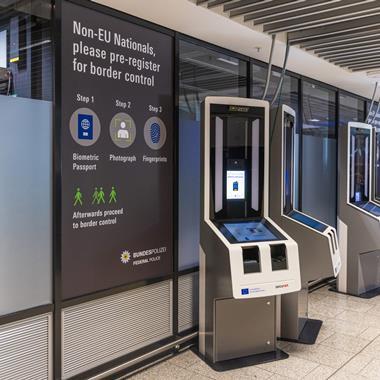
Why the success of Europe’s new digital border system will depend less on biometrics than on airport operations according to aviation commentator, Raúl Valencia.
After years of preparation, the European Union’s Entry/Exit System (EES) has entered operational reality. For airports, however, the real challenge is only just beginning.
The first summer with EES fully operational will not primarily test biometric technology, software performance or regulatory compliance. It will test whether airports can successfully integrate a new border process into one of the most complex operational environments in modern transport.
Every summer, Europe’s busiest airports operate close to their processing limits. Passenger volumes increase sharply, aircraft schedules become more concentrated and even small disruptions can propagate across the network within hours. Adding a new digital border procedure into this environment transforms EES from a technology programme into an operational one.
This distinction matters because digital transformation in aviation is rarely constrained by technology alone. More often, success depends on how effectively new processes fit within existing passenger flows, organisational structures and operational decision-making.
For airport operators, the question is therefore no longer whether digital borders represent the future. The question is whether airport operations are ready to support them at scale.
Early operational experience already illustrates the scale of the challenge. Since the system entered operation, several major European airports have reported significant border control delays, with passengers facing queues of between two and five hours during peak periods at airports including Rome Fiumicino, Palma de Mallorca, Tenerife South and Paris Beauvais. At Milan Linate, more than 100 easyJet passengers reportedly missed a flight after becoming trapped in extended passport control queues, demonstrating how quickly localised border delays can cascade into wider operational disruption.
Border control becomes a passenger flow challenge
EES fundamentally changes the nature of border processing.
Traditionally, passport control focused on document verification and manual passport stamping. EES introduces biometric enrolment, additional passenger interactions and new verification procedures for non-EU travellers entering the Schengen Area.
The operational challenge is not how quickly an individual passenger completes the process. It is how the system performs when hundreds of passengers from multiple long-haul arrivals reach border control simultaneously.
A small increase in average processing time may appear insignificant in isolation. During peak arrival banks, however, those additional seconds can translate into longer queues, increased terminal congestion, missed connections and operational pressure across the airport.
This is why EES should not be viewed simply as a border management initiative, it is a passenger flow management challenge.
Airports will need to monitor operational indicators that extend beyond individual processing times, including queue evolution during peak periods, impacts on connecting passengers, availability of processing positions and the system’s ability to recover quickly after disruptions.
Ultimately, capacity under EES will be measured not by the speed of biometric verification, but by the airport’s ability to maintain predictable passenger flows under sustained demand.
Collaboration becomes operational infrastructure
EES also changes how organisations must work together.
Border authorities remain responsible for immigration control, yet passengers experience the entire arrival journey as a single process. When delays occur, travellers rarely distinguish between border agencies, airport operators, airlines or technology providers.
Operationally, however, these organisations often continue to manage their responsibilities independently. EES exposes the limitations of that model.
A delay in border processing can quickly affect baggage reclaim, passenger assistance, airline operations and terminal congestion. The performance of the overall system increasingly depends on how effectively information and operational decisions are shared across organisations.
In many respects, EES requires airports to adopt a more integrated operational philosophy, similar to the collaborative approaches that have transformed airside operations through Airport Collaborative Decision Making (A-CDM). While A-CDM focuses on aircraft movements, EES highlights the need for comparable coordination across the landside passenger journey.
The challenge is therefore not organisational ownership, but operational integration.
Resilience will matter more than automation
Digital transformation projects are often evaluated by their performance under normal operating conditions, but airports operate under very different circumstances.
Technology failures, connectivity issues, unexpected passenger peaks or staffing shortages are not exceptional events, they are operational realities that airports must manage every day.
Recent operational experience demonstrates how quickly even marginal increases in individual processing times can accumulate under real operating conditions. Across several major European airports, queues stretching to between two and five hours during peak periods have highlighted that the challenge is rarely the biometric transaction itself, but the cumulative effect of processing thousands of passengers arriving within concentrated time windows. What begins as a delay of only a few additional seconds per traveller can quickly escalate into terminal congestion, missed connections and wider operational disruption.
The success of EES will therefore depend less on perfect system availability than on how effectively airports and border authorities respond when normal operations are disrupted.
Clear contingency procedures, predefined decision-making responsibilities and alternative processing methods become as important as the technology itself.
These concerns are increasingly shared across the airport industry. Stefan Schulte, President of ACI Europe and Chief Executive Officer of Fraport, recently urged European policymakers to “stop pretending… that EES is working just fine. It is not,” warning that lengthy queues experienced during the first weeks of operation demonstrate the need for greater operational flexibility. His remarks reinforce a central lesson from EES: the success of digital border systems will ultimately depend not only on technology, but on the resilience of the operational ecosystem supporting them.
In this context, resilience should be measured operationally rather than technically. A highly automated border process that lacks effective fallback procedures may ultimately reduce reliability instead of improving it.
Passenger communication is part of operational performance
Another frequently underestimated factor is passenger preparedness.
Travellers who understand EES requirements before arriving at the airport complete border formalities more efficiently and require less individual assistance. Those who arrive uncertain about registration procedures or documentation inevitably increase processing times.
Passenger communication should therefore be viewed as part of operational capacity rather than simply a customer service activity.
Providing consistent information through airline communications, airport channels and terminal signage can improve compliance while reducing unnecessary delays during peak periods.
As aviation continues moving toward digital identity, biometric processing and initiatives such as IATA’s One ID, passenger understanding will become an increasingly important component of operational efficiency.
A wider lesson for aviation
The significance of EES extends well beyond European border management.
Global passenger demand continues to grow, with IATA forecasting almost eight billion passenger journeys annually by 2043. Meeting that demand will require airports to deploy increasingly sophisticated digital technologies throughout the passenger journey.
EES offers one of the first large-scale opportunities to observe how those technologies perform under real operational pressure.
Its implementation demonstrates that successful digital transformation depends on far more than software, biometrics or regulatory frameworks. It depends on whether airports can integrate new digital capabilities into complex operational ecosystems where multiple stakeholders, physical infrastructure and passenger behaviour interact continuously.
Europe’s first summer with fully operational digital borders will therefore become more than a test of EES itself.
It will demonstrate whether aviation has reached the next stage of digital maturity. Because the future airport will not be defined by how many digital systems it deploys, but by how effectively those systems work together when operations are at their busiest.









No comments yet