



In part 2 of this series, Davide Bassano, Director of Sustainability at Gruppo SAVE answers audience questions received during IAR’s energy revolution webinar.

When will your geothermal project progress to construction?
Technically, the system is designed as a low‑enthalpy, closed‑loop geothermal field based on vertical probes. Geological studies cited in the Masterplan show that in the Venice area temperatures at 1 km depth are roughly 42.7°C, at 2 km around 62.4°C and at 3 km about 80.2°C, which confirms that the subsoil does not contain anomalous geothermal reservoirs and is suitable only for shallow, low‑enthalpy applications. For this reason, the design is based on closed circuit double‑U probes that exchange heat with the ground without extracting water and without interacting with aquifers, thus preventing risks connected with subsidence or contamination. A depth of 200m per probe is adopted based on thermal response tests carried out during previous airport works, which showed average undisturbed temperatures of approximately 17°C at such depths and stable soil conductivity thanks to the sandy local strata.
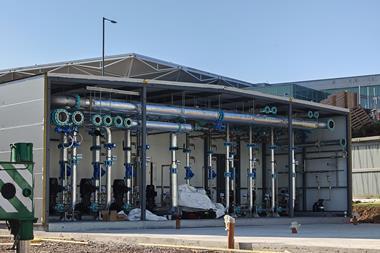
The geothermal field is dimensioned to include 468 vertical borehole probes, each 200m deep, spaced about 20 m from one another to avoid thermal interference. The field would occupy around 155,000m² (about 15.5 ha) and, with an assumed ground heat extraction rate of 35W per metre of borehole, the system can deliver an estimated 5.5MW of thermal power. The field is connected to four electric heat pumps which operate both in winter and in summer: in winter they extract heat from the probes to feed the district heating system and in summer they reject heat back into the ground to stabilise subsurface temperatures and avoid long‑term thermal drift. This arrangement allows the geothermal field to supply approximately 29% of the airport’s thermal demand in the 2037 scenario. Average operating COP for geothermal heat pumps is calculated at around 2.7, reflecting realistic source temperatures and flow conditions. Continuous monitoring of outlet temperatures from the geothermal field is foreseen to prevent excessive thermal depletion of the ground.
The masterplan also justifies the exclusion of high‑enthalpy systems because deep drilling would not be economically viable, the area does not contain high‑temperature resources, and such drilling would be incompatible with the lagoon’s hydrogeological fragility. The low‑enthalpy closed‑loop solution instead avoids any interaction with groundwater and satisfies the environmental, seismic and subsidence‑related constraints of the airport area.
In summary, the project is fully characterised from a technical standpoint - dimensions, thermal yields, probe configuration, heat pump plant, COP, geological basis, layout and expected contribution to the energy system are all extensively defined - while no timeline for construction, permitting, tendering or commissioning is provided anywhere in the document. The geothermal installation is part of the airport’s long‑term energy transition architecture, but as of the masterplan’s publication it remains a technical design without a scheduled start date.
Does Venezia Airport have a load demand management system in place or in development?
Venezia Airport is modelling hourly energy consumption, integrating photovoltaic + agrivoltaic generation, storage, heat pumps, PCA loads, mobility charging and hydrogen systems within a detailed simulation framework. However, this is cannot be considered as a load demand management system but rather as an internal energy model used for scenario analysis. Nothing indicates the presence of real‑time load orchestration, demand-response logic, or active peak-management infrastructure.
Given the proximity of large water bodies and likely tidal movements, has underwater hydro/turbine power generation been considered in your masterplan?
The Venezia Airport Energy Transition Masterplan did consider the possibility of exploiting nearby water bodies - specifically the Dese River and the Venice lagoon - as renewable energy sources. However, these options were evaluated and explicitly discarded.
The Masterplan analysis shows that the airport examined whether heat extraction or energy recovery from surrounding water bodies could be viable. It concluded that neither the Dese River nor the lagoon is suitable for renewable energy generation systems - including underwater hydro or tidal‑based technologies - for several technical, environmental, and regulatory reasons.
Using the Dese River as a thermal or energetic source would require several kilometres of underground pipework, faces strong seasonal variability in flow and temperature, is limited by strict thermal‑discharge constraints, and becomes inefficient in winter conditions. It also states that the Venice lagoon is environmentally protected (UNESCO designation and multiple overlapping constraints) and therefore cannot be used as a source for such systems. These evaluations led the airport to exclude water‑based energy technologies altogether.
Underwater hydro, tidal, or lagoon‑based turbine technologies were assessed but rejected. Venezia Airport’s Masterplan does not include any underwater hydro/tidal generation project, primarily due to environmental constraints, insufficient resource potential, and regulatory incompatibility within the lagoon ecosystem.
Have you seen any negative effect of the agrivoltaic park on aviation traffic (reflections, glare, etc.) and is the pure financial business case positive?
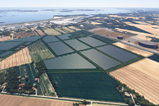
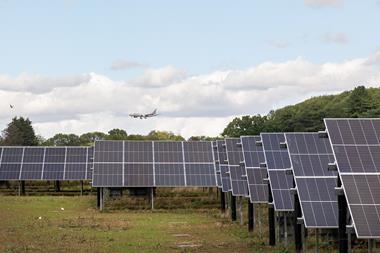
Regarding the potential negative effects of the agrivoltaic park on aviation traffic, the masterplan includes an explicit evaluation of the regulatory constraints that apply to photovoltaic surfaces placed within or near airport operational areas. Because the site lies inside the UNESCO lagoon perimeter and under ENAC aviation-safety jurisdiction, the airport is required to assess visual impacts such as glare, reflections and any optical disturbance that could affect pilots or air‑navigation operations. To support this assessment, the document references ENAC’s guidelines on the reflectivity of solar modules, noting that modern photovoltaic panels typically reflect around four to five percent of incident light and that this reflectivity is comparable to or lower than that of water surfaces or ordinary glass. These values are presented to clarify that the intensity of reflections from photovoltaic modules is significantly lower than many other natural or built surfaces normally present within an airport environment, and therefore compatible with regulatory thresholds. The masterplan states that any installation must receive ENAC approval and must be designed in accordance with aviation‑safety prescriptions, which confirms that the topic has been analysed and incorporated into the planning process.
On the economic side, the same masterplan explains that all technologies considered for the airport’s energy transition, including agrivoltaics, were tested against strict techno‑economic criteria. The document makes it clear that the sizing of each system was carried out with the explicit requirement that the overall investment generate a positive net present value. Technologies that did not meet this economic threshold or did not offer a competitive financial performance were discarded, while agrivoltaics was retained because it satisfies the economic justification. The Masterplan also highlights how the agrivoltaic installation supports high levels of airport self‑consumption, which improves its financial outcome by displacing expensive purchased electricity and stabilising long‑term operating costs. This economic rationale is explicitly mentioned as part of the planning criteria governing the selection and dimensioning of the renewable‑energy portfolio.
In conclusion, the masterplan both considers the potential glare and reflection impacts on aviation safety -concluding they fall within acceptable regulatory limits and are subject to ENAC verification -and confirms that the agrivoltaic project passes the financial viability criteria used in the airport’s long‑term energy strategy.
Are you expecting an interesting IRR for rooftop PV projects?
In all of the technical and economic material analysed across the energy transition masterplan and related internal documents, photovoltaic and agrivoltaic deployment is chosen primarily as a decarbonisation strategy, not because these systems promise exceptionally high IRRs.
The masterplan explains that SAVE’s selection process for energy technologies requires positive economic viability, but the driving criterion is the ability to eliminate Scope 1 and 2 emissions and achieve net zero by 2030, 20 years ahead of the European airport-sector target. PV and agrivoltaics were therefore selected because they allow the airport to electrify almost all thermal and mechanical systems, supply a very large share of electrical demand through self‑production, and remove fossil fuels from operations. This is articulated clearly in the Energy Transition Masterplan, where the rationale for photovoltaics is framed around emission elimination, energy autonomy, and system resilience rather than maximising return on capital.
It is also evident that the masterplan evaluates IRR and NPV only to ensure financial feasibility, not as the decision driver. Technologies with weak environmental impact but strong IRR — such as some e‑mobility charging models, which show very high IRR in separate analysis — are not prioritised in the same way because they do not materially contribute to decarbonising the airport’s energy system.
PV and agrivoltaics therefore enter the plan because they align structurally with the airport’s decarbonisation strategy, not because they outperform other investments in financial terms. Their IRR is acceptable, but the purpose of the investment is environmental, strategic and regulatory, not financial.
Missed the International Airport Review ‘Accelerating the energy revolution’ webinar? No problem! Watch it on-demand here!












No comments yet