
With passenger numbers soaring past pre-pandemic levels and airports straining to keep pace, HID’s Matthew Insley argues that seamless airport experiences are within reach if we clear up misconceptions about biometrics – and act on existing solutions.
For an industry built on movement, the airport sector can sometimes feel paralysed by its own safeguards. Implementing available biometric technology promises shorter wait times, smoother flows, and greater security, yet the deployment lags behind the ambition.
According to Matthew Insley, HID’s Director of Strategic Alliances, the real obstacles aren’t technical – they stem from hesitation and misinterpretation of regulations. Demystifying biometrics is essential to driving progress.
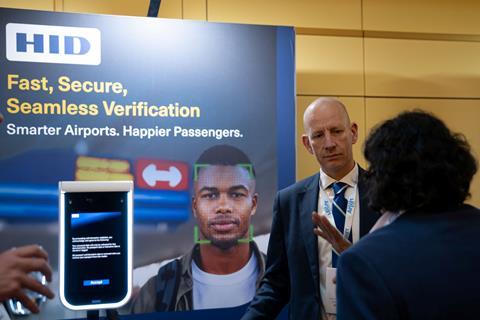
Insley is a veteran of the secure access and identity space. Before joining HID in October 2025, he spent over two decades at IDEMIA navigating the complex worlds of biometric terminals and government-grade security. Now, he is focused on how strategic partnerships can help airports cope with a resurgence in passenger demand that is straining legacy infrastructure.
The regulation scapegoat
Speaking to IAR at the International Airport Summit 2025 in Berlin, Insley noted a recurring theme: the tendency to use regulation, particularly GDPR, as a reason to halt innovation.
“There has always been a bit of a ‘but’,” Insley explains. “The ‘but’ isn’t because the technology isn’t available, or because a need hasn’t been identified. It is: ‘But we can’t do that because GDPR is a very sensitive subject.’”
He suggests that while data protection is paramount, it is occasionally used as a “bucket of cold water” to dampen necessary changes. Biometrics can ease congestion, reduce manual checkpoints, and improve passenger satisfaction, but the pressure on airports may soon force the issue. With passenger numbers now exceeding pre-COVID levels in many regions, the old methods of manual checks and stopping points are becoming unsustainable.
“The pressure on those needs is definitely building,” he says. “It is not through lack of will that it’s not happening… but the pressure is being brought to bear on how we unlock this using technology.”
The reality of the ‘breeze-through’ airport
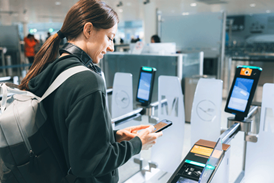
The industry dream has long been the “walk-through” airport – a facility where a passenger moves from curbside to airside without breaking stride, authenticated continuously by non-intrusive biometrics. This not only promises speed and convenience for travellers but also enables better allocation of airport staff and resources.
Sceptics argue this is science fiction. Insley argues it is already here.
“I think we are already at the walk-through airport,” he asserts. “I would go as far to say you can breeze through an airport if the infrastructure and biometrics have all been aligned correctly beforehand.”
He points to airports like Abu Dhabi and Changi, where large-scale deployment proves seamless travel is possible when technology is properly integrated. The real challenge in Europe and the UK is aligning legacy infrastructure, not inventing new solutions.
The sceptical passenger and the ‘Mum Test’
Perhaps the most significant hurdle to the widespread adoption of biometric corridors is public perception. Data privacy concerns are real, but Insley believes they are often based on a misunderstanding of how the technology works. To combat this, communication teams can adopt a simple, relatable approach he calls the ‘Mum Test’ to explain the technology in a reassuring way.
“When I think of a sceptical passenger, the epitome of that is probably my mother,” Insley says. “She is not a technologist at all; she hates it. She asks, ‘Why can’t I just take my passport and do it the old way?’”
His response to her – and to the industry’s critics – is to flip the script on data value. When a passenger hands over a passport or a credit card, they are surrendering highly valuable, stealable data. A biometric template is different.
“I’ve always said, selling biometrics is easy; it’s just about demystifying it. You see a lightbulb moment. I am a carbon-based lifeform, and this person is asking for some otherwise useless measurements from my fingerprint or my face to use in their system. Only that can be used to identify me.”
Insley argues that, unlike a credit card number or a physical passport, a biometric template (a mathematical representation of a face or fingerprint) is of “no use to anybody else” if compromised.
“I’ll happily give you my fingerprints. What are you going to do with them?” he asks. “I leave them all over the world anyway – on glasses, on steering wheels. But when I’m giving it to someone to help me, to keep myself secure, I don’t get why people are concerned.”
Augmenting ageing infrastructure
The vision of a high-tech, seamless hub is easy to imagine for a new build in the Middle East. It is harder to visualise for a 50-year-old terminal in the UK with narrow corridors and legacy infrastructure.
Insley’s approach at HID is not to advocate for “ripping and replacing,” which is operationally impossible for most busy airports. Instead, the focus is on augmentation.
“We’re not here to replace; we’re here to augment,” he says. “We try to provide in a very low footprint… to be that very front, thin, important layer to the back-end systems.”
By deploying high-end document scanners and biometric touchpoints at the edge of the interaction, airports can automate 80 or 90 per cent of passengers who are standard travellers. This increases passenger throughput, reduces queues, and frees up staff to do what they do best: handle exceptions and provide care to those who really need assistance.
“Most people going through an airport don’t need assistance,” Insley notes. “Free up staff from doing repetitive, boring tasks to actually dealing with the exceptions where they are needed.”
Security remains the north star
Despite the focus on efficiency and throughput, Insley is keen to stress that the primary function of the airport environment – security – cannot be diluted.
“Security must be at the heart of everything,” he says. “At HID, we have security initiated right at the design phase. The design process has security built in throughout the manufacturing process, as well as the tools we build into the products we eventually sell.”
As airports move forward, the path is clear: dispel myths about biometrics, integrate technology thoughtfully, and reject regulation as an excuse for delay. This is key to a seamless, secure future. Aiming for specific metrics, such as reducing the journey from curbside to boarding gate to just 20 minutes, can serve as a powerful motivator for change, encouraging airports to accelerate their modernisation efforts.
“Don’t shy away from this problem,” Insley concludes. “Don’t bury our heads in the sand. Now is the time to act: airports must modernise and embrace biometrics to stay competitive, ensure security, and create the seamless journeys passengers expect. Those that lead this change will attract more footfall and define the future of air travel.