

Budapest Airport has begun construction of a new terminal complex, marking a €1bn investment to expand capacity and strengthen Hungary’s aviation gateway.
Budapest Ferenc Liszt International Airport (BUD) has officially launched construction of a new terminal complex, marking a significant milestone in a €1 billion long term development programme designed to transform capacity and passenger experience.
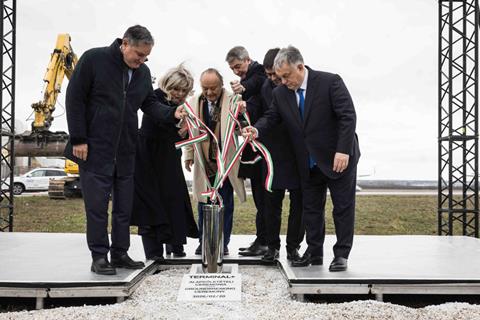
The foundation stone was laid during a ceremony attended by Viktor Orbán, Prime Minister of Hungary, Márton Nagy, Minister for National Economy, Nicolas Notebaert, President of VINCI Concessions and VINCI Airports, and François Berisot, CEO of Budapest Airport. The event formally signalled the start of a large scale expansion and modernisation programme at BUD.
Following a record year in 2025, when BUD handled nearly 20 million passengers, representing a 35% increase compared with the end of 2023, the project is intended to meet sustained traffic growth and future proof the airport’s infrastructure. The investment programme, valued at €1 billion over the next decade, is among the most substantial airport development initiatives in Central Europe.
The development includes a new 35,000 sqm main terminal with centralised check in, optimised security screening zones and integrated commercial areas designed to enhance passenger flow and dwell time. A 19,000 sqm passenger pier will be constructed alongside the expansion of apron areas by 132,000 sqm, incorporating 13 new aircraft stands and a dedicated de-icing facility.
Landside works form part of the scheme, including refurbishment of car parks, upgrades to internal and external road networks and enhancements to kerbside areas aligned with the new centralised terminal layout.
The Hungarian Government has also announced complementary surface access investments, including a direct rail link to BUD and the refurbishment and multi-lane expansion of the airport express road.
In parallel, targeted upgrades to Terminal 2 are underway to maintain operational resilience during construction. These include reconfiguration of the check-in hall to add counters, security lane enhancements with advanced screening technology, reorientation of automatic gates and the creation of a dedicated lane for passengers with reduced mobility, families and Fast Track users. Pier B will also be expanded to increase non-Schengen handling capacity.
Upon completion, BUD’s incremental capacity is expected to increase by more than 10 million passengers, reinforcing its role as a leading international gateway for Hungary and the wider Central European region.
Stay Ahead in Aviation — Subscribe for Free!
Get exclusive access to the latest aviation insights from International Airport Review — all tailored to your interests.
✅ Expert-Led Webinars – Learn from industry leaders
✅ Weekly News & Reports – Airport updates, thought leadership, and exclusive interviews
✅ Event Invitations – Be part of the International Airport Summit
✅ Partner Innovations – Discover the latest industry trends
Choose the updates that matter most to you. Sign up now and stay informed, inspired, and connected — all for free!
Thank you for being part of our community. Let’s keep exploring the future of aviation together!