


International Airport Summit speaker István Szabo, explains why Berlin Brandenburg Airport is using its current spare capacity to improve passenger flow now - before future growth, tighter schedules and new processes create delays, longer queues and pressure on operations and revenue.
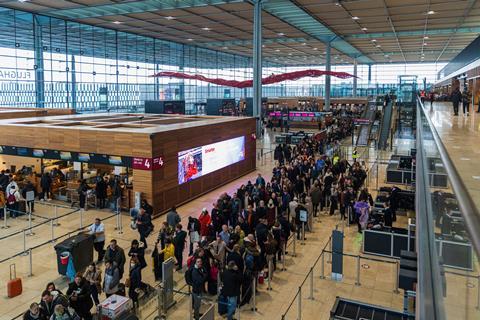
Berlin Brandenburg Airport is not capacity-constrained today. That is precisely why now is the moment to engineer passenger flow – before growth, geopolitics or schedule density turn comfort into pressure.
The window most airports miss
Berlin Brandenburg Airport (BER) was built with significant headroom. With around 26 million passengers in 2025 against a designed capacity well above that figure, BER is not, in operational terms, a constrained terminal. We have space at the kerb, lanes at security, and gates at the pier. On most days, our queues are short and our dwell times are healthy.
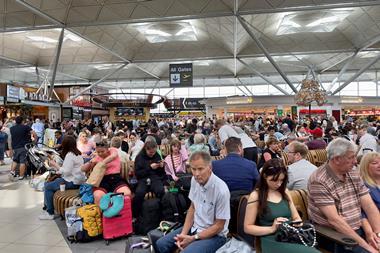
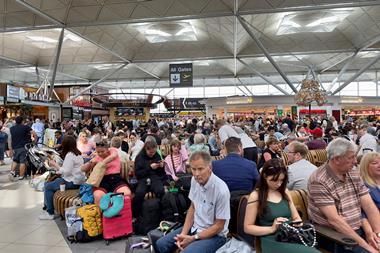
This is exactly the moment to think hardest about flow. Most airports start optimising passenger flow when they are already in trouble – when the queues are visible, the complaints are loud, and the commercial impact is showing in the monthly numbers. By that point, the easy interventions are gone, and every change is a retrofit. The window to design flow into the operation, rather than bolt it on later, is the window we are in now.
Why BER are not waiting
Three forces will close that window. First, traffic recovery and growth. European aviation continues its return to and beyond pre-pandemic volumes, and BER’s natural catchment supports meaningful growth over the next decade. Second, schedule peaks. Low-cost carriers, who are central to our route network, concentrate departures in tight morning and evening waves. Capacity headroom across the day disappears quickly when 60% of it is consumed in two windows. Third, process complexity. EES, ETIAS, evolving security technology, and shifting airline check-in practices all add steps that did not exist a decade ago. Each step, individually small, compounds into a measurable queue time.
Any one of these would be manageable. In combination, they will turn today’s comfortable terminal into tomorrow’s constrained one – unless the operating model is ready before they arrive.
What designing ahead actually means
Engineering for future constraints is not the same as building more terminals. It is about three less visible investments.
The first is data infrastructure. We are building the sensor layer, the flow models and the operational dashboards now, while we have the slack to test, calibrate and trust them. A predictive queue model deployed in a quiet terminal can be tuned and validated. The same model deployed for the first time in a peak crisis is a liability, not an asset.
The second is operational discipline – the closed loop of forecast, decision, execution and measurement. Reallocating security lanes, repositioning staff, opening or closing gates, adjusting bag drop assignments: these decisions need to be made in minutes, by clearly accountable people, with the authority to act. That muscle is built through repetition in calm conditions, not invented under pressure.
The third is partnership architecture. Flow is never the airport’s problem alone. Airlines shape the peak through their check-in practices. Security providers determine throughput through their staffing and lane design. Handlers determine bag release time. Retailers and F&B partners depend on dwell to convert. We are using this period of operational comfort to establish joint reviews, shared data, and aligned incentives across these parties – conversations that are far harder to start when everyone is firefighting.
Concrete steps already in motion
Two examples from BER illustrate the approach.
Family lane at security: We recently introduced a dedicated lane for passengers travelling with small children. Today, this is a passenger experience initiative – families get a calmer, less rushed checkpoint. But the operational logic is also forward-looking: when our peaks intensify, removing the slowest-processing cohort from the standard lanes will protect throughput on those lanes. We are building the lane, the staffing model and passenger awareness now, so the capability is mature when we need it.
Dynamic lane management: We are moving from fixed lane allocations toward near-real-time reassignment based on forecast and actual load. In today’s conditions, this primarily improves consistency. In the conditions of tomorrow, it will be the difference between a manageable peak and a public one.
Dwell as the commercial output
There is a reason flow matters commercially as well as operationally. Passengers who clear security calmly and early spend more, eat more, and rate the experience higher. Revenue per passenger correlates more tightly with average dwell time than with footfall. As long as our peaks remain modest, dwell is healthy and the commercial offer benefits. Protecting dwell as traffic grows is one of the clearest reasons to invest in flow now: every minute lost to a future queue is a minute lost to the commercial floor.
This is also why the airline–airport conversation must evolve. A check-in process that pushes its peak too close to departure is, in commercial terms, a tax on the airport’s retail performance and on the passenger’s experience score. We are increasingly able to quantify this, and increasingly willing to discuss it with our airline partners as a shared problem.
What constrained terminals teach – and what unconstrained terminals should learn
There is a tendency in our industry to assume that the airports doing the most interesting work on flow are the most squeezed ones. There is truth in this: constraint is a powerful teacher. But the airports that will define the next decade of passenger experience are not only the ones forced to innovate by their physical walls. They are also the ones who use their headroom deliberately – who treat capacity comfort as a window for capability building, not a reason to defer it.
BER is in that window now. The fireside chat in Rome will give us a chance to compare notes with airports further along the constraint curve. I expect we will find that the playbook converges – synchronise inputs, specialise where the passenger mix is heterogeneous, close the operational loop, treat dwell as a shared output – whether you are designing for a constraint you already feel or one you can see coming.
The best time to engineer flow is before you have to. That is the position we are working from.
István Szabo will explore these themes in greater depth during his fireside chat ‘Unblocking passenger flow and satisfaction in constrained terminals’ at International Airport Summit on 11 November. This session examines how airports can create smoother passenger flow even when operating in increasingly constrained terminal footprints.
Register for the summit today to ensure you are in the room when István takes to the stage.





No comments yet