

Samuel í Hjøllum Rude, Vice President Head of Operational Airport Services at Copenhagen Airport explains how their new departure operator module will increase chute utilisation and delay new infrastructure.
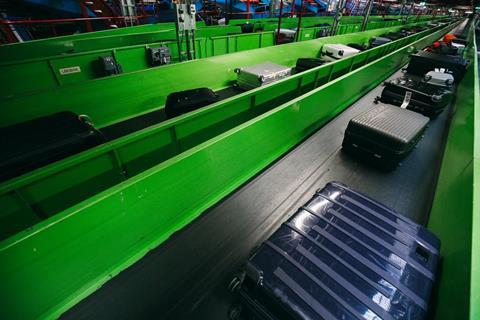
In April 2026, Copenhagen Airport (CPH) introduced its newest innovation in baggage optimisation: the departure operator module, a decision‑science and AI‑enabled solution designed to increase the utilisation of baggage chutes, make‑up positions, and early baggage storage. As passenger volumes continue to rise, the ability to extract more from every square metre of existing infrastructure has become critical. The new module represents a strategic step in CPH’s long‑term ambition to enhance operational efficiency through data‑driven processes and intelligent automation.
Operating within tight physical boundaries
Like many major airports, Copenhagen Airport operates with significant spatial constraints. Runways positioned south and east of the terminal area and major rail and motorway infrastructure to the north leave limited room for physical expansion of the baggage system. As a result, the airport has, for many years, focused on optimising existing processes and facilities rather than solely relying on large‑scale construction to accommodate growth.
This focus has intensified in recent years with CPH experiencing strong increases in passenger and baggage volumes, putting additional pressure on the availability of make‑up positions and baggage chutes. With capacity becoming increasingly scarce, the airport needed a smarter approach to allocation of departing baggage. One that could respond dynamically to operational patterns while respecting the limitations of the physical BHS infrastructure.
AI, forecasting, and intelligent allocation
The introduction of the departure operator module builds on several earlier successes in applying machine learning and advanced allocation algorithms to airport operations. Given the positive experiences in other areas of the baggage process, it was a natural step for CPH to extend these technologies to the allocation of make‑up chutes. The module combines machine learning with advanced optimisation logic to forecast baggage volumes, predict segregation levels, and determine the number of make‑up positions required for each departing flight.
By analysing historical and real-time data, the system establishes baggage show‑up curves that allow it to predict when bags will enter the system, enabling more precise use of the early baggage store (EBS) and significantly shorter opening windows for the chutes.
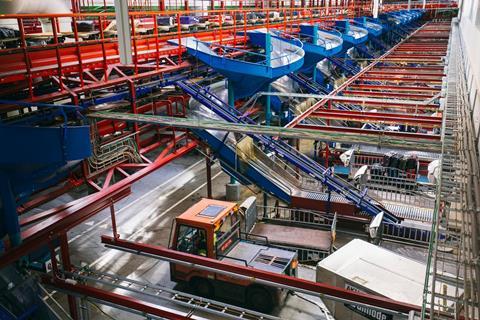
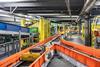
This introduces what CPH refers to as a ‘compressed build’ model, where make‑up processes are condensed into tighter intervals. Instead of allocating long opening periods as a buffer against uncertainty, the system uses data‑driven predictions to match actual operational needs much more closely. Once the required number of make‑up positions and opening durations are defined, the system allocates flights across the 130 chutes in Baggage Factory 3. Here, an advanced optimisation algorithm takes on what is essentially a highly complex jigsaw puzzle, filling even the smallest gaps in the Gantt chart. The result is a significantly improved utilisation of every available position within the baggage hall.
A robust integration with high‑level control
To ensure that the optimised allocation could be implemented in real operations, CPH decided early in the development process to integrate the departure operator module with the airport’s high‑level control system (VIBES). The integration approach was carefully designed to maintain operational resilience and avoid creating new dependencies that could introduce unnecessary risk. Rather than pushing real‑time instructions into the control system, the optimised allocation is transferred in a pre‑tactical process the day before operations (D‑1).
This ensures that the high‑level control always operates with a stable, validated allocation plan, while retaining the ability to manage last‑minute changes, delays, cancellations, and other schedule disruptions without relying on real‑time input from the optimisation module.
This hybrid design provides what CPH describes as the best of both worlds: an airport that benefits from cutting‑edge machine learning and optimisation, while remaining robust in the face of operational irregularities. It also aligns with CPH’s philosophy that technological innovation should never compromise system stability, particularly in mission‑critical environments such as baggage handling.
Change management as the real foundation for success
Although the departure operator module includes advanced AI and algorithmic components, Copenhagen Airport has deliberately avoided framing it as an IT project. Instead, it has been managed from the beginning as a change management initiative with a strong operational anchor. Recognising that ground handling companies and baggage control room staff would ultimately be the users most affected by the new allocation principles, CPH involved these groups early in the design and prototyping phases.
Through workshops, simulations, and operational dialogue, operational employees contributed insights into show‑up patterns, build behaviours, and day‑to‑day constraints that the optimisation system needed to respect.
In addition, the project required close collaboration between the algorithm developers, the high‑level control supplier, and the airport’s team. This partnership ensured that technical performance, operational feasibility, and system resilience evolved in parallel rather than in isolation. The result is a solution that does not merely perform well in theory, but is shaped to fit real operational needs, making it easier for frontline staff to adopt and trust the new, compressed processes. For CPH, this operational involvement has been as important to the project’s success as the underlying technology itself.
Unlocking capacity today while preparing for tomorrow
With the departure operator module moving into operation, Copenhagen Airport expects to handle a substantial increase in departures before additional infrastructure becomes necessary. Beyond immediate capacity gains, the system will generate richer and more granular data, enabling further refinement of algorithms and continuous improvement of operational strategies. The new module joins a suite of earlier digital solutions already in place at CPH, including live optimisation for arrival allocations and systems that identify ‘hot’ transfer bags to support ground handlers in choosing the most efficient transfer process for each connection.
Although these digital tools significantly increase the capacity of the existing baggage facilities, CPH also recognises that long‑term growth requires physical expansion. To support future demand, the airport has launched a tender for a new baggage sortation facility inspired by modern warehouse operations. The new facility will feature an individual carrier system, a large early bag store, and eight make‑up stations designed for lean, batch‑based processes. In parallel, a new baggage reclaim hall with expanded transfer offload capacity will come into operation in 2027. These developments form part of a long‑term transformation that combines digital optimisation with modern physical infrastructure.
Samuel will be presenting on this innovation at the International Airport Summit taking place in Rome on 10-12 November. Make sure you are in the room to hear first-hand how their innovation improved the utilisation of baggage chutes, make up positions, and early baggage storage, and to network with him afterwards.
Register for your FREE* ticket foday.
*Free aviation leader tickets are applicable to senior managers and above from airports, airlines, regulatory bodies and aviation authorities only.
This article was published in International Airport Review’s baggage innovation eReport in May 2026.
To read the full eReport click here.



No comments yet