

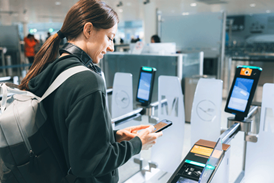

International Airport Summit speaker Tatsuya Izumi of Narita International Airport asks: “is baggage handling a hidden goldmine?”

The world has changed dramatically over the roughly 50 years since Narita Airport first opened. Handwritten paperwork and wired telephones have largely disappeared. Today, everything is connected to the internet. We communicate with people around the world on wireless smartphones with no buttons, and AI can gather and present information for us in an instant.
And yet, despite all this progress, one part of air travel still works in a surprisingly traditional way: checked baggage. Bags are still sorted by reading barcodes printed on paper tags and then loaded into containers largely by hand. Of course, there have been improvements. Barcode reading has become more accurate, moving from infrared scanning to optical character recognition. Some airports have also upgraded from belt-based sortation systems to individual carrier-based transport, improving baggage control. Even so, much of the overall process still depends heavily on human labour.
Mishandled baggage: a shared headache
According to SITA Baggage IT Insights 2025, 6.3 bags per 1,000 passengers are still mishandled. This remains a shared headache across the aviation industry, costing an average of $5 billion each year. Many people across the sector have been working hard to solve this problem. However, real-world constraints, such as the need to minimise cost and avoid disruption to existing operations, have made it difficult to find a truly fundamental solution.
Looking at this challenge, one might feel discouraged and think, what a difficult industry to be in. But I believe we should see it differently.
It is easy to feel overwhelmed by the sheer number of problems and limitations. But when a challenge is this clear, and when so many new technologies are becoming available, there is a real opportunity to create new value.
Exploring baggage identification methods
The first issue I focused on was baggage identification. At many airports, each checked bag is identified through the barcode printed on its baggage tag, which is then used for sorting and verification. But in a certain number of cases, the tag is damaged during transport, or even comes off completely, leading directly to mishandling.
Some airports, such as Hong Kong International Airport, have adopted a different solution by attaching RFID-enabled tags to every bag, allowing more accurate identification. However, compared with ordinary paper baggage tags, RFID tags are more expensive and require the right infrastructure for reading them. For that reason, many airlines and airport operators have not been eager to introduce them on a large scale. Reusable electronic tags with built-in RFID have also emerged, but these too have yet to become widely adopted.
As I explored alternative solutions, I spoke with several engineers from start-ups providing AI solutions. Through those conversations, I became convinced that AI-powered image recognition could offer a strong new way to identify baggage. One of those companies showed real interest, and we decided to start our journey to develop the technology with them.
A proof-of-concept with potential
Our first step was to test whether AI could realistically acquire the ability to identify baggage. We carried out a proof-of-concept using an untrained AI model to see whether it could recognise baggage, and whether it could match images of the same bag taken at two different locations. The results were encouraging. Even without any prior training, the AI was able to recognise the presence of baggage in an image and distinguish one bag from another with an accuracy of over 50%. That was enough to show the idea had real potential.
We then trained the AI using 5,000 baggage images and continued improving its performance. Today, we have reached a level where the system can identify baggage correctly with over 90% accuracy. Our next challenge is to ensure that performance remains stable under various and difficult real-operating conditions. We are now exploring ways to reduce the impact of factors such as lighting and image resolution so that accuracy does not drop depending on camera specifications and installation conditions. Development is continuing with implementation in mind.
A better future for baggage handling
If a solution based on this technology can be realised, it could make baggage tracking and management both more precise and more affordable. Instead of relying only on expensive Automatic Tag Readers (ATRs), which also require installation space, airports could make use of images from CCTV cameras that are already installed in many locations. This would open the way for more detailed baggage tracking at lower cost.
It could also help enable baggage reconciliation system (BRS) functions, which are currently one of the barriers to automating baggage loading and unloading. In addition, if an image of a lost bag can be captured, it may be possible to extract customer-related information from that image, identify the bag more quickly, and shorten the time needed to return mishandled baggage to the passenger.
Once the technology reaches a fully practical level, the first use case we envision is manual coding, the process of reading tag information or adding ID to baggage that ATRs fail to read automatically. By simplifying the tag-reading and baggage-number input tasks that are currently performed by hand, we hope to reduce labour and improve efficiency. If strong results can be achieved, we would then like to expand the technology into other operational areas, further improving both accuracy and applicability.
In the future, I also hope that standards for this approach can be developed so that passengers, airlines and airport operators around the world can benefit from it.
This is how a single operational challenge can become the seed of new value. Moving forward, I want to continue solving problems one by one, and turning those solutions into new value for the industry and for passengers alike.
Tatsuya will be speaking at International Airport Summit 2026 in Rome on this very topic. Make sure you are in the room while he is on stage to gain insight first-hand and ask him questions.





No comments yet