Richard Thompson of Smiths Detection explores how airports are shifting towards integrated, connected screening systems as CT, AI support and open architecture redefine security performance, throughput and resilience across checkpoints and hold baggage.
Airport security sits at the intersection of growth and constraint. Passenger volumes arrive in peaks rather than tidy averages, airport expansion struggles to keep pace with growth, and screening teams are expected to deliver assurance without security becoming a bottleneck in the journey.
The interdependence across screening is well understood. A slowdown at divestment becomes a queue in the terminal, and disruption in hold baggage can ripple into on-time performance and baggage delivery. Yet in many airports, cabin baggage and hold baggage still operate as adjacent domains, shaped by different regulatory deadlines, investment cycles and, often, different digital ecosystems. That can leave performance optimised in parts rather than across the whole journey.
The next phase of baggage screening is therefore becoming a holistic question, driven as much by digital transformation as by imaging capability. Connectivity, open architecture and secure interoperability are moving from technical preferences to operational requirements. These aspects determine whether airports can integrate multi-vendor environments, scale improvements across lanes and terminals, and introduce new workflows without repeated disruption.
CT becomes the baseline, but the operational prize is flow
Computed tomography (CT) has become the anchor technology for modern screening, both at the checkpoint and in the hold. Its technical advantage is well known: three-dimensional imaging improves visibility and separation of objects compared with conventional two-dimensional X-ray. The more consequential change, however, is operational. CT can reduce the number of steps that have often made screening appear to operate in a stop-start pattern.
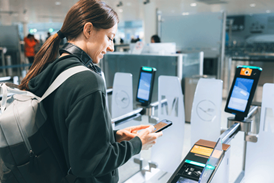
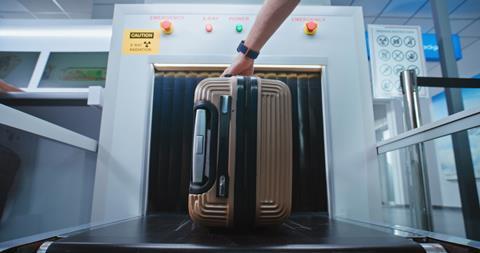
For cabin baggage, that shift is most visible at divestment. Traditional processes often require passengers to remove laptops, liquids and other items, increasing tray handling, slowing the lane and creating uncertainty that compounds into queues. CT-based screening can simplify those instructions, though the detail depends on local rules and the capability of the deployed system. In some deployments, Smiths Detection’s HI-SCAN 6040 CTiX is associated with a reduced divestment configuration, allowing travellers to keep electronics in their bags and, where permitted, carry liquids in volumes of up to two litres without removing them. The significance is not convenience for its own sake, but the effect on variability. The fewer moments the process forces passengers to stop, unpack, interpret instructions under pressure and repack, the steadier the lane becomes.
Flow, however, is rarely dictated by the scanner alone. It is shaped by how quickly exceptions are resolved, how reliably trays circulate, and how well the operation absorbs the minor disruptions that occur every day, from small faults to staffing gaps. That is why the physical design of the lane is now treated as part of screening performance rather than a separate procurement category. Systems such as Smiths Detection’s iLane A20 address the mechanics of movement because a few seconds saved at divestment or tray return can add up across thousands of passengers, particularly when an operation is running close to its limits.

Credit: Smiths Detection.
Decision-making becomes the bottleneck that matters
As imaging capability improves, decision-making often becomes the limiting factor. Airports can install more capable systems and still find that alarm volumes, secondary checks and manual resolution dictate throughput.
This is one reason interest in AI has become more practical than ideological. The question is not whether algorithms look impressive in a demonstration, but whether decision support reduces avoidable interventions and makes outcomes more consistent when the lane is under pressure.
In Smiths Detection’s range, iCMORE is positioned as AI-enabled decision support that flags defined targets to help operators focus on what genuinely requires judgement. For airport leaders, that translates into a more stable checkpoint because routine decisions can be handled more efficiently and expertise can be concentrated where it is most needed.
This is also where automation needs restraint. The next few years are unlikely to be defined by sweeping replacement of human judgement, not least because aviation security is governed by validation, oversight and accountability. A more plausible path is incremental automation of routine review and workflow triage, within the governance frameworks regulators demand. The system becomes better at handling the predictable so operators can focus on the exceptional, and the airport gains consistency while maintaining the security standards that keep the travelling public safe.
Hold baggage shifts from compliance to operational value
Hold baggage screening is governed by different realities. It is largely invisible to passengers, but operationally unforgiving. It must process large volumes continuously, handle transfer complexity, and maintain compliance without creating congestion that ripples into flight schedules.
Procurement has traditionally been driven by mandated upgrade cycles. That framing is changing. Airports are increasingly treating hold baggage as a long-term systems investment, judged on reliability, false alarm rates and lifecycle performance. High false alarm rates do not just add cost; they slow the system and raise the risk of missed connections. Uptime, serviceability and maintenance planning have become strategic because the cost of disruption is measured across the wider operation.
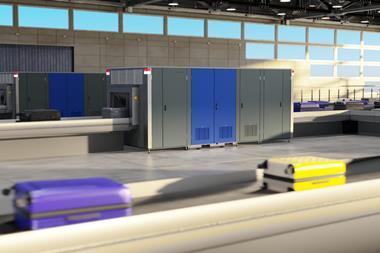
Smiths Detection’s SDX 10080 SCT sits in this context as a hold baggage CT platform designed for high-volume performance and improved material discrimination, i.e. low false alarm rates. Dual-energy capability helps distinguish materials that can appear similar in CT, and the platform is engineered to accommodate complementary detection methods as requirements evolve. Its modular architecture supports scaling as operations grow and to enable upgrades without redesigning the wider system. The broader shift is towards layered detection and upgradeable platforms, rather than replacement driven solely by compliance deadlines.

Credit: Smiths Detection.
Connectivity and open architecture are the real pivot
If CT is the baseline technology shift, connectivity is the operational shift that turns screening into an end-to-end capability. Airports rarely run single-vendor estates. They manage a mix of lanes, scanners, baggage handling systems and IT platforms accumulated over years. In that environment, interoperability is not a design preference; it is the condition for improving performance without rebuilding everything.
Open architecture has become shorthand for this requirement. It reflects a push towards modular systems that integrate with third-party technologies, incorporate new capabilities, and evolve through software. For airports, the appeal is practical: less lock-in and a clearer path to scale improvements across an estate, with more capability added through software and integration rather than disruptive replacement cycles.
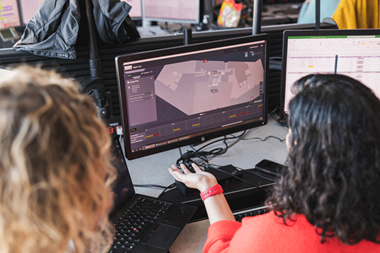
Connectivity also enables new operating models. Centralised image review and remote screening architectures can shift workload away from the lane, reduce congestion at the point of screening, and pool expertise across a network rather than relying solely on what is available at a particular workstation. That matters in two ways. It increases operational flexibility, helping airports allocate skill where it is needed most, and it can improve consistency by reducing the variability that comes from isolated decision-making under pressure.
None of this comes without cost. Connectivity pulls cybersecurity and governance to the centre, because a connected security system must be defensible as well as efficient. Airports increasingly judge not only what a system can detect, but how it manages data, access, updates and auditability. In practice, the digital layer becomes part of security performance.
What airports are really buying is an operating model that performs under pressure, not a collection of discrete machines. The value sits in how well checkpoint and hold baggage operate as one system: shared data, consistent workflows, and a clear line of sight from detection performance to throughput and disruption recovery. That is why software and connectivity are moving to the centre. They determine whether improvements can be scaled across terminals, introduced without repeated operational upheaval, and governed with the auditability and cybersecurity that aviation demands. Any “end-to-end” claim only matters to the extent it delivers that outcome: an integrated set-up that can be managed, measured and improved over time.
What comes next?
The next phase of baggage screening will be shaped by convergence rather than a single breakthrough. CT will continue to spread, driven by regulation and by the operational logic of reducing friction at the checkpoint and improving detection capability in the hold. AI-enabled decision support will expand cautiously, focused on routine review, alarm triage and consistency under peak load. Open architecture will harden into an expectation as airports seek systems that integrate across vendors and evolve through software without repeated disruption.
The unifying theme is that screening is becoming a networked capability. The most important improvements will not always be the most visible, but they will show up in outcomes that matter to airport leadership teams: stable throughput at peak, predictable recovery from disruption, defensible performance under audit, and a passenger experience that does not falter at the point of security.
Baggage screening will ultimately be judged on three outcomes that have to be delivered together: regulatory compliance, strong security performance, and throughput. What is changing is how airports intend to achieve that balance. The emphasis is shifting towards resilience and control: technology that reduces process friction, decision support that improves consistency, and secure connectivity that allows performance to be managed across an entire estate. In a sector where demand continues to rise and space remains finite, the airports that perform best will be those that treat screening as a system that can be run, measured and improved over time.
About the author
Richard Thompson sits on the senior leadership team and is accountable for the Technology and Marketing (Portfolio) functions of Smiths Detection. His primary objective is assuring the sustained long-term performance and profitable growth of the portfolios including innovation and digital transformation.
Richard joined Smiths in 2016 and has served as Head of Market: Western Europe, Global Industry Director: Aviation and VP: Marketing. Prior to Smiths, Richard spent 8 years in GM roles at Honeywell (Process Controls), and 6 years as MD of ENRAF UK.
Richard holds a BA in Business Studies and has worked several international assignments including 4 years based in Singapore. Richard speaks fluent French and lives in the UK.