


Firat Ocak, Aviation Development Director at iGA Istanbul Airport, tells International Airport Review how sister airport partnerships, new runway capacity, and a luxury private terminal are driving the hub’s ambition to become Europe’s busiest airport.
As one of the world’s largest aviation hubs, iGA Istanbul Airport continues to grow and expand. Yet, developing and expanding an airport can go beyond just increasing its own physical footprint.
Sister airports have become an important connection for iGA. Concisely, a sister airport is a cooperative partnership between two global aviation hubs that agree to share knowledge, operational strategies, and data.
Firat Ocak, Aviation Development Director at iGA Istanbul Airport, explains that:
“We [iGA] are giving a lot of importance to these sister airport partnerships. We now have 11 airports which make up a very diversified portfolio. The most recent [partnerships we have formed] are with Chicago and Sydney Airports.”
The collaborations between iGA and its sister airports create value for both airports. Several of iGA’s sister airports are situated in China, the largest being Beijing Capital International Airport (PEK).
iGA became a Chinese Friendly Airport back in 2019. That included changing all of its signage, introducing Chinese-language signs, Chinese-speaking information kiosks and implementing Alipay and other Chinese payment systems throughout the airport. During all these projects, iGA took input from its sister airports.
Being a fairly new airport, having opened in 2019, iGA doesn’t have any capacity issues.”
“They gave us feedback on what to do next. Every year we collaborate with [our sister airports in China] on celebrations such as Chinese New Year. We stay in touch to discuss what else we can do throughout the year,” says Firat.
Infrastructure basis for growth
iGA Istanbul Airport has claimed the top spot globally for hub connectivity, overtaking Frankfurt according to the Airport Industry Connectivity Report by ACI EUROPE. Fundamental in driving that growth, according to Firat, is “infrastructure itself.”
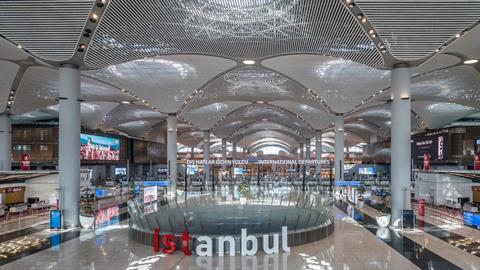
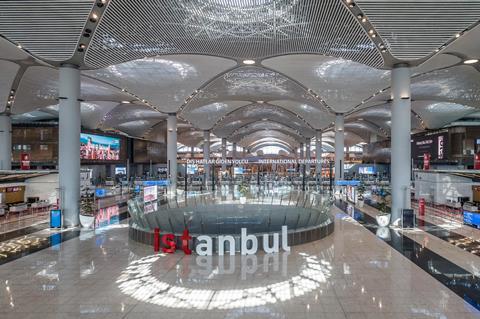
Being a fairly new airport, having opened in 2019, iGA doesn’t have any capacity issues. With a terminal building of 1.4 million square metres, iGA Istanbul has one of the largest terminal buildings under one roof in the world.
They also have three independent parallel runways, which enable more than 110 to 120 aircraft movements per hour.
“This puts us in a very good position for our home carrier to continue growing. At the same time, we can attract new airlines to meet demand,” notes Firat.
Connecting passengers generate less yield for iGA, while they can earn more from point-to-point passengers. Firat tells how they are “working to increase Istanbul’s tourism potential and grow our point-to-point traffic.”
“We have a concession period of 25 years starting from 2019. There was a force majeure event, so we’ll now be operating until around 2047.”
By then, iGA expects to exceed 120 million passengers.
This year it is targeting 90 million passengers and looking to surpass London to become the busiest airport in Europe. After that, everything depends on how Istanbul grows as a destination and how transfer traffic develops.
“Personally, I don’t think 120 million passengers will be enough. Our infrastructure is capable of handling up to around 150 million passengers,” says Firat.
Opening a crosswind runway
This year iGA will be opening up its fourth runway, specifically a crosswind runway running east to west. It will only be used for departures because arrivals cannot be assigned there due to the way it intersects with existing arrival operations.
Aircraft departing towards the east, such as domestic destinations, Asia or Southeast Asia, will be able to use that runway directly. It will improve efficiency, reduce departure taxi times and allow airlines to burn less fuel.
Firat notes:
“At the moment, aircraft generally depart towards the north and then turn in the air if they are heading east or south. With the new runway, they’ll be able to depart directly to the east and continue straight on course. So, it will provide additional fuel efficiency.”
Luxury terminal

iGA has opened a private terminal, the first of its kind in Turkey. The Jetex iGA Terminal is a luxury VIP private aviation and passenger facility at Istanbul Airport. It serves both private jet users and commercial airline travellers seeking an exclusive airport experience.
The region has a significant premium passenger base. Istanbul has almost 70 million people in its wider region and also has substantial connecting traffic from the CIS (Commonwealth of Independent States) region and the Middle East.
“We recognised there was strong demand for a premium passenger experience. The terminal is completely separate from the main terminal. Passengers travelling on either commercial or private flights can use it,” reveals Firat.
The Jetex opened at the beginning of May, and at that time they were serving around 30 to 40 passengers per day.
“We expect these numbers to increase, particularly as our busiest period starts in June. The recent issues in the Middle East affected us and we saw a number of cancellations, particularly from Qatar. As demand recovers, we’re aiming for more than 100 passengers per day.”
For Firat, it’s clear that iGA’s growth is multifaceted, and that development enriched by collaboration will help drive the airport’s future performance.
About the interviewee

Firat Ocak is the Aviation Development Director at iGA Istanbul Airport, a role he has held since May 2024. Based in Istanbul, Türkiye, he brings nearly nine years of experience with the airport, having previously held roles at İGA Istanbul Airport as well as TAV Airports. Firat holds a degree from Bilkent Üniversitesi (2004–2008) and brings a strong skill set in project planning, business planning, business strategy, management, and analysis.












No comments yet