
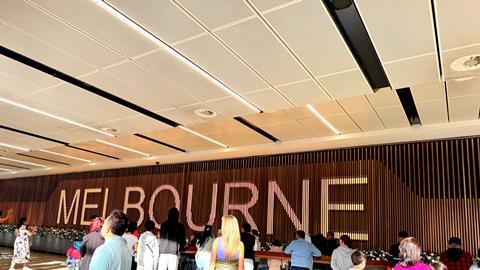
Planning and design of Melbourne Airport’s $4.5 billion international terminal expansion is advancing, with new artist impressions released after the closure of the Departures ramp.
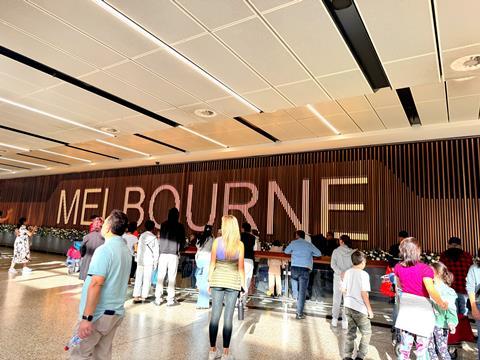
Planning and design of the $4.5 billion international terminal expansion at Melbourne Airport (MEL) is progressing, following the opening of new pick-up and drop-off zones for Terminals 1, 2 and 3 earlier this month.
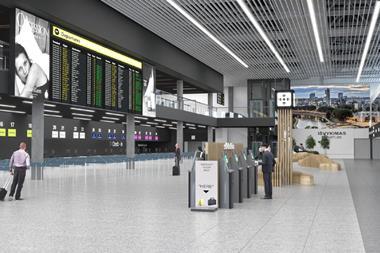
New artist impressions have been released showing the additional space that will be created as the terminal footprint expands into the current forecourt area. The designs will enlarge the check-in, arrivals and departure satellite areas and seek to maximise natural light to create a calming environment and enhance passengers’ sense of wellbeing.
Staged delivery alongside third runway construction
The expansion will be delivered as a series of projects so that Australia’s largest 24-hour gateway can continue to operate, with works taking place alongside construction of Melbourne Airport’s third runway. The project is enabled by the closure of the 56-year-old Departures ramp and the opening of the new pick-up and drop-off zones in the T123 Transport Hub.
Melbourne Airport said planning, design and staging of the project are still being worked through, with enabling works in the terminal forecourt expected to continue for most of next year. The airport acknowledged the scale of the challenge: “Suffice to say it will be complex given the need to keep Australia’s largest 24-hour international gateway open and operating while expanding the terminal infrastructure!”
The airport said that although construction of the third runway and the international terminal expansion will take place at the same time, there will be very little interface between the two projects because they are located on opposite sides of the airport. The third runway is being built to the west of the existing north-south runway, while the terminal complex is to the east. Melbourne Airport described the projects as complementary, enabling airlines to schedule more flights to the places passengers want to fly, at the times they want to travel.
In the first two weeks of operation, the new zones and elevated roadway have cut average travel times between Mickleham Road and the airport drop-off zone by 10 minutes during peak times. Feedback from drivers and passengers has been positive, and the airport is adding signage where needed to help people navigate the new arrangement.
Melbourne Airport said the transition had “highlighted the importance of listening to travellers and responding quickly to problems that impact the passenger experience.” It added that it was grateful for the way passengers had embraced the changes and appreciated their patience as work continues on the terminal facilities.
Melbourne Airport CEO Lorie Argus said the new zones were the first phase of a $17 billion privately funded infrastructure pipeline.
“Demand for travel to and from Melbourne continues to grow and we are building the terminal, airfield and transport facilities we need to support that,” she said.
Argus said the closure of the Departures ramp allows the airport to move to the next stage of planning.
“With the old Departures ramp now closed to traffic we can start to plan further changes in the arrivals forecourt that will allow us to start construction on the much-needed international terminal expansion.”
When terminal works are complete, passengers will have more space at check-in and baggage claim, with higher ceilings and more natural light, alongside five additional gates for airlines and an upgraded lounge and retail offering, according to the airport. The third runway is intended to reduce flight delays and give airlines greater flexibility in scheduling.
The announcement follows Melbourne Airport’s busiest September on record, with 3,143,097 passengers (excluding transits) passing through the terminals, up 2.5 per cent on September 2025. Domestic passengers totalled 2,114,826, an increase of 3.6 per cent, while international passengers rose 0.2 per cent to 998,271. The airport said the Brisbane Lions, Fremantle Dockers, San Francisco 49ers and LA Rams contributed to the result.
For the financial year to September, total passengers numbered 9,200,687, down 0.5 per cent on the same period of FY 2025/26. International passengers fell 1.3 per cent to 2,961,607, while domestic passengers declined 0.2 per cent to 6,239,080.
Argus said: “We’re incredibly excited to be delivering this upgrade to Melbourne Airport and we thank people for their patience while we work to build the new infrastructure in amongst our 24-hour operation.”




No comments yet