
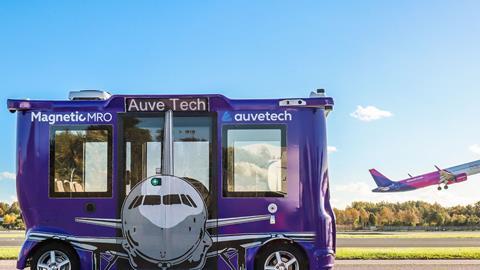
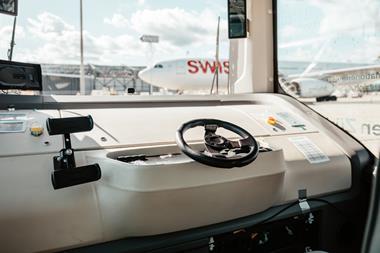
This week’s picture of the week is Auve Tech demonstrating its MiCa autonomous shuttle operating at Tallinn Airport without an onboard safety operator, supporting Magnetic MRO’s daily transport of employees and equipment.

Auve Tech has demonstrated its MiCa autonomous shuttle operating at Tallinn Airport (TLL) without an onboard safety operator, in cooperation with Magnetic MRO. The demonstration showed autonomous transport under remote supervision in a live airport environment.
Auve Tech received authorisation in August 2026 to remove the onboard safety operator from its passenger service at the airport. The company said it became the first European company to operate autonomous passenger transport at an airport without an onboard safety operator following the approval. Government, aviation, industry and media representatives experienced a service that is not a closed-course pilot, as it supports Magnetic MRO’s daily transport of employees and equipment.
Remote supervision supports fleet scalability
MiCa is an eight-passenger electric autonomous shuttle developed and manufactured in Estonia for the transport of people and goods in airports, industrial sites and urban environments. The Level 4 autonomous vehicle uses cameras and LiDAR sensors to perceive its surroundings and can be monitored and supported through a remote supervision centre.
Kaarel Variksaar, CEO of Auve Tech, said: “The real breakthrough for autonomous vehicles will occur when the technology can operate daily in real-world environments without a human on board. We have reached precisely this stage at Tallinn Airport. A single remote operator can monitor multiple vehicles, and this is a key step toward making autonomous transport economically competitive and scalable.”
The remote supervision model allows one supervisor to oversee several vehicles and intervene only when needed, rather than assigning one driver to every vehicle. According to the company, this improves fleet utilisation, reduces operating costs and allows the service to scale without staffing increasing at the same rate, while maintaining safe and efficient operations.
The cooperation between Auve Tech and Magnetic MRO began in 2023 with testing inside the airport area and moved into commercial operations in 2025 after continuous development, validation and experience in complex conditions. Today, MiCa shuttles connect Magnetic MRO facilities on the airside, covering approximately 1,000 kilometres per week with an average autonomy rate of 99.9 per cent.
At Magnetic MRO, the shuttles connect hangars across the airport area, transporting employees and equipment between facilities. The service has become part of everyday MRO operations, reducing reliance on conventional transport, and Auve Tech said it demonstrates how autonomous mobility can be integrated into a highly regulated aviation environment.
Risto Mäeots, CEO of Magnetic Group, said: “For us, this is not about testing technology anymore. The autonomous vehicles are already part of our daily operations, supporting the continuous movement of people and supplies between our hangars. They help us manage the last mile of our internal logistics more efficiently, while allowing our people to focus on the work where their expertise is really needed. Removing the onboard safety operator is an important next step in making the solution even more efficient and scalable.”
As airports work to improve efficiency and address workforce challenges, Auve Tech said autonomous shuttles offer a way to move passengers, employees and equipment. They can support staff transport and logistics services, as well as future passenger mobility solutions.
Riivo Tuvike, Chairman of the Management Board of Tallinn Airport, said: “Tallinn Airport has always placed great importance on innovation and on creating an environment where new technologies can be tested and developed in real-life conditions. Auve Tech began testing autonomous vehicles at Tallinn Airport in 2023, and the airport environment, with its strict safety requirements, rules and procedures, provides an excellent setting for gaining the experience and knowledge needed to introduce autonomous mobility more widely in the future.
“We are particularly pleased that Tallinn Airport has now become the first airport in Europe where an autonomous vehicle has been authorised to operate without an onboard safety operator. This is an important step towards more efficient, sustainable and innovative airport operations.”
Auve Tech said it continues to develop autonomous mobility for airports, industrial campuses, logistics hubs and other controlled environments, with several years of experience and deployments worldwide.
No comments yet