
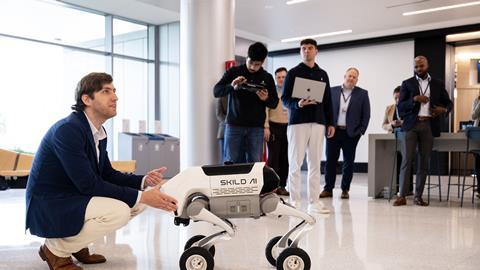
This week’s Picture of the Week looks at Skild AI’s quadruped robots, which will be trialled in the airside terminal at Pittsburgh International Airport, initially for air-quality monitoring before expanding into wider terminal operations.
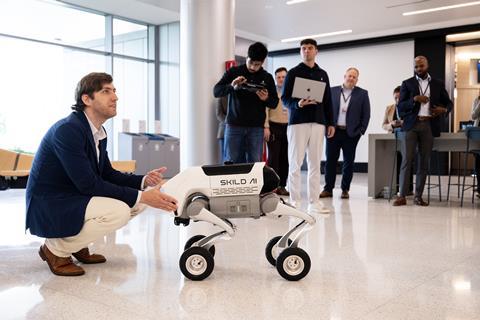
Pittsburgh International Airport (PIT) is to trial four-legged robots in its Airside Terminal in a new project under its xBridge innovation programme, working with Pittsburgh-based robotics company Skild AI.
The quadrupeds, powered by Skild AI’s adaptive autonomy software, will be evaluated for their ability to navigate complex airport environments and support terminal operations. Fitted with advanced sensors, cameras and AI-driven perception, the robots can roam autonomously, detect anomalies and provide real-time data to operations staff.
Three-phase trial for terminal robots
Up to four autonomous robots and two charging stations will be deployed across the Airside Terminal, each with a defined area and keep-out zones. Skild AI will carry out installation, mapping, supervision and monitoring, and will provide on-site training to PIT staff.
The project will progress through multiple phases, allowing the airport and Skild AI to evaluate the technology across a range of functions. The first will focus on mobile indoor air-quality monitoring, with a robot autonomously collecting location-specific data, monitoring established thresholds and alerting airport personnel when readings fall outside defined parameters.
The second phase will explore applications to complement custodial and terminal operations teams. These include identifying full or nearly full trash bins, detecting potential spills to accelerate response and reduce safety hazards, and monitoring passenger congestion to give operations teams greater visibility of crowded areas.
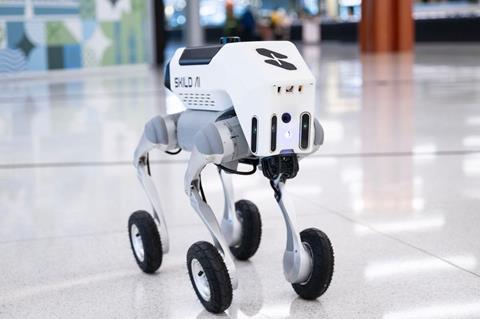
The third phase will examine more advanced uses, including a potential partnership with BioFlyte, a former xBridge participant, to pair the quadruped platform with its airborne biological threat detection technology. This could provide mobile monitoring beyond fixed sensor locations. The project will also assess autonomous delivery of items such as food and beverages to select airside locations.
Deepak Nayyar, Executive Vice President and Chief Technology Officer at PIT, said: “Pittsburgh is a global leader in robotics and AI. Through xBridge, we’re creating a place where that innovation can move from the lab into the airport environment and ultimately help shape the future of the industry.”
Sara Ahmadi, head of product at Skild AI, said: “We share the belief that robots will transform how public infrastructure operates, and we’re grateful for the confidence they’ve put in Skild and the energy they bring to making that happen.”
Skild AI was founded in Pittsburgh in 2023 by Deepak Pathak and Abhinav Gupta, both faculty members at Carnegie Mellon University’s Robotics Institute and School of Computer Science. Pathak serves as chief executive and Gupta as president. The announcement coincides with Pittsburgh hosting the Intelligent Robots & Systems (IROS) Conference 2026, with more than 70 countries represented.
Separately, xBridge is supporting a trial by Arrow Analytics, in partnership with Southwest Airlines, of its EZ-Board system at Gate A7. The autonomous technology uses off-the-shelf depth cameras and real-time analytics to track how carry-on bags move through boarding, giving gate agents a live view of baggage volume and helping predict the overhead bin capacity required.
Valerie McNeill, Chief Operating Officer of Arrow Analytics, said: “We are excited to work with the innovative team at PIT as we continue to develop our EZ-Board product and computer vision offerings for airports and airlines.”









No comments yet