



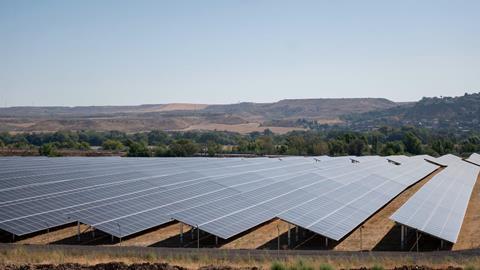
This week’s picture of the week highlights Madrid-Barajas Airport’s major photovoltaic park, supporting renewable energy generation and Aena’s long-term decarbonisation strategy.
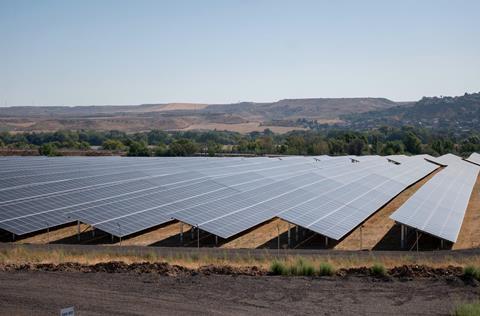
Adolfo Suárez Madrid-Barajas Airport (MAD) is strengthening its renewable energy infrastructure through a major photovoltaic park that has become one of the most powerful airport solar generation systems in the world.
The facility forms part of Aena’s Photovoltaic Plan and its wider 2021-2030 Climate Action Strategy, which has an investment value of more than €750 million. The strategy is designed to reduce emissions from airport operations while increasing the use of renewable energy across Aena’s network.
The airport’s main photovoltaic installation has a nominal capacity of 120 MWn and is already operational. Covering approximately 142 hectares across several areas of the airport site, it contains around 215,000 photovoltaic modules and can produce approximately 242.9 GWh of electricity annually.
This level of generation is equivalent to the average annual electricity consumption of around 74,000 homes. The installation is the largest of three photovoltaic plants planned for the airport and represents a significant expansion of renewable energy generation within airport infrastructure.
Madrid airport expands solar power capacity
The wider photovoltaic park will eventually comprise three installations with a combined capacity capable of generating energy equivalent to more than 100,000 homes. Once fully developed, the park is expected to generate enough electricity to cover 100 per cent of the airport’s electricity consumption.
A second 7.5 MWn self-consumption plant is currently under construction. Covering 22 hectares, the installation will generate approximately 11.8 GWh of electricity each year exclusively for airport consumption, without feeding surplus electricity into the distribution grid.
The plant is expected to provide around 16 per cent of the annual electricity consumption of Terminals 1, 2 and 3. Its generation will be equivalent to the average consumption of approximately 3,600 homes and is expected to prevent around 2,575 tonnes of carbon dioxide emissions annually.
A third photovoltaic installation is also planned, with a nominal capacity of 45 MWn. The proposed plant will cover approximately 41 hectares and is expected to generate around 79.2 GWh annually.
The location of the three facilities has been determined according to available land within the airport boundary, environmental considerations and the area’s potential for solar generation. Aena has also considered airport safety requirements when determining the sites and designing the installations.
During a visit to the operational photovoltaic plant, Spain’s Third Vice President and Minister for Ecological Transition and the Demographic Challenge, Sara Aagesen, highlighted renewable energy as an important component of greater energy independence.
Spain’s Minister of Transport and Sustainable Mobility, Óscar Puente, described the installation as an example of the aviation sector’s contribution to the energy transition, with renewable generation supporting emissions reductions and more sustainable airport operations.
Maurici Lucena said Aena’s wider sustainability strategy included significant investment in climate action, with the photovoltaic programme forming one of its principal projects.
Aena had already achieved a 74.4 per cent reduction in its own emissions in 2025 compared with 2019. The company is targeting carbon neutrality in 2026 and Net Zero Carbon by 2030, bringing forward the sector’s global commitment by two decades.
The Madrid-Barajas project forms part of a wider rollout of solar infrastructure across Aena’s airport network. Photovoltaic installations are already operating at 12 airports, using rooftops, parking canopies and ground-mounted systems depending on local conditions.
Further projects are also progressing. Solar developments at Seville Airport are in the bidding process, while projects at Málaga-Costa del Sol Airport, La Gomera Airport, Valencia Airport and Zaragoza Airport have been awarded. Installations at Alicante-Elche Miguel Hernández Airport, Josep Tarradellas Barcelona-El Prat Airport and Reus Airport are under construction.
The photovoltaic programme forms part of a broader airport decarbonisation strategy alongside fleet electrification, energy efficiency improvements and the deployment of cleaner technologies.
At Madrid-Barajas, the combination of large-scale solar generation and future photovoltaic capacity is intended to reduce dependence on conventional electricity sources while increasing the resilience of airport energy infrastructure.
The project demonstrates how airport land can be used to support renewable energy production alongside core aviation operations. For Aena, the completed photovoltaic park will represent a major step towards its 2030 climate objectives while positioning Madrid-Barajas as an international example of renewable energy integration within airport infrastructure.







No comments yet