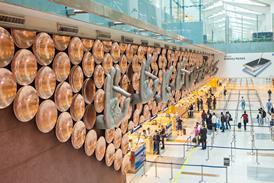
Elenium Automation’s Robert Michaels on why self-service moved the check-in queue and how automation adds capacity without new terminal space.
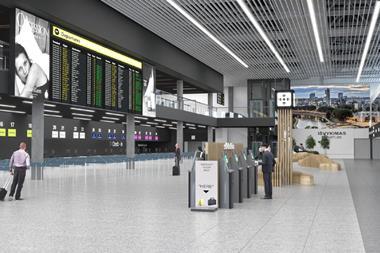
For a long time, queues at check-in meant it was time to get the builder on the phone: the terminal needed expanding. Self-service was meant to change that, with kiosks and bag drops unlocking bottlenecks without new space. Yet many airports now face an uncomfortable truth. Self-service did not fix the check-in queue, it moved it. It took the agent’s job, handed it to a tired passenger with a suitcase and a toddler, and then everyone wondered why the queue did not go away.
Imagine if Uber had made getting a ride harder than hailing a cab. Nobody would have used it. Uber succeeded because it took steps away from the customer, simplifying their journey and removing frustration. Airport self-service has too often done the opposite, and passengers use it not because it is better, but because they have no alternative. The question the industry rarely asks is whether passengers are getting a better experience. Too often, they are not.
The answer is neither more concrete nor more self-service. It is automation: an experience designed around what the passenger wants, not one imposed on them because the airport has run out of space.
Concrete is too slow for the next peak
The pressure on terminal space is not easing. From Tuesday 10 November, Ryanair will close check-in and bag drop 60 minutes before departure, up from 40, to give passengers more time to get through security and passport queues.1 At Brussels Airport, processing an arriving visa passenger during the morning peak takes two to three times longer under the EU Entry/Exit System.2
Building, meanwhile, takes years: Manchester Airport’s newly approved expansion of its Terminal 3 departure lounge is due for completion in 2028.3 Expansions like this matter, but they are slow and costly relative to the capacity they add.
For the next several peaks, the capacity an airport has is the capacity it already owns. The question is how much of it is being swallowed by process rather than by passengers.
Self-service turned the passenger into the agent
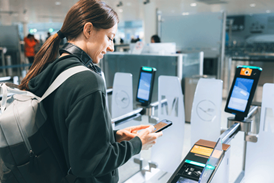
Watch a typical self-service journey. At the kiosk, the passenger scans documents, confirms details, answers prompts, waits while the booking is retrieved and tags the bag. At the bag drop, they place the bag, scan the same documents they confirmed minutes earlier, scan the tag, often with a hand-held scanner, and wait for acceptance. Some even require passengers to download a specific app or use their own phone to operate the machine. Every step depends on the passenger understanding it and getting it right. Every mistake adds seconds, and at peak, seconds become queues.
This is particularly visible in Europe, where hand scanners and processes requiring passengers to do more have become the norm. Anyone who has heard ‘unexpected item in the bagging area’ at a supermarket self-checkout knows how quickly people tire of being made to do the work. A passenger who scans, presses a button and then watches their bag refuse to move feels exactly the same.
Real automation takes the action away
Self-service changes who performs a step. Automation asks whether the step needs to happen at all and, if it does, how the system can do it for the passenger. The passenger should not have to think. Tag it, drop it, off it goes, with their attention free for the trip, and the airport’s shops, ahead.
Virgin Australia’s operation at Sydney Terminal 2 shows what that looks like. Using a fully automated, touchless ‘Drop and Go’ experience, with Elenium’s Voyager software tightly integrating Elenium kiosks and bag drops, Virgin Australia achieves sub-10-second bag drop transactions, including full baggage compliance, safety checks and booking validation.
The work is done before the passenger reaches the bag drop, so their time at the unit is reduced to the one thing only they can do: putting the bag on the belt.
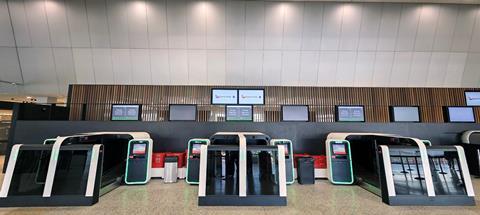
At peak, those seconds compound. Each unit serves more passengers an hour, queues clear faster after a bank of departures, and the same floor space delivers more throughput.
Automation is also arriving fast elsewhere in the airport. Dubai International is moving registered travellers through border control in as little as 3.4 seconds, with no passport or boarding pass to show,4 and biometric group-processing lanes that verify several passengers at once are due at Asia-Pacific airports within the next year.5 If a border can clear a passenger in seconds without a passport, why are we still asking passengers at a bag drop to scan theirs again?
Passengers are also showing they will pay to remove friction. With travel becoming increasingly premium, TSA PreCheck alone passed 20 million members in 2024,6 each paying to take steps out of their journey.
Europe has the chance to lead here. The technology for real automation exists and is proven. What is needed is a move away from measuring success by how many tasks are handed to the passenger, towards how many can be removed altogether.
Model it before you build it
Automation changes how passengers move through a terminal, so its impact should be understood before a single unit is installed. Airports should model their operations using simulation platforms, such as Elenium PaxSim, to see how a change in process affects queues, throughput and space, before it is implemented. Three questions are worth testing:
- Which steps can move upstream, or disappear? Every prompt, look-up and confirmation should be challenged: could it happen earlier in the journey, or not at all?
- Will the improvement travel? Airlines meet a different hardware mix at almost every station. Software that runs on third-party hardware lets a faster flow reach the whole network. In Melbourne, Virgin Australia’s Voyager kiosk and bag drop applications completed onboarding in a terminal running on third-party kiosks and bag drops.
- Who carries the cost of capacity? Large construction programmes are often recovered through higher airport charges. Usage-based models, where an airline pays only when a bag is successfully processed, with no fixed fees and no start-up costs, tie cost directly to throughput instead.
Engineering the next peak
The concrete will come as airports grow. But the most reliable way to add capacity now is to take time out of every transaction that already happens and give passengers the experience they would choose. The airports that come through the next peak best will not be the ones with the most floor space, or the most kiosks and bag drops. They will be the ones that asked, of every step, whether it needed to be there, rather than how good their passengers are at playing check-in agent.
Elenium is offering airports simulations of their check-in and bag drop operations using PaxSim, to show what automation could release in their existing terminal. Visit Elenium at the International Airport Summit in Rome on Wednesday 11 and Thursday 12 November 2026 to request a simulation.
About Elenium Automation
Elenium Automation provides check-in kiosks, self bag drops, a Common Use Self Service (CUSS) platform and the Voyager application suite for airlines and airports. Commercially available since 2016, Elenium has over 1,000 kiosks in operation worldwide and over 300 self bag drop units deployed globally, across over 35 airports and 45 airline partners, serving more than 250 million passengers a year.
References
- Ryanair, ‘Airport check-in and bag drop to close at 60 mins (up from 40 mins) from Nov 2026’, 22 April 2026. https://corporate.ryanair.com/news/ryanair-airport-check-in-bag-drop-to-close-at-60-mins-up-from-40-mins-from-nov-2026/
- Brussels Airport press release, 23 October 2026. https://pressroom.brusselsairport.be/following-persistent-problems-with-the-european-entry-exit-system-brussels-airport-is-once-again-investing-in-additional-infrastructure-to-reduce-waiting-times-at-border-control
- Manchester Airport, ‘Manchester Airport’s Terminal 3 to expand in multimillion pound revamp’, 23 October 2026. https://mediacentre.manchesterairport.co.uk/manchester-airports-terminal-3-to-expand-in-multimillion-pound-revamp/
- LBC, ‘Dubai airport trials AI border check’, 21 July 2026. https://www.lbc.co.uk/article/dubai-airport-trials-ai-border-check-5Hjddy2_2/
- TTG Asia, ‘IDEMIA Public Security readies biometric passenger clearance system for Asia-Pacific airports’, 1 October 2026. https://www.ttgasia.com/2026/10/01/idemia-public-security-readies-biometric-passenger-clearance-system-for-asia-pacific-airports/
- TSA, ‘TSA PreCheck reaches milestone with 20 million members’, 8 August 2024. https://www.tsa.gov/news/press/releases/2024/08/08/tsa-precheckr-reaches-milestone-20-million-members