


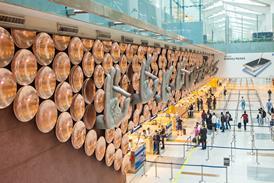

iGA Academy says linking training with live operations at Istanbul Airport, supported by international partnerships, can turn learning into capability as aviation faces growing skills demand.
Closing aviation’s skills gap: where theory meets practice
Aviation is entering a period of sustained growth and increasing complexity. Airports Council International (ACI) World forecasts global passenger traffic to reach 10.2 billion in 2026 and 18.8 billion by 2045. At the same time, International Civil Aviation Organisation (ICAO) forecasts indicate that more than 2.5 million new aviation personnel will be required by 2043 to maintain safe and efficient operations.
The challenge ahead is therefore not only one of infrastructure or capacity. It is also a challenge of people, skills and knowledge.
Artificial intelligence, automation, sustainability requirements and new operating models are already changing how airports work. Yet aviation remains an industry in which the human factor – judgement, co-ordination, adaptability and decision making – remains critical.
Preparing for future growth will therefore require more than recruiting additional people or increasing training hours. It will require aviation training systems capable of developing people and capabilities at the pace of operational change.
The future of aviation training is therefore not simply about delivering more learning. It is about turning learning into capability.”
Where theory meets practice
Aviation is a highly interconnected ecosystem. Decisions made in one area can simultaneously influence terminal and airside operations, security, airlines, ground handlers and the passenger journey. Effective aviation training therefore needs to help professionals understand not only their own responsibilities, but also the operational environment around them.
This is where combining theory with practical experience becomes particularly valuable.
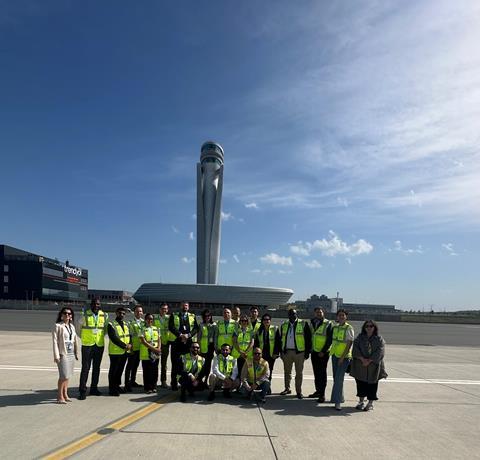
Located at the heart of one of the world’s largest aviation hubs, iGA Academy is able to connect structured aviation training with the operational environment of iGA Istanbul Airport. Participants can complement classroom learning with operational observation, simulation, on-the-job experience and direct interaction with aviation professionals.
This connection is central to iGA Academy’s approach: training for operational excellence by bringing learning closer to real operations.
International standards and external recognition provide an important foundation for this model. As an ICAO TRAINAIR PLUS Platinum Training Centre of Excellence, the first and only in its region, iGA Academy operates within internationally recognised aviation training frameworks. Consecutive recognition from ACI World for training excellence further supports an approach that combines international standards with practical operational experience.
The objective, however, is not recognition itself. It is to use the operational environment and accumulated expertise of Istanbul Airport to create training experiences that help aviation professionals translate knowledge into practice.
Connecting academia and industry
The same principle extends beyond professional aviation training. Academic institutions and the aviation industry bring different and complementary strengths to developing future talent: academia provides strong theoretical and analytical foundations, while airports can provide direct insight into how those principles are applied within complex, evolving operations.
Creating stronger connections between the two can therefore help future aviation professionals enter the industry with both a solid academic foundation and a clearer understanding of operational realities.
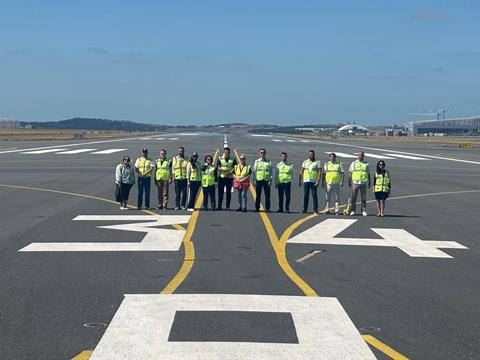
iGA Academy works to support this connection locally and internationally. Each year, more than 1,000 high school and university students are hosted through local learning initiatives, while more than 100 international students and academics visit Istanbul Airport for learning and operational observation.
iGA professionals also deliver airport management courses at universities, bringing current industry experience into the classroom and creating another channel through which academic knowledge and operational practice can interact.
For aviation training, this relationship matters. Theory provides the foundation; practice gives it operational context.
From global partnerships to shared capability
Aviation has always depended on international co-operation. As operations become more complex and specialised, the ability to connect expertise across institutions and borders will become even more important.
For this reason, a global aviation training centre has a role beyond delivering courses. It can serve as a platform where international standards, specialist expertise, operational experience and different perspectives come together.
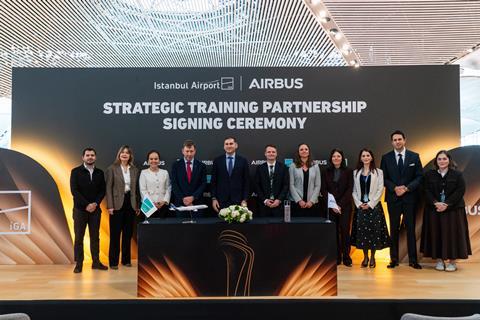
iGA Academy’s global training ecosystem has been developed through co-operation with major aviation institutions and specialist partners, including ICAO, ACI, IATA, EUROCONTROL, Transportation Security Administration (TSA), Women in Aviation International, Airbus Beyond and KUNZ, alongside airport partners and academic institutions around the world.
Istanbul also holds a distinctive place in global aviation training through the delivery of ACI–ICAO Airport Management Professional Accreditation Programme (AMPAP) activities, bringing aviation professionals from different geographies together in an operational airport environment.
The value of these relationships lies not simply in the agreements themselves. Their greater value comes from enabling knowledge exchange, common standards, specialist expertise, international collaboration and access to different operational perspectives.
In this sense, stakeholder engagement is not separate from capability development. It is one of its enablers.
No aviation training centre – and no airport – develops future capability in isolation.
Because while technology will continue to transform aviation, people will remain at the centre of operational excellence.”
Investing in people, sharing knowledge
The movement of knowledge also depends on the movement of people.
Secondments and professional exchanges provide aviation professionals with an opportunity to immerse themselves in different organisations, cultures and operating environments. In a global industry, this multicultural experience can broaden professional perspectives, challenge established assumptions and build relationships that continue well beyond the programme itself.
At iGA Academy, international secondments and exchanges are therefore approached as investments not only in individual development, but also in institutional knowledge.
Professionals gain experience through international aviation organisations and partner airports, while international colleagues are welcomed into the Istanbul Airport ecosystem. The experience acquired through these exchanges is then connected to internal knowledge-transfer mechanisms, including a network of more than 200 internal trainers.
The aim is to create a continuous cycle:
immersion → learning → knowledge transfer → organisational capability.
A secondment creates its greatest value when the knowledge gained by one professional can subsequently benefit many others. In this way, investment in people becomes investment in the organisation, and knowledge shared across institutions contributes to a stronger aviation ecosystem.
From training volume to workforce capability
Scale remains important. In 2025, iGA delivered approximately 300,000 employee-hours of training, with more than 8,200 employees completing at least one programme. But training volume alone does not define success.
The more meaningful questions are whether learning changes behaviour, improves co-ordination, strengthens decision making, preserves critical knowledge and contributes to safer, more resilient and more effective operations.
For iGA Academy, this is why aviation training is closely connected to the operational environment. The airport becomes more than the setting in which training takes place; it becomes part of the learning experience itself.
This approach is particularly important in aviation because the human factor remains central to operational excellence. Technology can automate processes and support decisions, but people must still interpret information, collaborate across functions, respond to unexpected situations and make decisions in complex operational environments.
The future of aviation training is therefore not simply about delivering more learning. It is about turning learning into capability.
Building aviation’s future together
The aviation industry of the coming decades will operate at a different scale and with different technologies, skills and expectations. Preparing people for that environment cannot be the responsibility of one airport, academy, university or international organisation alone.
It requires stronger connections between training and operations, academia and industry, people and institutions, and local experience and global knowledge.
This is the role iGA Academy seeks to play from Istanbul: bringing international aviation knowledge into an operational environment, creating opportunities for professionals and future talent to experience aviation in practice, and sharing the knowledge generated through that interaction across a wider global ecosystem.
Because while technology will continue to transform aviation, people will remain at the centre of operational excellence.
And preparing those people requires a place where theory meets practice.
For more information on iGA Academy’s training programmes and international collaborations, contact: HR_GlobalTeam@igairport.aero
Sources:
Airports Council International (ACI) World. World Airport Traffic Forecasts 2025–2054. ACI World, January 2026.
International Civil Aviation Organization (ICAO). Next Generation of Aviation Professionals (NGAP), A42-WP/153, EX/76, 42nd Session of the ICAO Assembly, 2025.



No comments yet