

There are two things that bind aviation together. The first is a language all of our own. Whether it’s airside or landside, discussing BAU in the ATC or checking what the FIDS are telling us, we share a shorthand that is instantly recognisable across airports and airlines around the world.
The second, and arguably more important, is our commitment to safety. Aviation is one of the safest forms of transport, which is testament to the importance our industry places on it. A focus on planning, preparedness and continuous improvement means safety runs through everything we do, and Edinburgh Airport (EDI) is no different.
Every decision, investment and improvement is guided by our responsibility to keep passengers, colleagues and the airport community safe. But as Scotland’s busiest airport, we also recognise our duty to reduce the environmental impact of our operations.
At Edinburgh Airport, our Greater Good sustainability strategy shapes how we think about these challenges. Teams across the campus are constantly looking at new ways to reduce emissions and improve efficiency, and being part of the VINCI Airports network helps us go further. VINCI Concessions has committed to a 51% reduction in Scope 1 and 2 emissions by 2030, and we benefit from sharing global best practice, learning from colleagues around the world and identifying innovative approaches that can be applied here in Edinburgh.
One of the most innovative examples can be found within our Fire and Rescue Service, where new training technology, alternative fuels and lower-carbon vehicles are helping us rethink traditional approaches without compromising operational readiness.
The Greater Good context
Gordon Robertson, Chief Communications and Sustainability Officer at Edinburgh Airport, explains why this approach matters:
“I think there used to be a misconception that sustainability wasn’t important to aviation, which unfortunately made it quite an uncomfortable topic, but the truth is it’s a journey we’ve been on for a number of years.
“When people think about airport sustainability, they often think of flights and emissions, big infrastructure projects and fuels. While these are an important part of the mix, our Greater Good strategy also challenges us to look much wider than that.
“We believe sustainability should be embedded throughout the organisation, including in areas where safety and resilience are the primary objectives. It’s not a choice between safety and sustainability – safety is non-negotiable. It’s about maintaining the safety standards our passengers, colleagues and regulators expect, while finding opportunities to reduce our environmental impact, whatever the area.
“The strategy is clear, but it requires buy-in from our teams and the ambition to embed it into everyday processes. It needs innovation and a desire to challenge established ways of working, and our Fire and Rescue Service is a fantastic example of that.”
Fanning the flames of progress
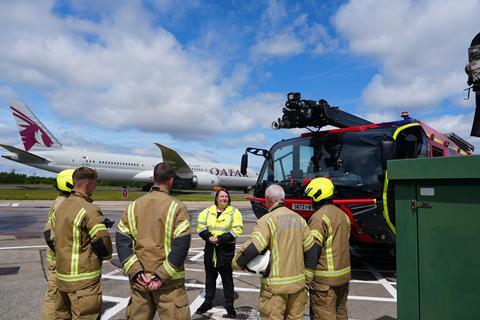
Cath Rae is Head of Airport Control, Fire and Resilience at Edinburgh Airport. A firefighter for 11 years, she is one of the first women to oversee fire operations at a UK airport.
She explains the role of the service and the innovation her teams have demonstrated:
“Put simply, our responsibility is the safety of the airport and airfield, and we need to ensure crews are ready to respond to any incident at any time. Thankfully, serious aircraft or terminal incidents are extremely rare, but that makes training even more important – and it needs to be regular and realistic so crews can prepare for a wide range of scenarios.
“It’ll come as no surprise that live-fire training is the established way of doing this, and it is a vital part of firefighter development. However, as part of Edinburgh Airport’s sustainability ambitions, we wanted to play our part and identify opportunities to modernise our approach without compromising operational readiness.
“We didn’t want to replace traditional training – we wanted to complement it. We wanted innovative ways to enhance our training provision, provide greater flexibility and support our environmental objectives. We wanted to be one of the lowest-carbon airport fire services in the UK.
“That’s what led us to invest in fire simulation technology, and it was a decision driven by our crews. The technology allows us to create a range of realistic scenarios in a controlled way, carry out training more frequently and reduce downtime between exercises – all while reducing our emissions.
“Safety will always be our priority, but that doesn’t mean we can’t challenge our thinking and find new ways of working. The best outcome is maintaining operational excellence and delivering engaging, realistic training while reducing our environmental impact, and I think we’ve done that.
“But as much as we can make the strategic case for new technology, it clearly has to work for the crews using it day to day.”
Training for the real world
Richard Melrose has been a firefighter at Edinburgh Airport for more than 30 years. A leading voice in adopting this innovative approach, he says it has benefited standard procedures:
“The most important thing is that training prepares you for the reality of the job. It sounds simple, but it is so critical. We need to maintain and build on our skills, confidence and decision-making, and make sure we’re ready to respond at any given time.
“The simulation technology has given us greater flexibility. We can create different scenarios quickly, repeat exercises more often and give crews a wider variety of response situations than the standard live-fire approach allows.
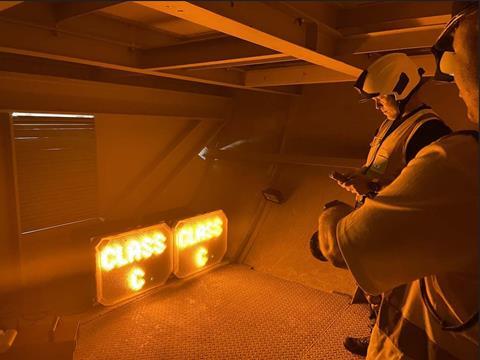
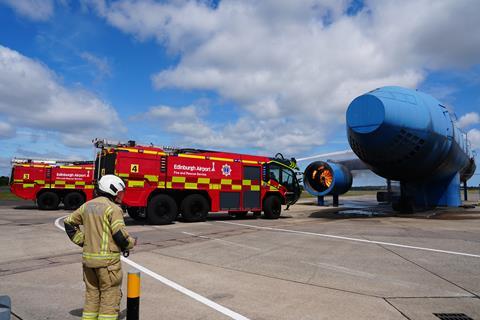
“Using modular fire panels, smoke simulation equipment and weighted hoses, we can recreate scenarios such as under-seat fires, overhead storage incidents and aircraft galley fires. The technology removes the need to burn fuel in certain situations, but it still creates realistic conditions that require the same teamwork, problem-solving and communication skills. And if there’s an area we want to focus on or revisit, we can repeat the scenario multiple times in a controlled environment without burning more fuel.
“This complements how we train – it doesn’t replace it. Traditional live-fire training remains a vital part of our development, now and in the future. There’s no substitute for real heat, smoke or flames, but the technology gives us more opportunities to train, challenge ourselves and prepare for different scenarios, while maintaining the high standards our role demands.”
Measuring progress through Greater Good
Robertson says this is a great example of how every team can play its part in the sustainability journey:
“Sustainability is embedded in everyday decision-making thanks to our Greater Good strategy, and that’s why we see these successful outcomes. Delivering environmental improvements across all areas of our operation, including those where safety and resilience will always come first, means we take incremental steps towards a more sustainable future.
“It’s done together – and the work carried out by our fire and rescue colleagues is a strong example of that in action – the results demonstrate it.
“Through investment in simulation technology and a reduction in fuel-intensive training exercises, the team is expected to save around 11 tonnes of CO2e each year. Alongside that, the transition of the service’s combustion-engine fire vehicles from diesel to Hydrotreated Vegetable Oil (HVO) is delivering a further annual saving of around 30 tonnes of CO2e. Together, that’s around 4% of the airport’s annual Scope 1 and 2 direct emissions footprint.
“The team has gone even further by adopting alternative fuels in its essential live-fire exercises. BioLPG is now used on the airport’s fire training rig, while HVO has replaced kerosene in training exercises. These changes ensure firefighters continue to experience realistic training conditions while significantly lowering associated emissions. And if that wasn’t enough, the service has also introduced two electric vehicles at the fire station, which are partly powered by electricity generated from our on-site solar farm.
“All of these measures are helping make Edinburgh Airport’s Fire and Rescue Service one of the lowest-carbon airport fire services in the UK. But more importantly, they show sustainability and operational performance can work together if we combine innovation, investment and a commitment to sustainable decisions.
“Whether through major infrastructure projects or improvements to everyday operations, the goal remains the same – to build a more sustainable airport while continuing to deliver the safe and resilient operation that so many people rely on every day.
“And that’s for the Greater Good.”
Supporting documents
Click link to download and view these files20260709_100833662_iOS
Other, Size 1.73 mb20260709_101952836_iOS
Other, Size 2.27 mb
No comments yet