





Thomas Bengtsson of Swedavia and Alan Marsden of EUROCONTROL, on behalf of the PEACOCK consortium, share how the project enables regional airports to become active contributors to the future European ATM network.
Regional airports are essential to Europe’s connectivity. They support tourism, business travel, territorial cohesion and social accessibility, yet they often operate with fewer digital tools and less operational integration than major hub airports.
While large airports increasingly benefit from Airport Collaborative Decision Making (A-CDM) processes and sophisticated Airport Operations Centres (APOCs), many regional airports continue to rely on more limited information-sharing capabilities. This can reduce predictability, particularly when disruption occurs during aircraft turnaround activities or winter de-icing operations.
The European PEACOCK project aims to address this challenge.
PEACOCK, short for Predictable and Environmentally friendly operations of regional Airports with COnnectivity and Climate as Keywords, is a Digital Sky Demonstrator supported by the Connecting Europe Facility and Single European Sky ATM Research (SESAR). The project brings together airports, EUROCONTROL and technology partners across Europe to demonstrate how regional airports can become more tightly integrated into the air traffic management (ATM) network while improving both operational efficiency and environmental performance.
Why predictability matters
Across Europe, regional and smaller airports account for more than 40% of departures. Yet many lack the infrastructure required to provide continuously updated operational information to the wider network.
The impact can be significant.
When departure estimates are inaccurate or updated too late, network flow management measures may no longer reflect operational reality. This can result in unnecessary delays, flight suspensions, inefficient slot allocations and reduced network performance.
The situation becomes even more challenging during winter operations. De-icing activities are often managed through local procedures and human expertise, with limited digital support. As weather conditions change rapidly, accurately estimating aircraft readiness for departure becomes increasingly difficult.
PEACOCK focuses on solving exactly these challenges.
Building on SESAR’s Connected Regional Airport concept
At the heart of the project lies SESAR Solution 0532, ‘Connected Regional Airports’. The solution builds upon the earlier SESAR concept of Regional Network Integrated (RNI) airports, which enables regional airports to share automated departure planning information with the EUROCONTROL Network Manager.
Rather than relying solely on traditional flight plan information, airports participating in PEACOCK generate Predicted Departure Planning Information (P-DPI) messages. These messages provide more accurate estimates of actual departure times, allowing the network to make better-informed tactical decisions.
The objective is straightforward:
- Better predictability
- Improved slot stability
- Fewer flight suspensions
- Reduced delay propagation across the network.
Previous European trials have already demonstrated significant benefits. A summer trial involving more than 100 airports and approximately 20% of ECAC departures showed a 60% reduction in flight suspensions and a 31% improvement in departure predictability when improved departure information was shared with network systems.
Bringing artificial intelligence to winter operations
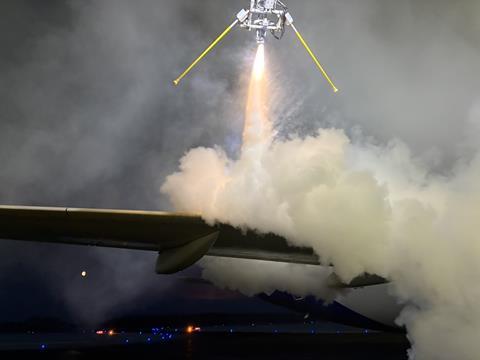
One of PEACOCK’s most innovative capabilities is its AI-based support for de-icing operations.
Winter disruption remains one of the most difficult challenges affecting airport predictability. Airports use different procedures, different operating models and sometimes different terminology. Moreover, de-icing duration depends on numerous variables including weather conditions, aircraft type, operational procedures and resource availability.
PEACOCK introduces machine learning models capable of predicting:
- The probability that a flight will require de-icing
- The expected duration of the de-icing process
- The operational impact on the predicted departure time.
The project combines weather information, aircraft-specific characteristics and operational data to create dynamic predictions that can be integrated directly into airport decision-making.
Demonstrations have already involved airports in Sweden, Czechia, Poland, Greece and Romania, representing a wide range of climatic and operational environments. Both remote and on-stand de-icing concepts are being evaluated to ensure applicability across different airport layouts and operating models.
The ambition is not simply to improve local operations but to provide the Network Manager with more reliable departure estimates even during degraded winter conditions.
Seeing the turnaround in real time
Another important element of PEACOCK is the use of AI-supported turnaround monitoring to improve departure predictability at regional airports.
Traditionally, many regional airports have limited visibility of turnaround progress once an aircraft has arrived on stand. As a result, network stakeholders often rely on standard turnaround assumptions rather than real-time information about the actual status of ground handling activities.
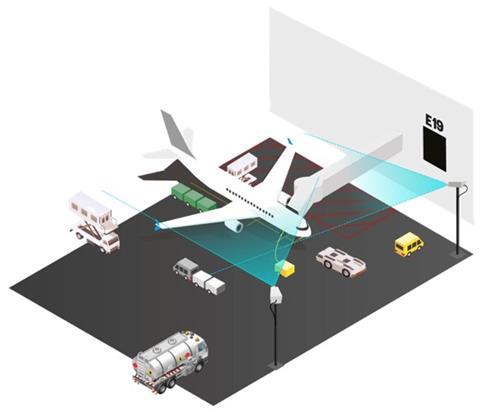
Rather than introducing a completely new turnaround monitoring concept, PEACOCK demonstrates how advanced monitoring capabilities can be integrated into airport and network operations to enhance predictability. At participating airports, camera-based and geo-location technologies are used to detect key turnaround events such as fuelling, baggage handling, catering activities, passenger handling and pushback preparation.
The monitored events are analysed using machine learning techniques to estimate when the ground handling process is expected to be completed. This results in a new operational parameter known as the Predicted End of Ground Handling Time (PEGT).
PEGT represents a significant step forward for regional airport integration. Instead of relying on fixed or historical turnaround assumptions, airports can continuously update departure predictions based on the actual progress of aircraft servicing activities. As additional turnaround events are observed, the prediction becomes increasingly accurate, allowing emerging delays to be identified at an earlier stage.
Within PEACOCK, PEGT is integrated into the Connected Regional Airports concept and used to improve the calculation of P-DPI messages shared with the EUROCONTROL Network Manager. This creates a more dynamic and data-driven picture of airport readiness, supporting both local operational decision-making and network-wide traffic management.
A pan-European demonstration
The consortium includes airports and organisations from across Europe, including Swedavia, EUROCONTROL, Prague Airport, Eindhoven Airport, Brussels Airport, Aéroports de Paris, Fraport Greece and several regional airports in Poland and Romania. Together, the project covers 26 airports.
Demonstrations are taking place in live operational environments and target Technology Readiness Level 8, bringing innovations close to deployment.

Looking ahead
The future European ATM network depends on the ability to improve predictability not only at the largest hubs but across the full airport ecosystem.
PEACOCK demonstrates that regional airports can become active contributors to network performance through affordable digital solutions, greater automation and effective use of artificial intelligence (AI).
The project also highlights an important lesson for the next generation of airport operations: predictability is no longer generated solely through procedures. Increasingly, it is created through data, connectivity and intelligent decision support.
By combining AI-driven turnaround monitoring, machine learning-based de-icing prediction and enhanced information sharing with the Network Manager, PEACOCK aims to show that even complex operational challenges can become more predictable.
For Europe’s regional airports, that may prove to be one of the most important innovations of all.













No comments yet