


Wellington Airport has completed installation of new runway safety zones with an important added bonus: expanding the usable length of the runway, helping better connect New Zealand’s capital city to the world. Matt Clarke, Chief Executive of Wellington Airport, explains further.
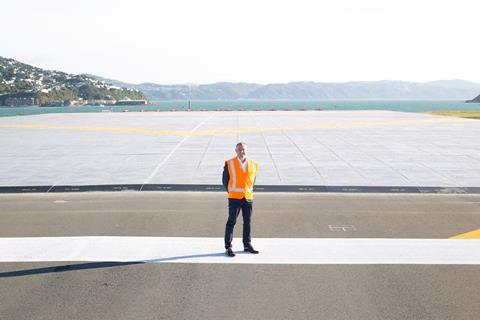
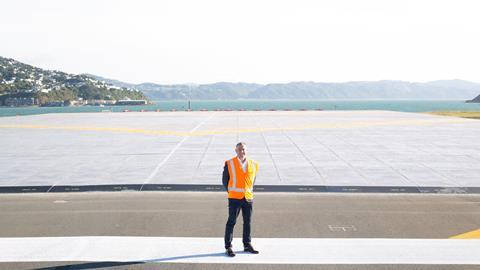
Engineered Materials Arresting System (EMAS) uses energy-absorbing blocks at each end of the runway to provide additional safety in the unlikely event of an aircraft overshoot. EMAS is now in use at numerous airports around the world, but few have installed it in such a challenging environment as at Wellington Airport.
Wellington Airport’s challenging location
Wellington Airport is conveniently located just 5km from the city’s CBD, but the coastal urban location also presents challenges. The runway length is naturally limited at both ends by water – Wellington harbour to the north and the rugged Cook Strait to the south. Residential homes closely surround the western and eastern boundaries.
The runway previously had a length of 1815m. While there have been more recent proposals for an extension, building seaward would be difficult and expensive – a scenario further complicated by New Zealand’s Resource Management legislation.
Enter EMAS
Wellington Airport has been closely following the progress of EMAS around the world and considering how it could work here.
Most other airports have simply added EMAS as a direct RESA replacement beyond the ends of the runway strips. However, Wellington Airport didn’t have this option due to our unbalanced field length, meaning a loss of starter extension on an already constrained runway length.
Instead, we proposed to align with FAA guidance and devised a plan to install EMAS with equivalence to FAA 1000ft RSAs, as opposed to CAA 240m RESAs.
As a result, we have increased our landing distance by 143m and a take-off distance by 37m.”
The challenge of installing EMAS
Installation of the individual EMAS blocks took place over the New Zealand summer from January to March this year. Each EMAS bed is around 55 by 90 metres and made up of more than 3,000 individual blocks, which were manufactured in the United States and shipped to Wellington in 2025.
In a way, physically installing the blocks was the easy part. Much harder was the planning and coordination required to realign the underground lighting, navigation aids, runway entrances and exits, and flight procedures. This enabling work began in March 2025.
Wellington Airport has a curfew between 1 am and 6 am, meaning this was the key window in which to prepare and install EMAS without disrupting flight operations.
The final changeover last night was the most complicated part of the whole project, with around 80 people involved. All of our line markings had to be updated in one go, for which we used 15 line marking trucks – just about every crew available in the lower North Island. We planned and rehearsed the sequence of everything to the minute to ensure we were all set for flights to begin on the new settings from 6 am on 24 March.
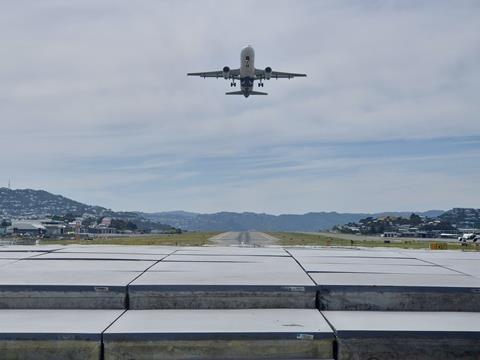
Collaboration was a key to the success of this project. We want to thank everyone involved, including our airlines, the Civil Aviation Authority, Airways, the New Zealand Airline Pilots Association, Runway Safe, and our contractors and advisors who worked tirelessly while the city slept.
Thanks to this hard work, the project was completed a week ahead of schedule and within the $35m NZD budget.
How EMAS extends the useable length of our runway
Wellington Airport previously operated with a minimum runway end safety area (RESA) of 90m, beyond a 60m strip as required by civil aviation regulations. Aligning with the FAA 1000ft RSA guidance, and designing an EMAS with 1000ft equivalence beyond the runway (1000ft being the combination of a 60m strip and a 240m RESA) enabled us to enhance safety, balance the field length, as well as enhance the useable runway length in between.
As a result, we have increased our landing distance by 143m and a take-off distance by 37m.
Enabling long-haul connections
The new runway dimensions mean Wellington Airport is now capable of handling next-generation widebody aircraft non-stop from major hubs in Asia and North America, while enabling full passenger loads on outbound services to destinations which were previously out of reach.
This is exciting news for travellers, given Wellington’s current international destinations are limited to the eastern seaboard of Australia and Fiji. There is a large under-served market of travellers from our region who currently must transit via other ports to reach Asia, North America and beyond.
Our new runway dimensions also allow more airlines to be able to use Wellington Airport as an alternate for their New Zealand flying. This could mean significant fuel savings, CO2 reductions and resilience to their operations.
While there are no new services to announce just yet, the turbulence currently felt by the travel industry will settle in time. We’re looking forward to celebrating the arrival of long-haul flights to the capital when the time is right.





No comments yet