




A box labelled “car parts” arrives at an airport. It smells like fish. When inspectors open it, they find thousands of shark fins. The discovery is a reminder that aviation security is not limited to protecting aircraft and passengers, but can also involve detecting illegal wildlife products moving through the global air transportation network.
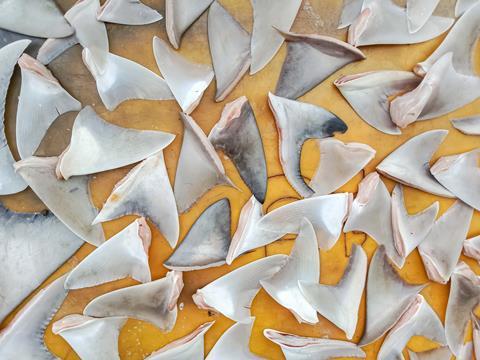
When we think about aviation security, we usually think about explosives, terrorism and threats to aircraft. However, airports face another, less familiar challenge: the use of international aviation networks to transport illegally traded wildlife products, including shark fins. Shark finning is the practice of removing a shark’s fins and discarding the remainder of the animal at sea. National Oceanic and Atmospheric Administration (NOAA) Fisheries notes that sharks may be unable to survive after their fins are removed and the carcass is returned to the ocean. It is important to distinguish shark finning from the broader illegal trade in shark fins: detached fins can also enter international commerce after sharks have been landed. Shark fins are internationally traded and have historically been associated with demand for products such as shark-fin soup.
The scale of the trafficking problem is reflected in the World Customs Organization’s (WCO) Illicit Trade Report 2024. The WCO reported a 200% increase in the number of shark fin seizures in 2024 compared with 2023. Although vessels accounted for approximately half of the reported cases, air transport was used in 33%. The WCO also reported that routine controls accounted for many of the detections. These findings illustrate why shark fin trafficking deserves attention in aviation security. Airports can function as transit points in international wildlife-trafficking networks, and documented cases show shark fins moving through commercial air cargo, passenger baggage and shipments whose declared contents did not match the goods inside. A World Bank wildlife-trafficking report specifically identifies shark fin shipments as being misrepresented as products such as dried seafood and fish maw, and identifies airports and air transit countries as part of these trafficking routes. From an aviation security perspective, these cases reveal several layers of interdiction: risk-based targeting, cargo inspection, documentation verification, passenger baggage screening, random controls and frontline observation.
Cargo
In January 2020, U.S. Fish and Wildlife Service wildlife inspectors at Miami International Airport inspected an in-transit air cargo shipment from Venezuela to Hong Kong. The shipment consisted of 22 boxes declared as fish maw, or fish swim bladders. Inspectors discovered that 18 boxes contained dried shark fins that had not been disclosed on the shipping manifest. The seizure contained 5,017 individual fins, and more than half of the morphologically identified fins were from species listed under Appendix II of the Convention on International Trade in Endangered Species of Wild Fauna and Flora (CITES). The shipment weighed approximately 635 kilograms (1,400 pounds). The Miami case demonstrates an important aviation security issue: the airport did not have to be the final destination for an illegal product to become relevant to enforcement. The shipment was in transit through Miami, making the airport a point at which wildlife authorities could inspect and intercept the shipment.
The Miami case demonstrates an important aviation security issue: the airport did not have to be the final destination for an illegal product to become relevant to enforcement
Hong Kong provides another example of the role of cargo inspection and risk assessment. In January 2024, Hong Kong Customs used risk assessment to inspect an air consignment declared as dry fish arriving from Dubai and found approximately 800 kilograms of suspected shark fins. In October 2024, another air consignment declared as household goods and arriving from Indonesia was inspected following risk assessment, resulting in the seizure of approximately 460 kilograms of suspected shark fins. In 2025, an unusual observation by a frontline inspector demonstrated another form of detection. At Ted Stevens Anchorage International Airport, an employee noticed that a box labelled “car parts” smelled unusual. When the box was opened, it contained thousands of shark fins. The subsequent investigation resulted in the confiscation of approximately 1,600 pounds of shark fins from nearly 17,000 sharks across the broader investigation.
Passenger baggage
Shark fins have also been detected in passenger baggage. In November 2023, Hong Kong Customs reported two separate cases involving passengers arriving from Brazil via Ethiopia. In each case, more than 450 kilograms of dried shark fins were found in checked baggage. In one case, the fins were carried in 15 pieces of checked baggage; authorities subsequently determined that some of the fins belonged to species regulated under CITES. The same route appeared again in March 2026. Hong Kong Customs intercepted a passenger arriving from Brazil via Ethiopia and found approximately 52 kilograms of suspected dried shark fins in her checked baggage. The fins were suspected to come from an endangered species listed under CITES Appendix II.
India provides another example. In August 2025, Chennai Customs’ Air Intelligence Unit intercepted two passengers departing for Singapore. Examination of their checked baggage recovered 11.6 kilograms of shark fins, with 5.8 kilograms recovered from each passenger. The passengers reportedly acknowledged that they had been recruited to transport the material. These cases demonstrate how wildlife trafficking can use the same passenger infrastructure that supports legitimate international travel. In such cases, a passenger can become a courier and checked baggage can become the transportation mechanism.
Conclusion
Not all successful interdictions rely on sophisticated targeting systems. The Anchorage case illustrates the continuing importance of frontline personnel. An employee’s observation of an unusual smell led to the discovery of thousands of shark fins. The WCO’s 2024 data also demonstrate the value of routine controls. In that year, Sri Lankan authorities seized 826.5 kilograms of shark fins at Bandaranaike International Airport after the shipment was selected at random. The shipment was destined for Hong Kong-China.
No single security mechanism identifies every threat. Instead, these cases illustrate the value of layered aviation security practices, including risk assessment, intelligence, screening and inspection, random controls, documentation checks and experienced frontline personnel. The WCO data show that both risk-based and routine controls can contribute to wildlife trafficking interdiction.
A successful seizure can also become more than a single enforcement action. When authorities intercept illegal wildlife products, the seizure can provide information about trafficking routes, origin and destination countries, shipping methods, commodity descriptions and documentation practices. Such information can contribute to future risk assessment. Since 2020, publicly documented cases have demonstrated the multiple ways that shark fins can move through the aviation network, including commercial air cargo, passenger baggage and misrepresented shipments.
2020–2026 airport/aviation shark-fin interdictions
| Year | Airport / Location | Country | Shark fins seized | Weight | Detection |
|---|---|---|---|---|---|
|
2020 |
U.S. |
5,017 |
~635 kg |
Cargo inspection |
|
|
2020 |
India |
— |
23.5 kg |
Intelligence |
|
|
2020 |
Sri Lanka |
— |
— |
Cargo inspection (snaggletooth sharks, not just shark fins) |
|
|
2021 |
Colombia |
~3,500 |
— |
Cargo inspection |
|
|
2022 |
Philippines |
— |
14.4 kg |
Random inspection |
|
|
2023 |
China |
— |
>1,200 kg |
Risk assessment |
|
|
2023 |
China |
— |
~50 kg |
Risk assessment |
|
|
2023 |
China |
— |
>450 kg |
Passenger inspection |
|
|
2024 |
China |
— |
~800 kg |
Risk assessment |
|
|
2024 |
China |
— |
~115 kg |
Risk assessment |
|
|
2024 |
China |
— |
~460 kg |
Risk assessment |
|
|
2024 |
Sri Lanka |
— |
826.5 kg |
Random inspection |
|
|
2024 |
China |
— |
973 kg |
Risk assessment |
|
|
2025 |
Thailand |
402 |
102 kg |
Intelligence |
|
|
2025 |
India |
— |
11.6 kg |
Intelligence |
|
|
2025 |
U.S. |
~17,000 sharks represented |
~726 kg |
Cargo inspection |
|
|
2026 |
China |
— |
~52 kg |
Passenger inspection |
|
|
2026 |
China |
— |
~162 kg |
Risk assessment |











No comments yet