
International Airport Review explores the shift to autonomous security operations that improve safety, passenger experience, efficiency and resilience. Plus, the exciting innovations happening in the space.
For decades, airport security operations have been built around a simple principle: detect threats while maintaining acceptable passenger throughput. However, as threat environments become increasingly complex and passenger volumes continue to grow, security leaders face mounting pressure to achieve both objectives simultaneously.
The challenge is no longer simply identifying prohibited items or responding to isolated incidents. Airports must now manage the evolving risk landscape, fluctuating passenger numbers, staffing constraints and rising expectations, all while maintaining operational resilience. In this environment, the industry’s focus is shifting beyond traditional decision-support systems towards increasingly autonomous security operations, in which advanced technologies can assess, prioritise and respond to potential risks under human oversight.
Rather than replacing security personnel, this evolution is enabling staff to focus their expertise where it delivers the greatest value, such as spotting suspicious behaviour and assisting passengers with empathy, while the technology handles routine screening decisions, optimises resource allocation, and supports faster, more targeted interventions.
The accelerating adoption of smart security
Recent years have seen security teams confronted by a broader and more dynamic threat landscape. Traditional concerns such as weapons and explosives remain ever-present, but airports must also prepare for emerging risks linked to insider threats, cyber-physical attacks and increasingly sophisticated methods of concealment.
Artificial intelligence (AI) is becoming an increasingly important component of modern security operations.
At the same time, passenger traffic continues to recover and grow, placing additional strain on security checkpoints and operational resources. Security leaders can no longer rely solely on increasing staffing levels or expanding checkpoint footprints to maintain performance.
As a result, airports are increasingly investing in smart security technology that combines data and automation to create more intelligent and adaptable screening environments. Developed through collaboration between airports, regulators, technology providers and industry organisations, smart security aims to strengthen security outcomes while improving operational efficiency and the passenger experience.
The approach recognises that security effectiveness and passenger flow are not competing priorities. Instead, they can be improved together through better use of data, automation and risk-based decision-making.
Maintaining throughput under pressure
One of the most significant drivers of security transformation has been the innovation of advanced screening technologies capable of delivering higher levels of threat detection without introducing additional friction into the passenger journey.
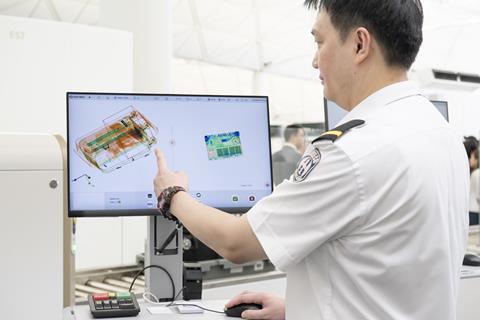
Computed tomography (CT) screening systems have become a cornerstone of this transition. By generating detailed 360-degree, cross-sectional 3D images of cabin baggage, CT scanners can detect and highlight prohibited items with greater accuracy than the human eye, compared with traditional X-ray systems.
The technology also enables passengers to leave liquids and electronic devices inside their bags during screening, reducing preparation times and helping checkpoints process passengers more efficiently.
Enhanced image quality and automated detection capabilities improve threat recognition, allowing operators to maintain security standards even during periods of peak demand. This is particularly important as airports seek to accommodate future traffic growth without continually expanding terminal infrastructure.
The result is a more scalable security operation that can absorb increases in passenger volume while maintaining consistent performance.
AI and automation enable more targeted intervention
Artificial intelligence (AI) is becoming an increasingly important component of modern security operations. Rather than simply supporting operator decisions, AI-powered systems can analyse screening images, identify anomalies and prioritise items requiring further inspection in real time.
This enables a shift from broad, resource-intensive screening approaches towards more targeted intervention strategies.
Instead of manually reviewing every bag with the same level of scrutiny, security personnel can focus attention on passengers, items or situations identified as presenting elevated risk. Automated algorithms can rapidly process vast quantities of screening data, highlighting areas that warrant human assessment while allowing low-risk passengers to move through checkpoints more quickly.
For example, historically, a Transport Security Administration (TSA) agent had to select a passenger’s perceived gender, and misgendering frequently led the body scanner machine to flag anomalies, which resulted in pat-downs. The TSA uses Low Probability of False Alarm (Low-PFA) algorithms to train AI systems deployed for on-person screening, the TSA updated this to a gender-agnostic AI algorithm, which has reduced false alarms and, therefore the number of extra screenings needed on passengers. This has sped up the process, while also making the security process less invasive.
This evolution towards autonomous security operations represents a significant shift in how airports approach both security and efficiency.
As machine learning capabilities continue to improve, these systems are becoming increasingly effective at distinguishing genuine threats from benign items, reducing false alarms and helping security teams deploy resources more efficiently.
For airport operators, the operational advantage lies not only in improved detection performance but also in the ability to make faster, more consistent decisions across the screening process.
Reducing manual search and passenger preparation
Historically, secondary searches have represented one of the most significant causes of delay within airport security operations. Every bag search requires additional staff resources, extends passenger processing times and introduces variability into checkpoint performance.
Advanced screening technologies and AI-assisted image analysis are helping reduce the frequency of these interventions by providing greater certainty during the primary screening process.
Passengers also benefit from a more streamlined experience. Requirements to remove laptops, tablets and liquids have traditionally created bottlenecks at checkpoint preparation areas, particularly during peak periods. By reducing these preparation steps, airports can improve throughput while creating a less stressful journey for travellers.
The cumulative effect may appear incremental at the individual passenger level, but across millions of annual passengers, the operational impact can be substantial.
However, despite the clear evidence that CT scanners will speed up passenger processing by removing the need to divest items, some UK airports have reported that more bag searches are required due to the sensitivity of the new scanners, which have been triggering manual searches of bottles and food products.
Resilience is now measured by predictability and flow
The concept of resilience within airport security has traditionally centred on maintaining effective threat detection during periods of disruption or heightened alert.
While this remains critical, airport leaders are increasingly recognising that resilience must also encompass predictability, consistency and flow.
A security checkpoint that delivers strong detection performance, but experiences frequent congestion, unpredictable wait times or significant throughput fluctuations can still create operational vulnerabilities. Delays at security often cascade throughout the terminal, affecting retail performance, gate operations, passenger satisfaction and overall airport efficiency.
Autonomous and semi-autonomous security systems help address this challenge by reducing operational variability. Automated decision-making processes deliver greater consistency than purely manual workflows, while real-time data enables operators to identify emerging bottlenecks before they impact passenger flow.
In this context, resilience becomes not only the ability to detect threats but also the ability to maintain stable operations under changing conditions.
Supporting long-term capacity and terminal planning
As airports plan for future growth, security operations are becoming an increasingly important consideration in terminal design and capacity planning.
Historically, accommodating rising passenger numbers often required expanding checkpoint areas, adding screening lanes or increasing staffing levels. While these measures remain relevant, smart security technologies offer an alternative pathway to growth.
By improving lane efficiency, reducing secondary searches and accelerating passenger processing, advanced security systems enable airports to extract greater capacity from existing infrastructure. This can defer or reduce the need for costly terminal expansions while supporting long-term traffic forecasts.
The availability of richer operational data also enhances planning capabilities. Airports can gain deeper insights into passenger flow patterns, screening performance and resource utilisation, enabling more informed investment decisions and infrastructure strategies.
As a result, security is increasingly viewed not as a standalone operational function but as a strategic enabler of airport growth.
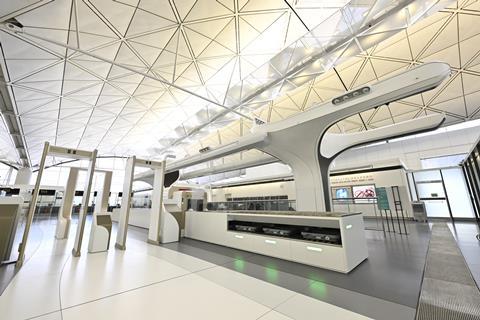
For airports such as Hong Kong International Airport, which introduced smart security screening channels starting in July 2024, they are already realising the benefits.
Jacob Cheung, Executive Director of Aviation Security Company (AVSECO) in Hong Kong, told International Airport Review that the new smart screening system is quicker, smarter and more accurate and has led to reduced queues and higher passenger satisfaction. He said: “With the old technology we used to screen around 240 passenger per hour per lane. Now we can screen 360 per hour, which is a 50% increase.”
Hong Kong Airport’s system is also equipped with auto tray recirculation, in-built tray sterilisation, and an automatic alert to passengers for uncollected items on the tray.
What comes next?
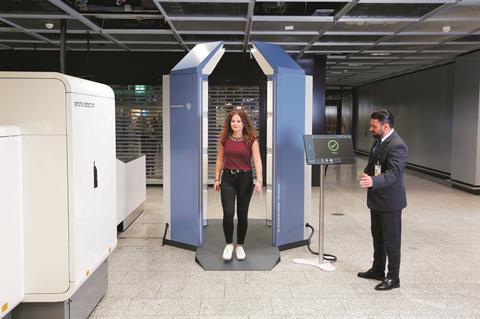
There has already been great innovation in the security space, especially at Frankfurt Airport, which pioneered 360° walkthrough scanners for passenger checks. Unlike conventional scanners that require individuals to stand still in awkward positions, this state-of-the-art system allows travellers to walk through the scanner at a normal speed. This not only speeds up the screening process but also reduces the stress and discomfort often associated with security checks.
Another pioneering initiative is that of the biometric corridors seen at Jakarta and Surabaya airports in Indonesia, and the smart tunnel at Dubai International Airport, which allows passengers to walk through immigration without stopping or showing their passport.
Meanwhile, the TSAin the United States is developing an automated passenger screening system that would not require a TSA officer to be present during the advanced imaging technology scanners. The OTA Automated Passenger Screening Gate System is currently in pre-deployment phase. The system is designed to reduce human intervention by using machine vision (a form of AI that can interpret visual information) to interpret and assess whether the passenger is in the correct stance for scanning. When the passenger has hit the correct body stance, the system automatically initiates the scan. The passenger can then be routed to the sterile side to collect their belongings if there is no anomaly, and if the passenger is flagged they are routed to an actual TSA officer. Physical access to the sterile area can be controlled by glass doors.
From reactive screening to intelligent operations
This evolution towards autonomous security operations represents a significant shift in how airports approach both security and efficiency.
Advanced screening technologies, AI-powered analytics and automation are enabling operators to move beyond traditional decision-support models towards more intelligent, responsive and scalable security environments. The goal is not to remove humans from the process, but to ensure that human expertise is applied where it delivers the greatest operational and security value.
As passenger volumes rise and threat environments continue to evolve, airports that successfully combine detection capability with predictability, flow and operational agility will be best positioned to meet the demands of the future.


No comments yet