

Maastricht Aachen Airport is the first airport in the world to put an AI-enhanced CT hold baggage screening system into live operation, showing how intelligent technology, human expertise and smarter processes can work together.
A world first in operational baggage screening
When Maastricht Aachen Airport (MST) switched on its new Smiths Detection hold baggage screening system on 1 July 2026, attention quickly focused on artificial intelligence (AI). But the real significance lies in integrating AI into one of aviation’s most regulated environments without compromising certification.
Certified detection software cannot simply evolve through unrestricted self-learning. Changes affecting certified security functionality require recertification. The certified security component therefore remains fixed and fully compliant, while AI operates alongside it.
This points to the future of airport security: not full autonomy, but certified detection technology combined with intelligent systems and human expertise.
Where AI adds intelligence
While certified algorithms identify regulated threat items, the additional AI layer can recognise evolving concealment techniques, changing object characteristics and emerging patterns.
That matters because threats do not stand still. Concealment methods can evolve faster than traditional certification cycles. AI can analyse operational data and identify patterns that may not have existed when earlier technologies were certified.
It does not replace established detection. It makes it smarter.
At Maastricht Aachen Airport, our philosophy is straightforward: People First, Powered by AI. Technology should strengthen human capability, not replace it.
Building on CT technology
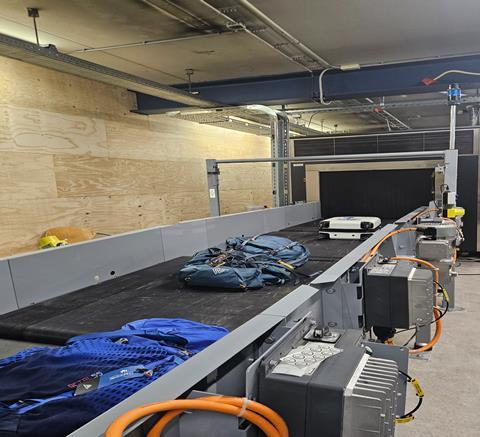
AI may attract the headlines, but CT provides the foundation. Modern Computed Tomography represents a major leap from conventional X-ray screening. It generates detailed three-dimensional images, allowing operators to inspect baggage from multiple viewpoints rather than relying on a single flat image.
AI builds on that data by analysing shapes, densities, compositions and concealment patterns. It helps identify unusual configurations and directs operators’ attention where it matters most.
Crucially, it does so without challenging the regulatory framework. Adaptive intelligence and certified security can work side by side.
The biggest operational gain is not actually AI
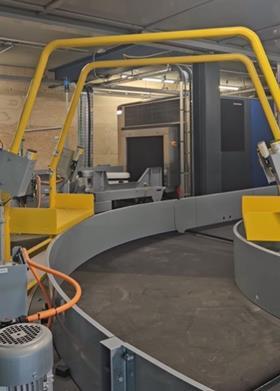
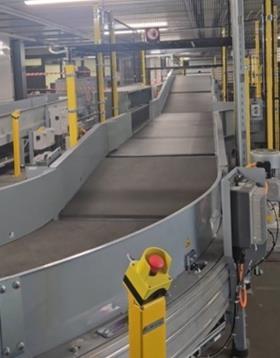
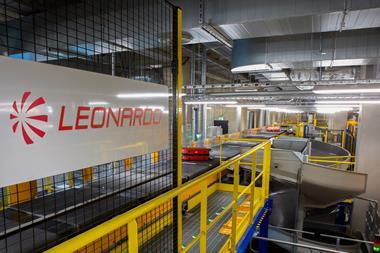
One of the most interesting lessons from Maastricht is that some of the biggest benefits come not from AI itself, but from redesigning the screening process around it. Traditional systems can create bottlenecks when an image requires further assessment. Our system uses intelligent baggage routing to avoid this.
A cleared bag continues immediately. A bag requiring further assessment automatically follows a separate route, giving security officers more time to review 2D and 3D imagery without disrupting the main baggage flow.
The result is significant: more than 1,800 bags per hour, with fewer bags requiring manual inspection and physical handling.
For security staff, this means fewer bags to lift and open and more time for analysis and decision-making. That improves efficiency, working conditions and security at the same time.
Keeping humans at the centre
AI does not make the final decision. Our security officers do.
Technology identifies patterns, flags anomalies and focuses attention. Trained professionals remain responsible for interpretation and action. The result is not human versus machine. It is human and machine.
That allows security professionals to spend less time on repetitive physical work and more time applying their expertise. To us, that is a far more valuable use of AI than simply reducing headcount.
Why Maastricht?
World-first innovations do not have to come from the world’s largest airports. Large scale has advantages, but it also brings complexity. At Maastricht Aachen Airport, shorter decision lines, close cooperation between management and operations and direct relationships with technology partners allow us to move faster.
Our scale can be an innovation advantage.
That never means taking shortcuts. In security, compliance is non-negotiable. But it does mean that promising technology can move from concept and testing into certified daily operation without remaining a pilot indefinitely.
Aviation has no shortage of innovation labs, pilots and presentations about AI.
The real test is simpler: Does it work on Monday morning when passengers are checking in?
In Maastricht, it does.
Implementing a world first while keeping the airport running proved once more that being agile does not make implementation easy.
Towards a smarter airport
For Maastricht Aachen Airport, baggage screening is not an isolated innovation. We are exploring AI and intelligent technologies across resource planning, process optimisation, predictive maintenance, operational forecasting and ground handling.
We have already introduced an AI-supported exoskeleton in cargo handling to assist employees with physically demanding work. The philosophy is the same: technology supports the person doing the job.
We are not interested in AI for the sake of AI. The question is much simpler: What operational problem are we solving, and can technology help us solve it better?
Sometimes the answer is AI. Sometimes it is automation, process redesign or better use of data. Often, it will be a combination.
A potential blueprint for the industry
Airports constantly balance security, efficiency and passenger experience. Traditionally, improving one could come at the expense of another. Our experience suggests they can reinforce each other.
Certified screening, adaptive intelligence, smarter processes and human expertise can deliver stronger security and greater efficiency simultaneously.
That principle extends well beyond baggage screening. The future of AI in aviation is not primarily about replacing people or rewriting regulations. It is about giving people better tools and turning data into better decisions.
Smaller airports can play an important role in making that future operational. Innovation is not measured by the size of an airport, the number of pilots launched or the sophistication of a presentation.
It is measured by what actually works.



No comments yet