



International Airport Review’s webinar on Wednesday will examine how airports are moving baggage handling innovation from pilot projects into operational reality. Featuring case studies from Aruba Airport Authority and Amsterdam Airport Schiphol, the session explores data-driven predictability, workforce-focused robotisation and the execution challenges that determine whether innovations scale successfully or remain confined to proof-of-concept trials.
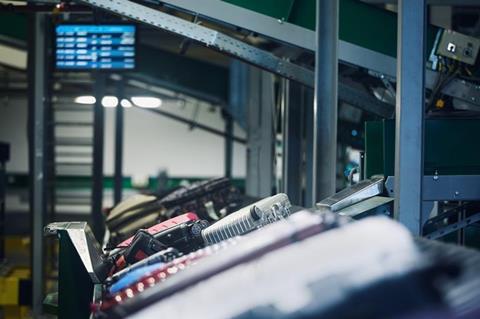
Airports are not short of ideas, but turning innovation into daily operational reality remains one of the industry’s biggest challenges. That is the central message of International Airport Review’s upcoming webinar, Scaling baggage innovation for operational resilience in 2026, which will explore how data visibility, targeted automation and infrastructure modernisation are reshaping baggage operations worldwide.
Taking place this Wednesday and moderated by International Airport Review Editor Holly Miles, the session brings together two practitioners working at very different scales but facing remarkably similar pressures: John Maduro, Baggage Handling Systems Engineer at Aruba Airport Authority, and Henk Brandsma, Strategic Process Developer for Baggage Handling at Amsterdam Airport Schiphol.
From reactive to predictable baggage flow
Opening the webinar, John Maduro will walk the audience through Aruba’s transformation from a largely reactive baggage handling operation into a data‑driven, predictable system. At Queen Beatrix International Airport, the introduction of an Individual Carrier System (ICS), Early Bag Storage (EBS) and full SCADA integration has fundamentally changed how baggage flows are monitored and controlled.
Where the legacy system offered limited visibility and relied heavily on manual intervention, the new architecture enables individual bag tracking, real‑time monitoring and controlled release from EBS. According to Maduro, this shift has delivered end‑to‑end visibility, reduced operational escalation during peak periods and supported compliance with IATA Resolution 753.
Crucially, the presentation will demonstrate how predictive operations are less about artificial intelligence buzzwords and more about defining thresholds, early warnings and intervention protocols that allow teams to act before congestion becomes disruption. For airports operating under capacity constraints or complex security processes such as U.S. CBP pre‑clearance, these fundamentals are fast becoming non‑negotiable.
Robotisation driven by people, not technology
While Aruba’s focus will be on data and flow predictability, Henk Brandsma will provide a candid view of automation from one of Europe’s busiest hubs. Schiphol’s robotisation journey spans two decades, but the current acceleration is being driven as much by working conditions and labour legislation as by throughput.
Brandsma will outline Schiphol’s phased approach to mechanisation, from lifting aids through to batch robots, linear robots and mechanical unloading modules. Each solution has been tested against real operational complexity, with honest discussion of what works, what does not and where manual intervention still plays a role.
Robots at Schiphol are designed to lift more so employees lift less, improving safety and sustainability of the workforce while maintaining flexibility during irregular operations.
Turning pilots into live operations
The panel discussion will move beyond technology into the harder question of execution, questioning whether airports often over‑pilot innovations, struggling to move from proof‑of‑concept to business‑as‑usual operations.
Data ownership, integration with airline and security systems, and change management will be central themes.
Watch the full discussion live and on demand
The webinar will offer practical insight for airports at every stage of their baggage journey.
Airport operators, engineers and decision‑makers can register to watch and participate in the live session, gaining access to detailed case studies from Aruba and Schiphol and an unfiltered discussion on what baggage operations must get right next.










No comments yet